



The biggest myth about probation in South Africa is that your employer can dismiss you for any reason, or none, and you can do nothing about it.
That is false. A probationary employee can refer an unfair dismissal dispute to the CCMA, exactly like anyone else.
What is true is that the bar your employer must clear is lower. Not absent. Lower.
How long can probation be?
The Labour Relations Act does not fix a period. The Code of Good Practice says probation must be:
- Determined in advance, and
- Of reasonable duration, fixed in relation to the nature of the job and the time it reasonably takes to assess whether you can do it
Three months is common. Six is common. A year for a straightforward job is hard to justify. A longer period for a complex, senior or technical role may well be reasonable.
The test is the job, not the employer’s convenience.
What your employer must actually do
This is the part employers skip, and it is where their case collapses.
During probation, your employer must give you reasonable evaluation, instruction, training, guidance or counselling to allow you to perform to the required standard.
And if your performance is below standard, your employer must tell you which aspects are not up to scratch, so you have a chance to fix them.
Probation is meant to be an active process of assessment and support. An employer who said nothing for three months and then dismissed you on the last day has not run a probation. It has run a countdown.
Before your employer can dismiss you
Even on probation, before deciding to dismiss you or to extend probation, your employer must:
- Give you an opportunity to make representations, and
- Allow you to be assisted by a trade union representative or a fellow employee
That is a hearing, in substance if not in name. If you were dismissed on probation with no meeting, no chance to respond and no representative, the dismissal is procedurally unfair.
Extending probation
Your employer may extend probation, but the extension must be for a reason related to the purpose of probation, meaning your suitability for the job.
An employer cannot extend probation because it is unsure about headcount, or because it wants to delay making you permanent, or to avoid a benefit that kicks in at the end. And probation may not be used as a device to deprive employees of the status of permanent employment.
You have a right to make representations before an extension too, not just before a dismissal.
Dismissal on probation: a lower bar, not no bar
The Code says a reason for dismissal during probation may be less compelling than the reason required after probation has passed.
So an employer that can show you were properly evaluated, told where you were falling short, given a fair chance to improve, and still did not meet a reasonable standard, will usually succeed.
An employer that skipped all of that will usually not, however genuine its disappointment.
The trap: con-arb is compulsory
Here is the thing that catches probationary employees out, and it is procedural rather than substantive.
If your dismissal relates to probation, you cannot object to con-arb. Everyone else can. You cannot.
Con-arb means conciliation and arbitration happen on the same day, before the same commissioner. If conciliation fails at 10am, arbitration starts at 11am.
So you get one day to run your entire case, and you must walk in ready:
- Your contract and the probation terms
- Every performance review, email and note about your performance
- Evidence of what training and guidance you did or did not receive
- The dismissal letter
- Witnesses, physically available
Turn up expecting a chat and you will lose a case you might have won. See how long does a CCMA case take for how con-arb works.
The 30 day referral deadline applies as normal. Use the calculator on our unfair dismissal page.
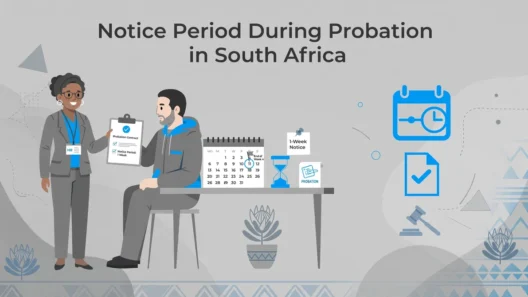
Notice during probation
Notice periods follow section 37 of the BCEA and are based on length of service, not probation status:
- One week if you have been employed for six months or less
- Two weeks if more than six months but not more than a year
Most probationary dismissals fall in the first band. Your contract may give you more, and if it does, the contract wins. See notice pay.
Your accrued leave must still be paid out. See our leave days calculator.
What probation does not affect
- UIF. You have been contributing, and you can claim. See how to claim UIF.
- Your right to a safe workplace, to be paid correctly, and to your BCEA entitlements.
- Automatically unfair dismissals. Dismissal for pregnancy, union membership or discrimination is automatically unfair on probation exactly as it is afterwards.
Severance is the exception. Statutory severance requires one completed year of service, so a retrenchment during probation earns no severance pay. See severance pay.
Frequently asked questions
How long is a probation period in South Africa? There is no fixed statutory period. It must be determined in advance and be of reasonable duration relative to the job. Three to six months is common.
Can I be dismissed during probation? Yes, but your employer needs a fair reason and a fair process. The reason may be less compelling than after probation, but it cannot be absent.
Can I take a probation dismissal to the CCMA? Yes. You have 30 days to refer an unfair dismissal dispute, exactly like a permanent employee.
Can my employer extend my probation? Yes, for a reason related to your suitability for the job, and after giving you an opportunity to make representations.
What notice do I get on probation? One week if you have six months’ service or less, two weeks if more than six months but under a year, unless your contract gives more.
Do I get a hearing before being dismissed on probation? You must be given the opportunity to make representations and to be assisted by a fellow employee or union representative.
Why is con-arb compulsory for probation dismissals? The law removes the right to object, so conciliation and arbitration run on the same day. Come fully prepared.
Sources
- CCMA, Frequently asked questions
- CCMA, Disciplinary procedures
This is general information, not legal advice.