



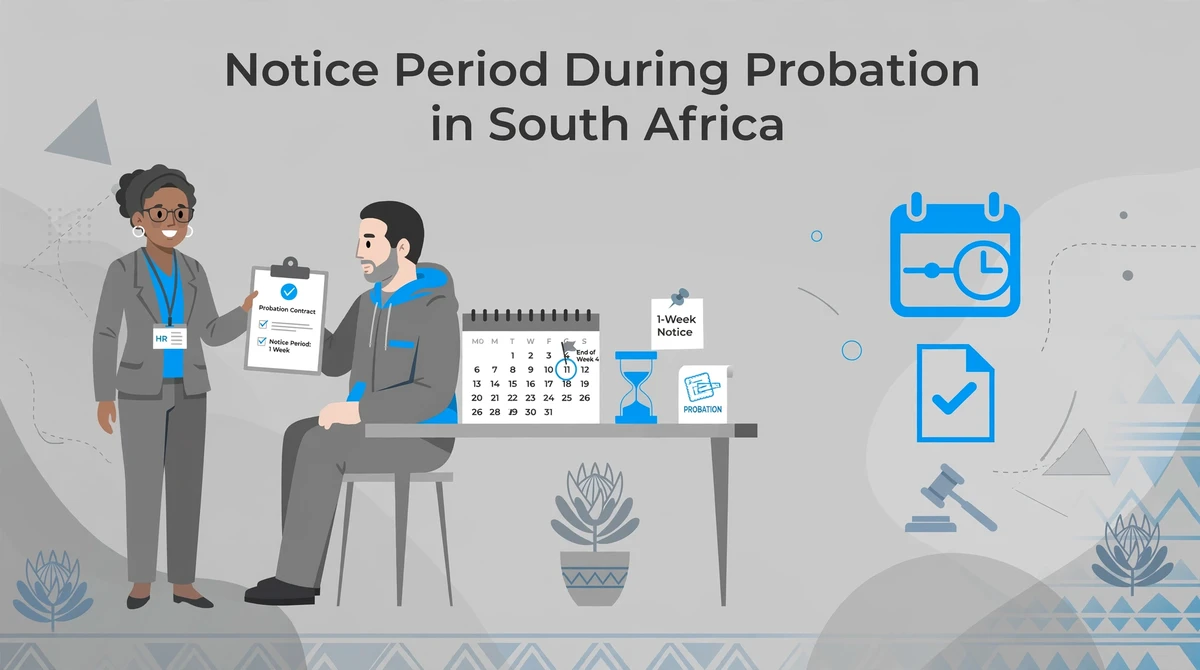
Probation does not suspend the Basic Conditions of Employment Act. If you resign during probation in 2026, you still owe one week of notice, because section 37 sets one week as the floor for anyone with six months of service or less. Your employer owes you the same week. What probation changes is not your notice, it is how easily your employer can end the relationship.
That distinction trips up a lot of new employees. Probation makes dismissal easier. It does not make notice disappear.
Quick facts
| Question | Answer |
|---|---|
| Does the BCEA apply during probation? | Yes, in full |
| Minimum notice on probation | 1 week, for both you and your employer |
| Can a contract say “no notice on probation”? | No. Section 37 cannot be contracted below |
| Can a contract say “24 hours notice”? | No. That falls below the statutory floor |
| Typical probation length | 3 to 6 months, but there is no fixed statutory limit |
| Must notice be in writing? | Yes, unless the employee is illiterate |
| Do you accrue annual leave on probation? | Yes, from day one |
| Can you be dismissed on probation? | Yes, but the process must still be fair |
The rule most contracts get wrong
Section 37 of the BCEA sets one week as the minimum notice for any employee with six months of service or less. Probation is almost always shorter than six months, which means probationers sit squarely in that first band.
One week is the floor. It cannot be reduced by agreement.
Plenty of South African employment contracts nonetheless contain a clause saying something like “during the probation period, either party may terminate on 24 hours notice” or “no notice is required during probation”. Those clauses are unenforceable to the extent that they fall below the Act. The Act does not care what you signed. One week stands.
If your employer tries to hold you to a 24 hour clause, or tries to walk you out with no notice at all, section 37 is on your side.
What probation actually changes
Probation is not a rights-free zone, and it never has been. What it does is lower the bar for the employer on one specific question: whether you are suited to the job.
An employer who wants to dismiss a probationer for poor performance does not have to meet the same standard they would for a confirmed employee. They still have to act fairly. That means they must have told you what was expected, given you a reasonable chance to meet it, offered guidance or training where reasonable, and given you an opportunity to respond before they made the decision.
What they cannot do is dismiss you without any process at all, and then point to your probation clause as cover. Probationers can and do win unfair dismissal cases at the CCMA. The referral deadline is 30 days from the date of dismissal, and it is a hard deadline.
Note also that dismissal for misconduct on probation is not treated more leniently. If you are dismissed for theft or dishonesty during probation, the employer must run a proper disciplinary process, exactly as they would for anyone else.
Notice runs in calendar days
The BCEA counts a week as seven calendar days, not five working days. One week of notice on probation is seven days, including the weekend.
Resign on a Monday and your last working day is the following Sunday, which in practice means Friday is your last day in the office, with the weekend closing out the period. Weekends and public holidays do not extend it.
Notice runs from the day it is given. It cannot be given while you are on annual leave or family responsibility leave, and it cannot run at the same time as any leave except sick leave.
The contract can go up, not down
Some employers set a longer notice period during probation, most often two weeks or one calendar month, on the basis that they want a proper handover even from a new starter.
That is lawful. Section 37 sets minimums, and the parties are free to agree on better terms. But there is a condition attached: section 37(3) requires that the notice period apply equally to both parties. Your employer cannot bind you to a month while reserving one week for themselves.
If your contract says you must give a month and they may give a week, that clause is defective. Point at section 37(3).
What you are owed when you leave on probation
Everything a confirmed employee is owed, on a pro-rata basis.
Annual leave accrues from your first day, not from the day you pass probation. Under the BCEA you accrue 21 consecutive days per annual leave cycle, which works out to 15 working days a year on a standard five day week, or roughly 1.25 days per month. If you leave after three months of probation with none taken, you have around 3.75 days owing, and those must be paid out.
Pro-rata salary for the days you worked.
A certificate of service, which is due regardless of how the employment ended or how short it was.
Your employer cannot withhold any of these because you did not complete probation.
If you are dismissed on probation
Two things are worth knowing immediately.
First, your employer still owes you notice. Dismissal on probation is not summary dismissal. Unless you were dismissed for gross misconduct after a proper hearing, you are entitled to one week of notice or one week of pay in lieu of it.
Second, you have 30 days to refer an unfair dismissal dispute to the CCMA. That deadline runs from the date of dismissal, not from the date you decide it was unfair. Miss it and you are into a condonation application, which is a harder road.
Being on probation does not mean the dismissal was fair. It means the employer had a lower bar to clear. If they cleared no bar at all, you have a case.
Related tools and reading
- Notice period in South Africa: full BCEA guide and calculator
- Resigning with immediate effect
- Leave payout on resignation
- Take-home pay calculator
Frequently asked questions
How much notice must I give during probation in South Africa? One week. Section 37 of the BCEA sets one week as the minimum for anyone with six months of service or less, and probation does not change that.
My contract says 24 hours notice during probation. Is that legal? No. Section 37 cannot be contracted below. One week applies regardless of what the clause says.
Can my employer dismiss me during probation without notice? No, unless it is a dismissal for gross misconduct following a proper hearing. Otherwise they owe you one week of notice or pay in lieu of it.
Do I accrue leave during probation? Yes, from day one. Roughly 1.25 days a month on a standard five day week, and it must be paid out if you leave.
Can I be unfairly dismissed while on probation? Yes. Probation lowers the bar for the employer, it does not remove it. You have 30 days to refer an unfair dismissal dispute to the CCMA.
Does one week of notice mean five working days? No. The BCEA counts a week as seven calendar days, including the weekend.
Can my employer make my probation notice longer than theirs? No. Section 37(3) requires notice periods to apply equally to both parties.
Methodology and sources
Notice periods and the equal-application rule come from section 37 of the Basic Conditions of Employment Act 75 of 1997. Annual leave accrual comes from section 20 of the same Act. Probation dismissal standards and the 30 day referral deadline reference the Labour Relations Act 66 of 1995, its Code of Good Practice on Dismissal, and the CCMA rules.
Provisions were verified against the Department of Employment and Labour and the published Government Gazette. This page was last reviewed on 12 July 2026.
Disclaimer
This guide explains South African labour legislation in general terms and is not legal advice. Probation dismissal disputes turn heavily on the specific facts and on what your employer did or failed to do. If you have been dismissed on probation and believe it was unfair, contact the CCMA promptly, as the referral deadline is 30 days.