



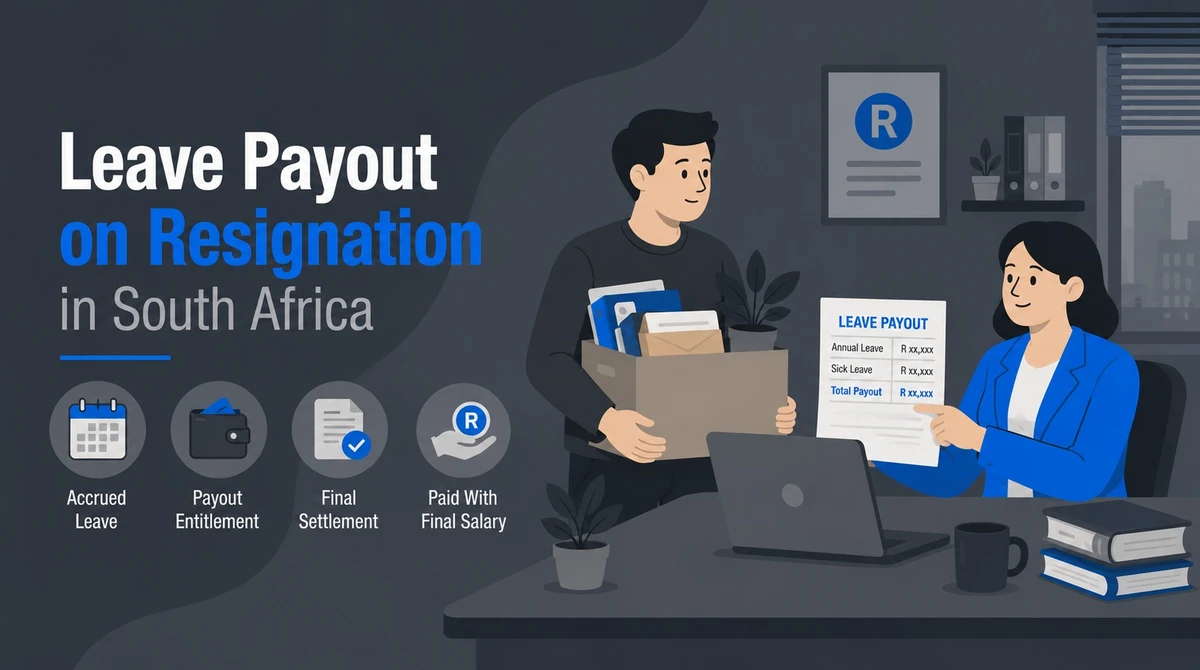
Every day of annual leave you have not taken must be paid out when you resign. The standard calculation divides your gross monthly salary by 21.67 to get a daily rate, then multiplies it by the days owing. On R20 000 a month with 8 days outstanding, that is R7 383.48 before deductions, and your employer has no discretion to withhold it.
The rule that catches people out is the other one: your employer cannot make you take that leave during your notice period instead of paying it. Section 20(11) of the BCEA prohibits it outright.
Quick facts
| Item | Detail |
|---|---|
| Governing law | Basic Conditions of Employment Act 75 of 1997, sections 20, 21 and 40 |
| Leave entitlement | 21 consecutive days per annual leave cycle |
| On a 5 day week | 15 working days per year, roughly 1.25 days a month |
| Daily rate formula | Gross monthly salary divided by 21.67 |
| Example on R20 000/month | R922.94 per day |
| Can leave be forced during notice? | No. Section 20(11) prohibits it |
| Does leave accrue during notice? | Yes. Your notice period is working time |
| Is the payout taxed? | Yes. It is remuneration and PAYE applies |
| Does it depend on how you left? | No. Resignation, dismissal or retrenchment, it is paid out |
How the daily rate is calculated
The BCEA does not spell out a single formula in the Act, but the standard used across South African payroll is a monthly salary divided by 21.67.
The 21.67 comes from arithmetic, not convention. A year has 52 weeks. On a five day week that is 260 working days. Divide by 12 months and you get 21.67 working days in an average month.
So the calculation runs:
Daily rate = gross monthly salary divided by 21.67 Leave payout = daily rate multiplied by days outstanding
On a gross monthly salary of R20 000, your daily rate is R922.94. With 8 days of leave owing, your payout is R7 383.48. On R35 000 a month, the daily rate is R1 615.14, and 8 days comes to R12 921.12.
Note that this is your gross salary, not your take-home. And note that the payout itself is taxable. It is treated as remuneration, so PAYE and UIF come off it in the normal way. The figure on your payslip will be higher than the figure in your bank account.
How many days you have actually accrued
The BCEA gives you 21 consecutive days of paid annual leave per annual leave cycle. That phrasing confuses people because it sounds like 21 working days. It is not.
Twenty one consecutive days includes weekends. On a standard five day week, it works out to 15 working days a year, which is roughly 1.25 days per month.
The Act allows two alternative methods by agreement: one day of leave for every 17 days worked, or one hour of leave for every 17 hours worked. These land in more or less the same place.
So if you resign after seven months and have taken nothing, you have accrued around 8.75 days. If you have taken three, you have 5.75 days owing.
Leave keeps accruing during your notice period. Your notice period is working time, and you accrue leave through it in the normal way. If you serve four weeks, you pick up roughly another 1.25 days, and those must be paid out too. Payroll departments routinely forget this. Check your final payslip.
The rule your employer cannot get around
Section 20(11) of the BCEA prohibits an employer from requiring an employee to take annual leave during a notice period.
This exists for a reason. The cheapest way for an employer to make a leave liability disappear is to tell a resigning employee to “take your leave during your notice”, so that the days are consumed rather than paid out. That is not lawful, and the Act shuts it down explicitly.
If you resign with four weeks of notice and 10 days of leave owing, you serve the four weeks and you are paid for the 10 days. Your employer does not get to collapse the two.
There is a related rule worth knowing. Notice cannot run at the same time as any leave you are entitled to under the Act, with sick leave as the only exception. Your employer cannot give you notice while you are away on annual leave, and they cannot time it so that your notice quietly runs down while you are on holiday.
What else belongs on your final payslip
Your leave payout is one line. A correct final payslip should also carry:
Pro-rata salary for the days you actually worked in your final month.
Pay in lieu of notice, if your employer chose to end the relationship immediately rather than have you serve out your notice. That is their right, and if they exercise it, they owe you the money for the full notice period.
Any pro-rata bonus you are contractually entitled to. This depends entirely on your contract, and discretionary bonuses usually fall away on resignation.
Your certificate of service, which is not money but is a legal entitlement and is due regardless of how you left.
Deductions come off in the normal way: PAYE, UIF, medical aid and retirement fund contributions up to your last day.
What your employer may not deduct
Section 34 of the BCEA prohibits an employer from deducting money from your wages without your written consent.
This matters most where you left without serving your full notice. Your employer may feel they are owed the value of the unserved days, and in theory they can pursue that. What they cannot do is simply take it off your final payslip. They need your written agreement, or a civil court order.
If your final payslip is short and nobody asked you to sign anything, that is a section 34 issue and you can raise it with the Department of Employment and Labour.
The one significant exception sits outside the BCEA. The Pension Funds Act allows an employer to recover certain debts you owe them from your pension fund, in defined circumstances. That is a narrow route and it does not open the door to arbitrary deductions from salary.
The three year window
Accrued leave does not vanish quietly.
Under the BCEA, leave must be granted within six months of the end of the annual leave cycle in which it accrued. Employers who let leave pile up beyond that are not extinguishing the liability, they are accumulating it.
If your employer tells you that leave from two years ago has “expired” and will not be paid out, do not accept it at face value. Whether it is still payable depends on your leave policy and how the cycles were administered, but a blanket statement that old leave simply falls away is usually wrong.
Related tools and reading
- Notice period in South Africa: full BCEA guide and calculator
- Resigning with immediate effect
- Notice period during probation
- Take-home pay calculator
- UIF benefits calculator
Frequently asked questions
How is leave payout calculated in South Africa? Divide your gross monthly salary by 21.67 to get a daily rate, then multiply by the number of leave days owing. On R20 000 a month, the daily rate is R922.94.
Can my employer make me take my leave during my notice period? No. Section 20(11) of the BCEA prohibits it. Outstanding leave must be paid out.
How many leave days do I accrue per month? Roughly 1.25 days on a standard five day week, which is 15 working days a year. The BCEA expresses this as 21 consecutive days per annual leave cycle.
Do I keep accruing leave during my notice period? Yes. Your notice period is working time and leave accrues through it. Check that your final payslip reflects it.
Is my leave payout taxed? Yes. It is treated as remuneration, so PAYE and UIF are deducted in the normal way.
Do I still get a leave payout if I am dismissed? Yes. Accrued annual leave is paid out regardless of how the employment ended.
Can my employer deduct money from my final payslip? Not without your written consent. Section 34 of the BCEA prohibits deductions from wages without written agreement.
Where does the 21.67 figure come from? A year has 260 working days on a five day week, and 260 divided by 12 months gives 21.67 working days per average month.
Methodology and sources
Annual leave entitlement and accrual come from section 20 of the Basic Conditions of Employment Act 75 of 1997. The prohibition on forcing leave during notice is section 20(11). Payment on termination is section 40, and the restriction on deductions is section 34. The 21.67 daily divisor is the standard South African payroll convention derived from 260 working days a year.
All worked examples use gross monthly salary before deductions. Provisions were verified against the Department of Employment and Labour and the published Government Gazette. This page was last reviewed on 12 July 2026.
Disclaimer
This guide explains South African labour legislation in general terms and is not legal or financial advice. Leave payout calculations depend on your specific leave cycle, your contract and your employer’s leave policy. If your final payslip appears incorrect, raise it with your employer in writing and contact the Department of Employment and Labour if it is not resolved.