



Your employer cannot simply announce that money is tight and let you go. Retrenchment is a no-fault dismissal, and the law places the burden on the employer: they must prove a genuine operational reason, and they must consult you properly before deciding. Most of what you will read online is a playbook written for the people doing the retrenching. This is the other side of the table.
Quick facts
| Item | 2026 position |
|---|---|
| Governing law | Section 189, Labour Relations Act 66 of 1995 |
| Type of dismissal | No fault. Operational requirements. |
| Burden of proof | On the employer |
| Severance pay | At least 1 week’s remuneration per completed year of service |
| Notice pay | Per the BCEA or your contract, whichever is better |
| Leave | Outstanding leave paid out |
| Default selection method | LIFO, last in first out |
| Large-scale rules (section 189A) | More than 50 employees, and 10 or more retrenched |
| No decision to dismiss (189A) | For the first 30 days |
| No notice of termination (189A) | Until 60 days have lapsed |
| Dismissal dispute deadline | 30 days, at the CCMA |
| Severance pay dispute deadline | No time limit |
They must prove it, not just say it
This is the single most important thing on this page.
An employer may only retrench for operational requirements: economic, technological, structural or similar needs. The business is no longer viable, or it must adopt technology to survive, or it is restructuring and your skills are no longer relevant.
The onus is on the employer to prove that a genuine operational requirement existed. They cannot merely claim the company was not making money. They must produce evidence of the financial position.
If they will not show you the numbers, that is not a detail. That is the case.
The section 189(3) notice: nine things it must contain
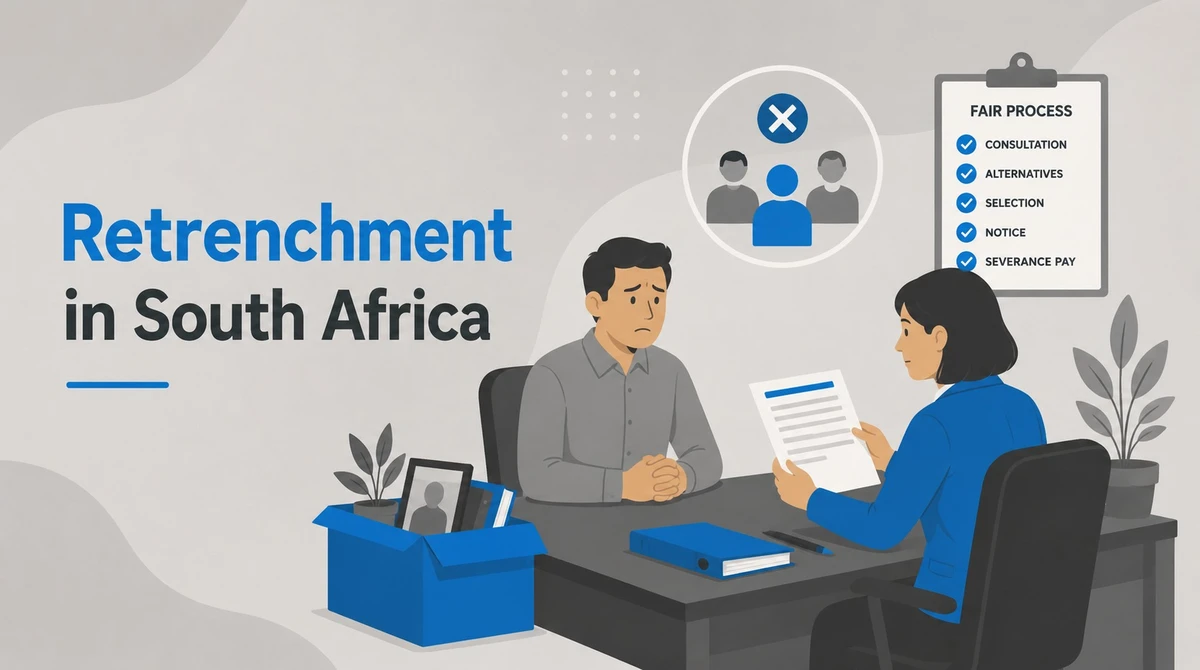
Before consultation begins, your employer must give you a written notice inviting you to consult, and it must disclose in writing:
- The reasons for the proposed dismissals.
- The alternatives considered, and the reasons for rejecting each one.
- The number of employees likely to be affected, and the job categories.
- The proposed method of selecting who will be dismissed.
- The timing, or period, over which the dismissals are likely to take effect.
- The severance pay proposed.
- Any assistance the employer proposes to offer.
- The possibility of future re-employment.
- The number of employees dismissed for operational requirements in the preceding 12 months.
Take your notice and check it against that list. If items are missing, the process is defective from the start, and you should say so in writing, in the first consultation meeting.
Item 2 is the one employers skimp on. They must not only list the alternatives, but explain why each was rejected. “We considered alternatives” is not compliance.
Item 9 is the one nobody asks about. It tells you whether this is a rolling retrenchment being sliced into pieces to stay below the section 189A thresholds.
Consultation is not an announcement
Section 189(2) requires a meaningful joint consensus-seeking process. The parties must genuinely attempt to reach agreement on ways to avoid the dismissals, minimise the number, change the timing, and mitigate the effects.
This is not a meeting where you are told the decision. It is a negotiation in which your input must be genuinely considered before it is rejected.
The Labour Court has said so directly. In a recent judgment, an employer was found to have run a checklist approach: it summarily rejected the employee’s proposed alternatives, refused to engage on selection criteria, and treated him with aggression during the meetings, accusing him of obstructing the process when he asked legitimate questions. The Court held the process fell short of a meaningful joint consensus-seeking process, even though only one employee was affected.
What this means for you:
- Put your alternatives in writing. Redeployment, reduced hours, a pay cut, short time, voluntary separation, unpaid leave, deferring the decision.
- If they are rejected, ask for the reason in writing.
- Keep every email. A checklist consultation is procedurally unfair, and the paper trail is what proves it.
A decision taken before consultation began is fatal to the employer’s case. If the restructure was announced internally, or your replacement was already advertised, that is evidence the consultation was theatre.
How they choose who goes
Section 189(6): selection criteria must be those previously agreed by the consulting parties. If no criteria were agreed, they must be fair and objective.
LIFO is the default. Last in, first out. It is the criterion the LRA recommends, because it is the most objective.
An employer may deviate from LIFO, but the deviation must be objectively justifiable — for example, retaining an employee with a skill critical to the business’s survival over a more senior employee without it.
If you are not the last in and you are being let go, ask why. Demand the objective justification in writing. And note that selectively nominating “problem” employees for retrenchment, instead of applying fair criteria, is one of the most common and most fatal employer mistakes. Criteria may not be directly or indirectly discriminatory.
Even where a single employee is affected, the employer is statutorily obliged to consider fair and objective selection criteria.
What you are owed
| Payment | Amount |
|---|---|
| Severance pay | At least one week’s remuneration for each completed year of service |
| Notice pay | Per the BCEA, or your contract if better |
| Outstanding leave | Paid out in full |
| Pro-rata bonus | If your contract provides for it |
Severance pay is set by section 41 of the BCEA. It is a minimum, not a maximum. Employers frequently offer more, particularly to secure agreement to a voluntary package.
Full breakdowns: severance pay and how it is taxed, and what notice you are owed.
You can refuse alternative employment and keep your severance
Section 41(2) of the BCEA: an employee who reasonably refuses an offer of alternative employment is still entitled to severance pay.
Both the reasonableness of the offer and the reasonableness of the refusal are weighed. An offer at half your salary, in another province, doing work you are not qualified for, is not a reasonable offer, and refusing it does not cost you your severance.
But an unreasonable refusal does forfeit it. Get advice before you turn anything down.
If more than 50 of you work there
Section 189A applies where the employer employs more than 50 employees and proposes to retrench:
| Employer size | Section 189A triggers at |
|---|---|
| 50 to 200 employees | 10 or more |
| 201 to 300 | 20 or more |
| 301 to 400 | 30 or more |
| 401 to 500 | 40 or more |
| 501 or more | 50 or more |
It also applies if the employer intends to retrench those numbers within a year, which is why item 9 on the notice checklist matters.
Section 189A gives you real protection:
- No decision to dismiss may be taken in the first 30 days.
- No notice of termination may be given until 60 days have lapsed from the section 189(3) notice.
- You may strike, or refer the matter to the Labour Court, once notice has been given.
- You may request CCMA facilitation. A consulting party representing the majority of affected employees may request it using LRA Form 7.20, within 15 days of the section 189(3) notice. A commissioner then has 60 days to conclude the facilitation, and may hold up to four meetings.
If the employer issues termination notices earlier than the law allows, a strike notice may be given immediately. That is a powerful lever, and almost no employee knows it exists.
Where to take a dispute
| Situation | Forum |
|---|---|
| The consultation applied only to you | CCMA |
| You were the only employee dismissed | CCMA |
| Your employer has fewer than 10 employees | CCMA, whatever the numbers |
| Large-scale retrenchment | Conciliation at the CCMA, then Labour Court |
| Dispute about severance pay | CCMA |
Deadlines:
- Unfair dismissal: 30 days, counted in calendar days including weekends and public holidays.
- Severance pay: no time limit. This is the exception. If you took your package months ago and have since realised you were short-paid, you are not locked out.
See our full guide to the CCMA.
Before you sign anything
Employers frequently offer a mutual separation agreement instead of running a retrenchment. It is faster for them, and it usually waives your right to challenge the dismissal.
Understand exactly what you are giving up: what you give up when you sign a mutual separation agreement.
And if you are weighing whether to jump first: should you resign or wait to be retrenched? The short answer is that resigning generally forfeits severance and UIF.
What to do this week
- Get the section 189(3) notice in writing and check it against the nine items above.
- Ask for the financial evidence. They must prove the operational requirement, not assert it.
- Submit your alternatives in writing and demand written reasons for any rejection.
- Ask for the selection criteria and the objective justification for any deviation from LIFO.
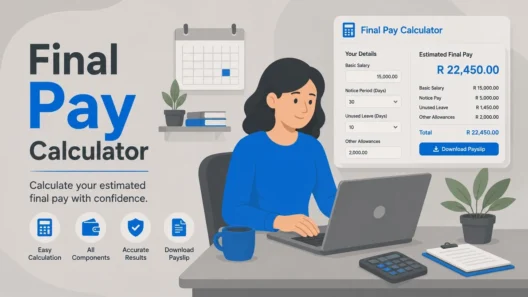
- Work out what you are owed. Use the retrenchment package calculator.
- Do not sign anything on the day it is put in front of you.
- Claim UIF as soon as you are dismissed. See how to claim UIF.
- Register as a work-seeker with the Department of Employment and Labour, which also runs employment counselling and training programmes for retrenched workers.
Related guides
- How much severance pay you are owed and how it is taxed
- What notice you are owed when you are retrenched
- What your employer must do before it can retrench you
- Should you resign or wait to be retrenched?
- What you give up when you sign a mutual separation agreement
- Retrenchment package calculator
- The CCMA in South Africa
Frequently asked questions
Can my employer retrench me without a reason? No. They must have a genuine operational requirement, and the onus is on them to prove it with evidence, not merely to claim it.
How much severance pay do I get? At least one week’s remuneration for every completed year of service. That is the statutory minimum under section 41 of the BCEA. Many employers pay more.
Is LIFO compulsory? No, but it is the default and the most objective criterion. An employer may deviate, but must objectively justify the deviation, and the criteria may not be discriminatory.
Can I refuse another job they offer me and still get severance? Yes, if your refusal is reasonable and the offer was not. Both are assessed. An unreasonable refusal forfeits your severance, so get advice first.
How long does the retrenchment process take? Small-scale consultation typically runs two to three weeks. Under section 189A, no decision to dismiss may be taken in the first 30 days, and no notice given until 60 days have passed.
Can we strike over a retrenchment? Under section 189A, yes. Once notice of termination has been given, employees may strike or refer the matter to the Labour Court. If the employer gives notice earlier than the law allows, a strike notice may be given immediately.
How long do I have to challenge my retrenchment? 30 calendar days at the CCMA for an unfair dismissal claim. There is no time limit for a dispute purely about severance pay.
Do I qualify for UIF after retrenchment? Yes, if you contributed. Claim immediately. Do not wait for a dispute to be resolved.
Methodology
The rules on this page come from the Labour Relations Act 66 of 1995, principally sections 189 and 189A, read with the Code of Good Practice on Dismissal Based on Operational Requirements, and from section 41 of the Basic Conditions of Employment Act, which governs severance pay. The section 189A facilitation process and LRA Form 7.20 are administered by the CCMA.
The description of what constitutes a meaningful joint consensus-seeking process reflects Labour Court authority on procedural fairness in retrenchment, including recent judgments holding that a checklist approach to consultation does not satisfy section 189.
Disclaimer
Searchis is not a law firm and this is not legal advice. Retrenchment deadlines are strict and the consequences of missing them are serious.
Whether an offer of alternative employment is reasonable, whether a selection criterion is objectively justifiable, and whether to sign a separation agreement are decisions with real financial consequences. Consider getting advice from a trade union or a labour law professional before you sign anything.