




Notice pay is the quiet part of a retrenchment package. It rarely gets negotiated, it rarely gets checked, and it is taxed at a rate that will surprise you.
It is also the component employers most often use to make an offer look bigger than it really is.
How much notice you are entitled to
Section 37 of the Basic Conditions of Employment Act sets the minimum by length of service:
| Length of service | Minimum notice |
|---|---|
| Six months or less | 1 week |
| More than six months, up to one year | 2 weeks |
| One year or more | 4 weeks |
| Farm worker or domestic worker employed more than six months | 4 weeks |
Two qualifications matter.
A collective agreement may shorten the four week period, but it can never go below two weeks. If you fall under a bargaining council, check what it says.
Your contract may lengthen it, and if it does, the contract wins. Senior roles routinely carry one, two or three calendar months of notice. That is enforceable and it is worth real money.
Notice must be given in writing, unless you cannot read, in which case it must be explained to you in a language you understand.
Working it versus being paid for it
Your employer has a choice under section 38. They can let you work out your notice period, or they can pay you the remuneration you would have received during it and end your employment immediately.
That second option is what people mean by “notice pay” or “payment in lieu of notice.” It is not a bonus and it is not goodwill. It is money you would have earned anyway, paid to you for staying away.
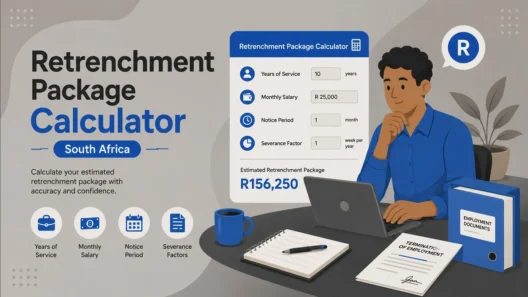
The practical difference for you is mostly tax timing and the date your UIF claim can start. If you are working your notice, that money reaches you as ordinary salary, not as part of the package, so leave that control set to None in our retrenchment package calculator.
Two things your employer may not do
They may not give you notice during a period of leave you are entitled to. If you are on annual leave and a notice letter lands, the notice does not start running until the leave ends.
They may not run your notice period concurrently with annual leave. Your employer cannot force you to burn your accrued leave during your notice, and then tell you there is nothing left to pay out.
This second one is a genuinely common trick. Watch for a final payslip where your leave balance quietly disappeared into your notice period. Accrued leave must be paid out on termination in its own right, and it must be paid in addition to your notice, not instead of it.
The tax on notice pay is brutal
Here is the thing almost nobody tells retrenched employees.
Severance pay is taxed on the SARS lump sum table, where the first R550 000 is taxed at 0 percent.
Notice pay is not. SARS is explicit that notice pay, leave pay and pro rata bonuses do not form part of a severance benefit. They are added to your normal income for the tax year and taxed at your marginal rate. For a mid career professional that is commonly 31 percent, and it can reach 45 percent.
A separate tax directive is required for the notice and leave portion, submitted under the reason “Other” rather than under a severance benefit reason. If your employer has lumped everything into one directive, something is wrong.
Why this makes notice pay a negotiating trap
Suppose your employer offers to “improve” your package by adding an extra two weeks of notice pay rather than an extra week per year of severance.
If your severance sits inside the R550 000 band, every rand of severance reaches you untaxed. Every rand of notice pay is taxed at your marginal rate. The employer has offered you a bigger gross number and a smaller net one.
Always compare offers net, not gross. If an employer wants to move money between the components, ask why, and run both versions through the calculator before you agree.
The same logic runs the other way. If you are being offered a very large package that pushes your severance well past R550 000, the marginal rates start converging and the arithmetic changes. Check, do not assume.
How notice pay is calculated
Notice pay is based on your remuneration, which is the same broad definition used for severance pay: it includes the cash value of employer contributions to your medical aid and retirement fund, plus housing, car and shift allowances. It is not your basic salary alone.
Weekly remuneration is monthly remuneration times 12, divided by 52. Four weeks of notice on a R30 000 package is therefore roughly R27 692, not R30 000.
Notice pay and your UIF claim
Your notice pay does not disqualify you from UIF, but it can affect when your benefit starts, because your employment technically ends on the termination date recorded on your UI-19.
Get the UI-19 right the first time. An incorrect or incomplete employer declaration is the most common reason a claim stalls. See our guides on how to claim UIF, the UI-19 form, and what to do if your UIF claim is rejected.
Frequently asked questions
How much notice pay do I get if I am retrenched? At least four weeks if you have a year or more of service, two weeks if you have between six months and a year, and one week if you have six months or less. Your contract may give you more.
Can my employer make me take leave during my notice period? No. Annual leave may not be run concurrently with your notice period, and accrued leave must be paid out separately on termination.
Is notice pay taxed? Yes, at your normal marginal rate. Unlike severance, notice pay does not qualify for the R550 000 tax free lump sum band.
Can I be paid instead of working my notice? Yes. Section 38 of the BCEA allows your employer to pay you the remuneration you would have earned during the notice period and terminate immediately.
Does notice pay count as part of my retrenchment package? It is usually paid at the same time and shown on the same offer, but SARS treats it separately, and so should you when comparing offers.
Sources
This is general information, not legal or tax advice.