



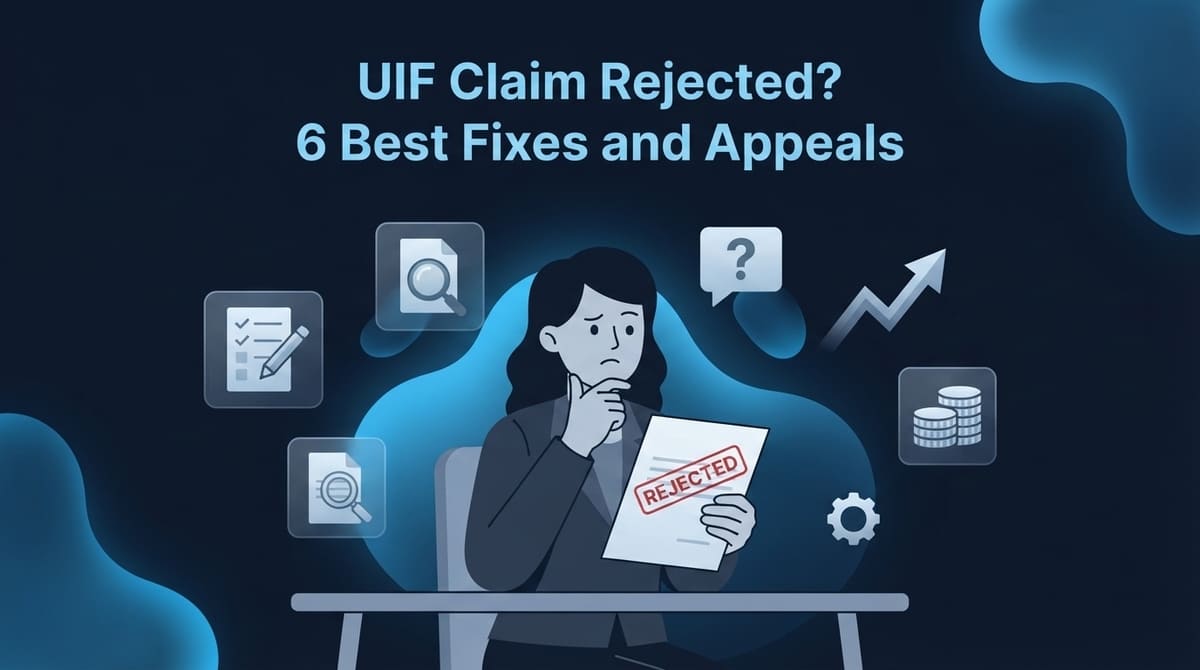
If your UIF claim was rejected, you have the legal right to appeal by lodging a UI-12 form, the Notice of Appeal against a decision of a Claims Officer, with the Regional Appeals Committee within 90 days of the rejection. Many rejections are also fixable without a formal appeal, because they are caused by correctable errors such as a wrong termination code or mismatched banking details.
This guide covers the six most common rejection reasons, which ones you can fix directly, and exactly how the appeal process works when you cannot.
Quick facts: rejected UIF claims
| Question | Answer |
|---|---|
| Right to appeal | Yes, under section 37 of the Unemployment Insurance Act |
| Appeal form | UI-12, Notice of Appeal against a decision of a Claims Officer |
| Deadline | Within 90 days of the rejection or suspension notice |
| First appeal body | Regional Appeals Committee, via your Labour Centre |
| Final appeal body | National Appeals Committee, whose decision is final |
| Cost | Free |
| Find the reason | Portal status, 0800 030 007, or a claims officer at a Labour Centre |
Step 1: get the exact rejection reason
Never appeal blind. The portal often shows only “rejected” without detail, so call 0800 030 007 or ask a claims officer at any Labour Centre to open the file and give you the specific reason. The right response depends entirely on which of the following applies.
The 6 most common rejection reasons and their fixes
1. Termination reason recorded as resignation
Resignation does not qualify for the unemployment benefit, so if your employer entered the “resigned” code on the UI-19 form when you were actually retrenched or dismissed, the claim fails automatically. The fix is a corrected UI-19 from the employer. If the employer will not correct it, or you resigned because conditions were intolerable, constructive dismissal can qualify, but only the CCMA, a Bargaining Council or the Labour Court can make that determination. Take the dismissal dispute there first, then use the ruling in your UIF appeal.
2. Incomplete or incorrect documents
A missing UI-19, an unsigned form, an incomplete application or wrong personal details will sink a claim. This is fixable without an appeal: correct the documents and resubmit through the channels in our guide on how to claim UIF. Ask the claims officer whether resubmission or appeal is the faster route for your file.
3. Banking details that do not match your name
The account on the claim must be yours and must verify. Fix the details with a stamped bank confirmation letter and have the claim reassessed. If payments were approved and then stopped rather than rejected outright, that is a payment problem, not a rejection, and our UIF payment delay guide covers it.
4. No contribution record or an employer who never declared you
If your employer never registered you or never paid contributions over, the fund has no record to assess. Report the employer at a Labour Centre, which can enforce registration and recover arrears. Your claim is assessed once the record exists, and an employer’s non-compliance is not a lawful reason for you to lose benefits permanently.
5. Claiming too late
The unemployment benefit must be claimed within 12 months of termination, and illness and maternity claims have their own shorter windows measured from the qualifying event. A genuinely late claim is the hardest rejection to overturn, but if the delay was caused by the fund’s own systems or by an employer withholding the UI-19, put that evidence in an appeal.
6. Exhausted credit days or disqualifying income
You accumulate 1 credit day for every 4 days worked, up to 365 days. If a previous claim used your credits, a new claim fails until new employment rebuilds them. Claims are also refused where you already receive certain other income for the same period, such as Compensation Fund benefits or a pension. Check your credit position with our UIF calculator before deciding whether an appeal has any prospect.
How to appeal: the UI-12 process
- Download and complete the UI-12. The official form, the Notice of Appeal against a decision of a Claims Officer (labour.gov.za), is issued in terms of section 37(1) of the Act read with regulation 8(1). It is free from the department’s website or any Labour Centre.
- State your grounds clearly. Include your full name, ID number, the date and place you applied, the date you received the rejection, and a concise statement of why the decision is wrong.
- Attach your evidence. Payslips, your employment contract, proof of contributions, the corrected UI-19, a retrenchment or termination letter, medical certificates for illness claims, and any CCMA ruling on the termination.
- Submit within 90 days. Lodge the UI-12 and attachments at your nearest Labour Centre, addressed to the Regional Appeals Committee. The 90 days run from when you were informed of the rejection, even if you only saw it as a status on the portal. A late appeal can be dismissed without being considered.
- Escalate if needed. If the Regional Appeals Committee turns you down and you still believe the decision is wrong, you can take the matter to the National Appeals Committee, whose decision is final. There is no fixed turnaround time for appeal feedback, so keep your reference and follow up through the Labour Centre.
FAQ
How do I appeal a rejected UIF claim?
Complete the UI-12 Notice of Appeal, attach evidence supporting your grounds, and lodge it at your nearest Labour Centre for the Regional Appeals Committee within 90 days of the rejection.
How long do I have to appeal a UIF rejection?
90 days from being informed of the rejection or suspension. Missing the window can see the appeal dismissed without consideration, so lodge it early even if you are still gathering evidence.
Can I appeal a UIF rejection online?
The formal route is the written UI-12 lodged through a Labour Centre. Some declined applications can also be disputed through the online benefit channels, but the UI-12 to the Regional Appeals Committee is the process the Act provides and the safest route on a deadline.
Why would UIF reject a claim if I contributed for years?
Long contributions do not cure a disqualifying fact. The usual culprits are a resignation code on the UI-19, exhausted credit days from a previous claim, a late application, or documents that failed verification. Get the specific reason first.
Can I claim UIF after resigning?
Not for the standard unemployment benefit. The exception is constructive dismissal, where you resigned because the employer made continued work intolerable, and that must be determined by the CCMA, a Bargaining Council or the Labour Court before the fund will treat it as a qualifying termination.
What happens after the National Appeals Committee?
Its decision is final within the UIF appeal structure. Beyond that point, remaining remedies are outside the fund, such as review proceedings, which is specialised legal territory where professional advice is worth getting.
Methodology and sources: This guide is based on the Unemployment Insurance Act 63 of 2001, including section 37 on appeals, the official UI-12 form published by the Department of Employment and Labour (labour.gov.za), and the department’s UIF claims and appeals guidance on the 90-day window, the Regional Appeals Committee and the National Appeals Committee.
Disclaimer: This article is general information, not legal advice. Appeal forms, deadlines and processes can change, and individual cases differ. Confirm the current process with the Department of Employment and Labour or a qualified legal adviser before relying on it.