


Most people have no idea how many leave days they have actually accrued, and almost nobody knows what those days are worth in cash if they walk out the door tomorrow.
Both numbers are below.
Annual Leave Days Calculator
Work out the leave you have accrued, what is left, and what it is worth in cash if you leave.
Enter your figures to see your estimate.
Breakdown and how this works
Section 20 of the Basic Conditions of Employment Act gives you 21 consecutive days of annual leave on full remuneration in every annual leave cycle. On a five day week that works out to 15 working days, and on a six day week to 18 working days. An annual leave cycle is 12 months with the same employer, running from your start date or from the end of your last cycle.
Leave does not vest upfront. It builds up month by month, so the default accrual is 1.25 days a month on a five day week, or 1.5 days a month on a six day week.
The Act allows a second method, but only by agreement: one day of leave for every 17 days worked, or one hour for every 17 hours worked. Your employer cannot impose this on you. If there is no agreement, the 21 day default applies.
Your daily rate is your monthly pay times 12, divided by 52, then divided by the days you work in a week. Your employer may not pay you cash instead of giving you leave while you are still employed. Leave is only paid out when your employment ends.
How many leave days per year in South Africa?
Section 20 of the Basic Conditions of Employment Act gives you 21 consecutive days of annual leave on full remuneration in every annual leave cycle.
That phrase confuses people, because 21 days sounds like a lot more than most of us actually get. The trick is that it means 21 consecutive calendar days, weekends included. What matters is how many of your working days fall inside that stretch.
- Five day week: 15 working days
- Six day week: 18 working days
An annual leave cycle is 12 months with the same employer, running from the day you started or from the end of your previous cycle. It is not the calendar year, and it is not your company's financial year.
You need to work more than 24 hours a month for the section to apply to you at all.
The two accrual rules, and the mess people make of them
This is where South African websites fall apart, so read carefully.
Rule one, the default. Your entitlement is 21 consecutive days per cycle. Leave does not vest upfront. It builds progressively, so on a five day week you accrue 1.25 days a month, and on a six day week 1.5 days a month. After eight months you have 10 days, not 15.
Rule two, by agreement only. The Act permits an alternative: one day of leave for every 17 days worked, or one hour for every 17 hours worked. This is useful for shift work and irregular schedules.
The critical point is the words by agreement. Your employer cannot simply impose the 17 day method on you. If there is no agreement, the default applies.
You will find South African attorney websites that merge the two rules and tell you that you accrue "1.25 days for every 17 days worked." That is two rules mashed into one and it is meaningless. The calculator above lets you run either method, and you will see they land in almost the same place over a full year: 15 days versus 15.3 on a five day week.
Carrying leave over
Unused annual leave is automatically carried over to the next cycle, unless there is an agreement to the contrary.
But there is a deadline. Your employer must grant leave from the previous cycle no later than six months after the end of that cycle. If it has not been granted by then, you can demand it, and your employer cannot refuse.
This is a genuinely useful right and very few employees know they have it. If you are being told "we are too busy, take it next year" for the second year running, you have a remedy.
Rules your employer may be breaking
Public holidays do not eat your leave. If a public holiday falls on a day you would ordinarily have worked, during a period of annual leave, you get an extra day of leave for it. It may not be counted as a leave day.
Leave may not run concurrently with sick leave. If you fall ill on holiday and have a medical certificate, that is sick leave, not annual leave.
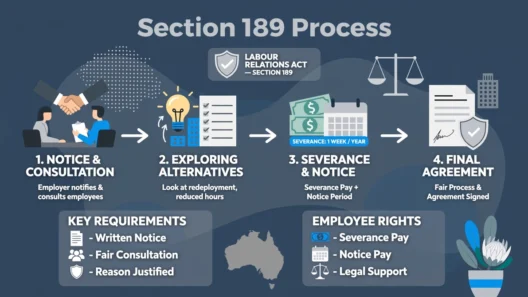
Leave may not run concurrently with your notice period. Your employer cannot make you burn your leave balance while working out your notice. This is one of the most common tricks in a resignation or retrenchment, and it is unlawful. See notice pay on retrenchment.
Your employer cannot buy your leave off you while you are employed. Payment in lieu of annual leave is prohibited during employment. Leave exists so that you rest.
Shutdowns are different. Your employer can require you to take annual leave during a shutdown, typically over December. If your balance is exhausted, the shutdown may lawfully be treated as unpaid leave. Plan for it.
What your leave is worth on termination
When your employment ends, for any reason, accrued leave must be paid out. Resignation, dismissal, retrenchment or retirement, it makes no difference.
Your daily rate is your monthly remuneration times 12, divided by 52, then divided by the days you work in a week. On a five day week that is roughly your monthly salary divided by 21.67.
One catch that catches people out. Payment for the pro rata portion of your current cycle is subject to a service threshold: you generally need to have been employed for more than four months. Leave under that threshold, and you may walk away with nothing for it, even though it has technically accrued.
Leave payout is also taxed at your normal marginal rate. It does not get the favourable treatment that severance pay does, which matters a great deal if you are being retrenched. See severance pay in South Africa and the retrenchment package calculator.
Your other leave
Annual leave is only one of several entitlements, and they have very different rules:
- Family responsibility leave: three days, paid, but only for a sick child or a death from a fixed list of relatives. It does not accumulate and is never paid out.
- Parental leave: up to four months, unpaid, completely rewritten by the Constitutional Court in October 2025.
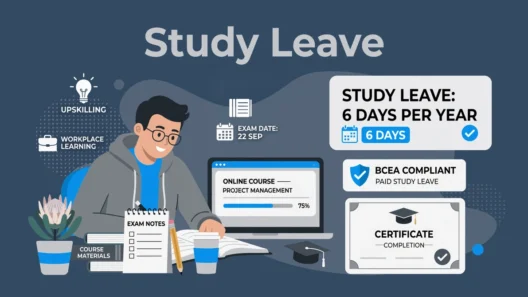
- Study leave: does not exist in South African law. At all.
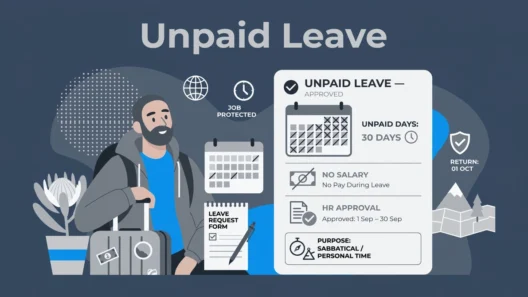
- Unpaid leave: not something you can demand.
Frequently asked questions
How many leave days per year in South Africa? 21 consecutive days per annual leave cycle, which is 15 working days on a five day week or 18 on a six day week.
How is annual leave accrued? By default, progressively: 1.25 days a month on a five day week. By agreement, one day for every 17 days worked.
Can my employer force me to take leave? During an annual shutdown, yes. Otherwise leave should be taken by agreement, and your employer may not unreasonably refuse a request.
Does annual leave expire? It carries over automatically unless agreed otherwise, and you can demand leave from a previous cycle if it has not been granted within six months of that cycle ending.
Is annual leave paid out when I resign? Yes. Accrued leave must be paid out on termination for any reason, subject to a service threshold of more than four months for the pro rata portion.
Can I get paid instead of taking leave? No, not while you are still employed. Payment in lieu of annual leave is only permitted on termination.