



Let us get the disappointing part out of the way.
The Basic Conditions of Employment Act makes no provision for study leave. It is not in the Act. It is not in any other piece of South African labour legislation. You have no legal right to it, your employer has no legal obligation to give it to you, and if you are refused, there is nowhere to appeal to.
Every other page you will read on this topic buries that answer under six paragraphs about exam preparation. There it is, in the first line.
So what do you actually get?
Whatever your employer decides to give you. Nothing more.
If you need time off to study or to write an exam, your options are:
- Your employer’s study leave policy, if one exists
- Annual leave, taken as ordinary paid leave
- Unpaid leave, if your employer agrees to it
- Your bargaining council’s collective agreement, if you fall under one
That is the whole list. Note that options two and three are just your normal leave, relabelled. You are not getting extra time. You are spending time you already had.
Your employer can make the rules, and they will stick
This is worth understanding clearly, because it surprises people.
If your employer says that study leave must be deducted from your annual leave, that decision applies. If your employer says study leave is unpaid, that decision applies. If your employer says there is no study leave at all, that decision applies.
None of this is unfair or unlawful. It is a matter for arrangement between you and your employer, and there is no statutory floor underneath it.
The one thing your employer cannot do is apply the policy inconsistently. If two employees in comparable positions are treated differently for reasons that touch a protected ground, that becomes a discrimination problem, and that is a different conversation.
The common employer policy
Where employers do offer study leave, a widely used convention has settled in South Africa:
Two paid days per subject, capped at ten paid days per calendar year. Anything beyond that is taken as annual leave or unpaid leave.
This is not law. It is custom. But it is a useful benchmark, because if you are negotiating and your employer offers less, you can point out that ten days a year is what a lot of South African employers already do, and if they offer nothing at all, you now know what to ask for.
Some employers structure it differently: a day before each exam, or a block of leave in the exam period, or simply “reasonable time off” left to the manager’s discretion. Get it in writing whichever way it goes.
The trap: study assistance agreements
If your employer is paying for your studies, read the agreement before you sign it.
Study assistance and bursary agreements almost always carry a work back clause. The typical structure is that you must remain in the employer’s service for a set period after qualifying, often one year for every year of funding, and if you leave early you repay some or all of the money.
Some also include the value of any paid study leave in the repayable amount.
None of that is unlawful, and it is not unreasonable in principle. But it is a restraint on your ability to move, and it is worth pricing before you accept. A funded qualification that locks you in for three years at below market pay is not free.
Ask, specifically:
- What triggers repayment? Resignation only, or dismissal too?
- Is the amount pro rated as I serve out the work back period, or is it all or nothing?
- Does it include the cost of paid study leave, or only tuition?
- What happens if I fail a subject and have to repeat it?
How to actually get study leave
Since you cannot demand it, you have to make it worth granting.
Frame it as a business case, not a favour. Which qualification, how long, and what specifically it lets you do for the employer that you cannot do today. A manager who can justify it upward will usually approve it.
Point at the Skills Development Levy. Your employer already pays a levy toward skills development and can recover a portion of it against approved training. Supporting your studies is not pure cost to them, and many managers do not realise this.
Ask for a policy, not an exception. An employer is often more comfortable creating a rule that applies to everyone than granting you a one off, which they then have to defend to your colleagues.
Get it in writing. A verbal promise of “we will sort out the exam days closer to the time” evaporates the week before the exam, when the team is short staffed.
Have a fallback. If the answer is no, you are taking annual leave. Plan your leave balance around your exam timetable from the start of the year, not in November. Work out where you stand with our leave days calculator.
The same logic applies elsewhere
Study leave is not the only thing people assume is a legal right and is not.
Religious holidays other than official public holidays are not regulated either. If you want time off for a religious observance that is not a public holiday, you take annual leave or unpaid leave. The BCEA is silent.
Compassionate leave for anything outside the narrow list in section 27 does not exist. See family responsibility leave, which is far narrower than most people assume.
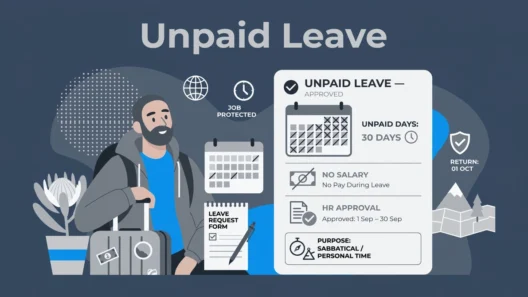
Unpaid leave is not something you can demand either. See unpaid leave in South Africa.
The pattern is consistent. South African labour law is generous on a small number of specified leave types and completely silent on everything else, and the silence is where employer discretion lives.
Frequently asked questions
Am I entitled to study leave in South Africa? No. The BCEA does not provide for study leave. It is entirely at your employer’s discretion, or governed by your contract or bargaining council.
How many days study leave am I entitled to? None, as a matter of law. Where employers grant it voluntarily, a common convention is two days per subject up to a maximum of ten days a year.
Can my employer make me take annual leave to write an exam? Yes. Your employer may require that study leave comes out of your annual leave, or that it is unpaid.
Can my employer refuse study leave? Yes, and you have no statutory recourse if they do. You may still request annual leave or unpaid leave in the ordinary way.
Do I have to pay back a bursary if I resign? Usually. Study assistance agreements almost always contain a work back clause requiring repayment if you leave before serving out an agreed period. Read it before you sign it.
Is study leave paid? Only if your employer says so. There is no statutory entitlement to study leave, paid or unpaid.