



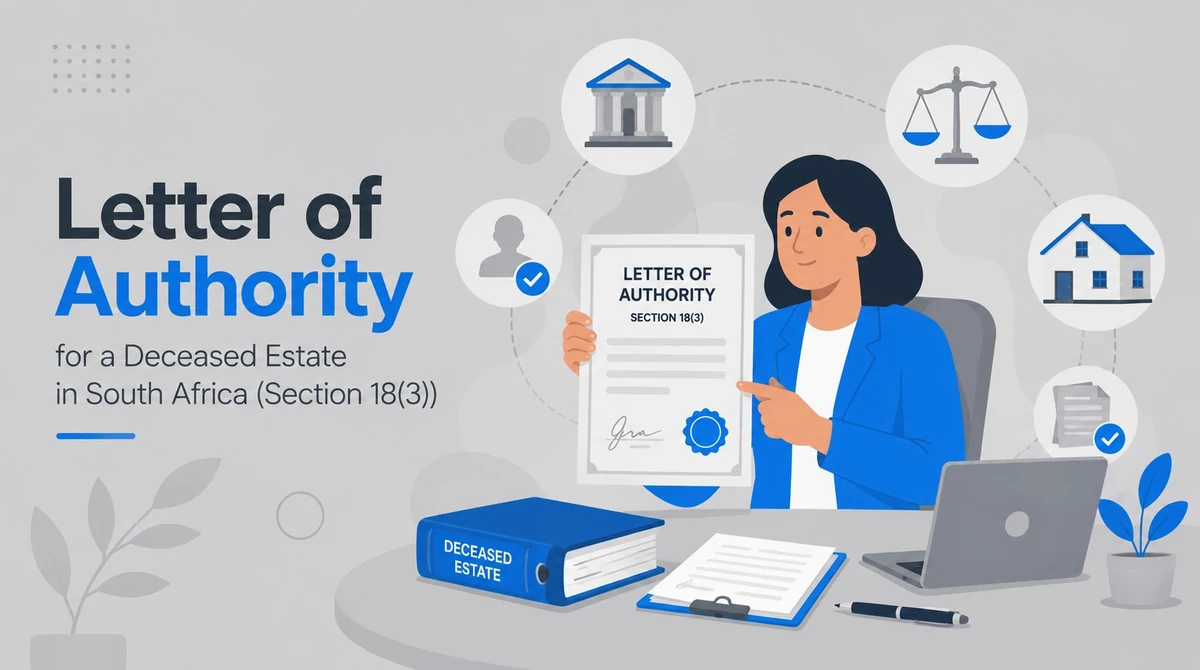
If the estate you are dealing with is worth R250,000 or less, you probably do not need to go through the full executorship process. Instead, the Master of the High Court can issue a letter of authority under section 18(3) of the Administration of Estates Act, which puts you on a shorter, cheaper, and faster path to winding up the estate.
This guide explains what a letter of authority is, when it applies, how it differs from a letter of executorship, and the documents you need to apply.
What a letter of authority is
A letter of authority is the document the Master issues for a small estate, one with a gross value of R250,000 or less. It is issued in terms of section 18(3) of the Administration of Estates Act 66 of 1965, which is why these are often called “18(3) estates”.
Instead of appointing a formal executor, the Master appoints a Master’s Representative. That person is authorised to administer the estate without following the full procedure set out in the Act. In practical terms, the letter of authority gives you the standing to deal with the deceased’s bank, close accounts, collect the assets, settle the debts, and distribute what remains to the heirs, all without the heavier steps that a larger estate demands.
When it applies
The deciding factor is the gross value of the estate. Where that value is R250,000 or less, the Master may dispense with letters of executorship and issue a letter of authority instead. Where the estate is worth more than R250,000, the full executorship route applies, with a formal executor and an advertised account.
There is also a smaller sub-route. A Magistrate’s Office service point may have jurisdiction where the deceased left no valid will and the gross value is under R125,000, in areas where the Paperless Estates Administration System is not yet in place. For most people, though, the estate is reported to the Master of the High Court in the area where the deceased lived.
Letter of authority versus letter of executorship
The two documents do the same basic job, granting authority to wind up an estate, but the route attached to each is very different, and that difference is the whole reason the R250,000 line matters.
A letter of authority applies to estates of R250,000 or less. The Master appoints a Master’s Representative rather than a formal executor. There is no requirement to advertise the estate, and no full liquidation and distribution account has to be drawn up, advertised, and left to lie open for inspection. A bond of security is generally not required. The result is a process that can be completed in a matter of weeks rather than many months.
A letter of executorship applies to estates worth more than R250,000. The Master appoints an executor, who must follow the full statutory procedure: publishing a notice to creditors, drafting a formal liquidation and distribution account, submitting it to the Master, advertising it, and allowing it to lie open for inspection for 21 days before anyone is paid. That process commonly takes eight months to well over a year.
In short, a letter of authority is the light version for small estates, and a letter of executorship is the full version for larger ones. The size of the estate, not your preference, decides which one applies.
How to apply
The estate must be reported to the Master of the High Court in whose area the deceased was living, within 14 days of the date of death. For a small estate the reporting set is lighter than for a full executorship, but you will still need the core documents: a completed death notice, the original or a certified copy of the death certificate, a next of kin affidavit where there is no will, an inventory listing the assets of the deceased, the original will if there is one, a nomination by the heirs of the person to be appointed as Master’s Representative, a declaration that the estate has not been reported to another Master’s office, and certified copies of the identity documents of the deceased and the nominated representative, plus the marriage certificate where applicable.
Once the Master has received and checked the documents, the letter of authority is issued. This usually takes anything from about two weeks to three months, depending on how complete the file is and the workload at the office. You can see the office details and what each Master’s office charges in the Master’s office fees guide.
One practical point catches families out. Where a bank or trust company is nominated in a will, it will often decline the appointment for a very small estate because the fee does not justify the work, which then leaves the family to nominate one of their own as the Master’s Representative.
What you can do once it is issued
The letter of authority is what financial institutions, the bank, and other parties want to see before they will release funds or transfer anything out of the deceased’s name. With it in hand, the Master’s Representative collects the assets, pays the valid debts, and distributes the balance to the heirs, following the will or, where there is none, the rules of intestate succession. Because there is no advertising step and no formal account to be examined and advertised, a small estate can be wound up quickly once the letter is issued.
Even in a small estate, some costs still apply, chiefly the Master’s fee and, if an agent assists, their charge. For how the professional fee is worked out on larger estates, see the executor fees guide, and for the bigger picture of how funds move after a death, see what happens to the money when someone dies.
Methodology note
This guide reflects section 18(3) of the Administration of Estates Act 66 of 1965, which allows the Master of the High Court to dispense with letters of executorship and issue a letter of authority for estates with a gross value of R250,000 or less, together with the reporting requirements and standard practice of the Master’s office. The R250,000 threshold, the R125,000 Magistrate’s Court sub-threshold, and the reporting documents are set by regulation and Directive and can change. Always confirm the current threshold and document list with the Master of the High Court before reporting an estate.
Disclaimer
This article is general information on the administration of small deceased estates in South Africa. It is not legal, tax, or financial advice and does not create any professional relationship. Estate rules and thresholds change over time, and each estate differs. For a decision on a specific estate, confirm the current position with the Master of the High Court or a qualified professional.