




An executor may charge up to 3.5% of the gross value of your estate, plus 6% of any income the estate earns after your death, plus VAT. On a R4 million estate that is R161 000. But 3.5% is a maximum, not a price, and you can cap it in your will. Most people never do, and their estates pay the maximum.
Quick facts
| Item | 2026 amount | Set by |
|---|---|---|
| Executor’s remuneration, maximum | 3.5% of gross estate value | Prescribed tariff |
| Income commission, maximum | 6% of income collected after death | Prescribed tariff |
| VAT | 15%, if the executor is VAT registered | SARS |
| Effective maximum with VAT | About 4.025% of gross assets | |
| Minimum remuneration | R350 | Prescribed tariff |
| Bond of security | 0.5% of gross assets per year until finalised | Master of the High Court |
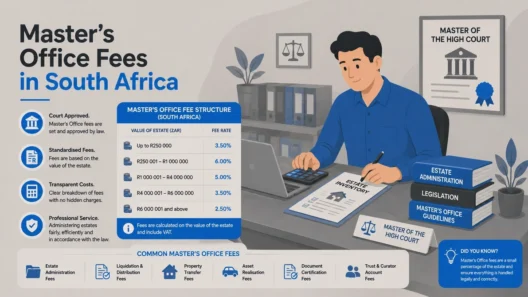
| Master’s Office fee | Nil to R7 000 | Prescribed scale |
| Advertising, two notices | About R2 300 plus VAT | Gazette and newspaper |
| Can the fee be reduced? | Yes. In your will. | Testator’s discretion |
The rule
Executor’s remuneration is a prescribed tariff, set under section 51(1) of the Administration of Estates Act 66 of 1965 and given effect by Chief Master’s Directive 4 of 2011.
3.5% of the gross value of the assets in the estate. Gross. Not net. The percentage is calculated before debts are deducted, which means an estate carrying a large bond still pays the fee on the full property value.
6% of all income accrued and collected after the date of death. Interest, rent, dividends earned during the administration.
Plus VAT, where the executor or its appointed agent is VAT registered. Which most professional executors are. So the real bite is closer to 4.025%.
Minimum R350.
If the deceased was married in community of property, the fee is calculated on the value of the joint estate.
What that costs
| Gross estate | 3.5% | Plus 15% VAT |
|---|---|---|
| R1 000 000 | R35 000 | R40 250 |
| R2 000 000 | R70 000 | R80 500 |
| R3 000 000 | R105 000 | R120 750 |
| R4 000 000 | R140 000 | R161 000 |
| R5 000 000 | R175 000 | R201 250 |
| R10 000 000 | R350 000 | R402 500 |
Set that against the Master’s Office fee on the same estates, which caps at R7 000. On a R4 million estate, the executor’s fee is over twenty times what the state charges.
The word almost nobody emphasises: maximum
The Act sets a ceiling, not a price.
- The Master may approve a lower amount.
- The executor may voluntarily charge less.
- And you, the testator, may specify the remuneration in your will.
If your will is silent on the fee, a professional executor will charge the maximum. Every time. That is not a scandal, it is a business charging its published rate. But it is a rate you were entitled to negotiate, and you were negotiating from your grave.
Clause one: cap the fee. A will can state that the executor’s remuneration shall not exceed an agreed percentage, or an agreed flat amount.
On a R4 million estate:
| Fee agreed in the will | Cost to your estate |
|---|---|
| Silent (default 3.5% plus VAT) | R161 000 |
| Capped at 2% plus VAT | R92 000 |
| Capped at 1.5% plus VAT | R69 000 |
One sentence. About R92 000.
The honest caveat: a professional executor is not obliged to accept an appointment at a fee they consider uneconomic. If you write a 0.5% cap into your will without telling anyone, your nominated executor may simply decline, and the heirs will have to nominate someone else. So agree the fee with your intended executor before you name them, and then record what you agreed. Nobody tells you this, and it is the difference between a clause that works and a clause that creates a mess.
Clause two: the security bond
This one is worth almost as much, and hardly anyone mentions it.
The Master requires an executor to lodge a bond of security covering the value of the estate’s assets. It costs roughly 0.5% of the gross asset value, per year, until the estate is finalised.
You are exempt if:
- The executor is the parent, spouse or child of the deceased, or
- The will directs the Master to exempt the nominated executor from furnishing security, or
- The executor is an attorney or company holding a Fidelity Fund Certificate.
That last point explains a great deal about why professional executors get appointed so readily.
On a R4 million estate running eighteen months, the security bond costs about R30 000. A single clause in the will removes it.
Two clauses. Roughly R120 000 on a R4 million estate.
Why the free will is not free
Look at what is happening in the market and it explains itself.
Banks, insurers and trust companies advertise free or heavily discounted will drafting. They compete hard for it. And the will they draft nominates them as executor.
Then, on your death, they charge the prescribed 3.5% plus VAT.
On a R4 million estate, that free will cost your heirs R161 000.
This is entirely lawful, it is disclosed in the mandate you sign, and the service they provide is real. Winding up an estate is genuinely difficult work. But you should know what you are trading, and you should know that the fee was negotiable at the moment you signed, and never again afterwards.
The rest of the bill
The executor’s fee is the largest line, but not the only one.
| Cost | Typical amount |
|---|---|
| Executor’s fee | Up to 3.5% plus VAT |
| Income commission | Up to 6% of post-death income |
| Master’s Office fee | Nil to R7 000 |
| Bond of security | 0.5% of gross assets per year, unless exempt |
| Advertising, Gazette and newspaper | About R2 300 plus VAT |
| Estate late bank account | Around R600 to open, plus ongoing charges |
| Conveyancing, if property transfers | On the LSSA guideline scale |
| Sworn appraiser, if the Master requires a valuation | On a sliding scale, plus travel |
| Bank charges, SARS clearance, valuations | Variable |
Time is money here. The 6% income commission runs for as long as the estate is open. An estate wound up in nine months costs less than the same estate wound up in twenty-four. Ask a prospective executor what their average turnaround is, and hold them to it.
What you can actually do
- Agree the executor’s fee before you name them, and record the agreed percentage or flat fee in the will.
- Direct the Master to exempt your executor from furnishing security. One clause, and it removes the 0.5% per annum bond.
- Understand that a free will is not free. If a bank or insurer drafts it and is nominated, they will charge the maximum.
- A family executor may waive the fee entirely. But a lay executor will usually need an attorney or agent to assist, and the agent charges. Compare the two properly rather than assuming family is free.
- Ask about turnaround. The 6% income commission accrues for as long as administration takes.
- Make sure the estate has liquidity. If there is not enough cash to pay the fees, duty and debts, assets get sold to raise it, and the heirs lose the asset rather than the cash.
Frequently asked questions
How much does an executor charge in South Africa? Up to 3.5% of the gross value of the estate, plus 6% of income collected after death, plus VAT. On a R4 million estate the fee is R140 000, or R161 000 including VAT. The minimum is R350.
Is the 3.5% fixed? No. It is a maximum. The Master may approve less, the executor may charge less, and you may specify a lower fee in your will.
Can I set the executor’s fee in my will? Yes, and it is the single most effective way to reduce it. Agree the figure with your intended executor first, because a professional may decline an appointment at a fee they consider uneconomic.
Is the fee calculated before or after debts? Before. It is charged on the gross value of the assets, so an estate with a large bond still pays the fee on the full property value.
What is the bond of security? Security lodged with the Master covering the estate’s assets, costing about 0.5% of gross asset value per year until the estate is finalised. A parent, spouse or child of the deceased is exempt, and a will can direct the Master to exempt the nominated executor.
Can a family member be the executor? Yes, and they may waive the fee. But a lay executor is usually required to be assisted by an attorney, trust company or accounting firm, and that agent charges.
Can heirs object to the executor’s fee? Yes. The executor’s proposed remuneration appears in the liquidation and distribution account, which the Master scrutinises. Heirs who consider the fee excessive may raise it with the Master, who may adjust it.
Is the executor’s fee deductible for estate duty? Yes. It falls within the administration costs deductible under section 4 of the Estate Duty Act.
How long does an estate take to wind up? Under twelve months where there are no complications. Eighteen to twenty-four months where there are. The longer it runs, the more income commission accrues.
Methodology
Executor’s remuneration is a prescribed tariff, not a market price. The figures on this page come from the Administration of Estates Act 66 of 1965, principally section 51(1), given effect by Chief Master’s Directive 4 of 2011, which sets the maximum at 3.5% of the gross value of the estate’s assets and 6% of income accrued and collected after death, subject to a minimum of R350 and VAT where applicable.
Master’s Office fees are prescribed by Schedule 2 of the Regulations to the same Act.
The worked examples are calculated directly from those tariffs. Advertising, bank and conveyancing costs are market prices and are labelled as indicative.
Related
- Master’s Office fees — the full prescribed scale, nil to R7 000
- Funeral cost in South Africa — what a death costs before the estate is even reported
Disclaimer
Searchis is not a law firm and this is not legal advice. Drafting a will, capping an executor’s fee and exempting an executor from security are all decisions with consequences, and they should be taken with a qualified professional.
The tariffs on this page are prescribed by legislation and cited as such. They are amended from time to time. Confirm the current tariff before relying on any figure here.