



The bank accounts freeze immediately. The funeral is due within a week. The estate pays out in nine to twenty four months. That gap, between the money that stops on day one and the money that arrives more than a year later, is the real financial shock of a South African death, and almost nobody is warned about it.
This page is about where the money comes from and when. For what things actually cost, see funeral cost in South Africa.
The timeline nobody shows you
| Event | When |
|---|---|
| Bank accounts frozen | Immediately, on death |
| Death reported to the Master | Within 14 days |
| Funeral | Usually within 3 to 7 days |
| Funeral policy pays out | 48 hours to a few days |
| Life policy with a named beneficiary pays out | Weeks |
| Letters of Executorship issued | 4 to 8 weeks, sometimes 3 months |
| Estate late bank account opened | After Letters are issued |
| Creditors advertised | 30 days to claim |
| Liquidation and distribution account lodged | Within 6 months of Letters |
| Account lies open for inspection | 21 days |
| Heirs paid | 9 to 24 months after death |
Read those two rows again. The funeral is on day five. The heirs are paid in month twelve.
The accounts freeze on day one
When a person dies in South Africa, their assets are frozen. Nobody can touch them, not the spouse, not the children, until the Master of the High Court appoints an executor and issues Letters of Executorship. That takes four to eight weeks at best.
The salary that was going to arrive at month end will not be spent. The savings account that was going to pay for the funeral is closed. The debit orders will bounce.
And if the deceased was married in community of property, the surviving spouse’s bank accounts are closed too. Not half of them. All of them, because in community of property there is one joint estate, and half of it now belongs to a dead person. The surviving spouse can usually arrange with the bank to keep an account open, but they must ask, and nobody tells them to.
This is the single most brutal, least discussed fact about death in South Africa. A widow can be left with a funeral to pay for on Friday and no access to her own current account.
So who actually pays for the funeral?
Somebody living, out of their own pocket. That is the honest answer.
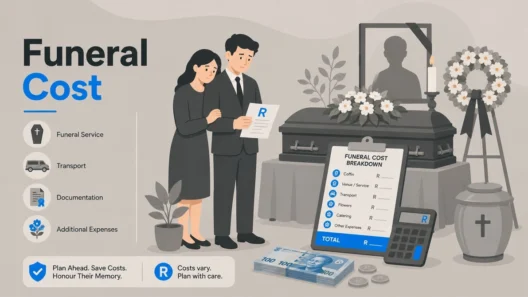
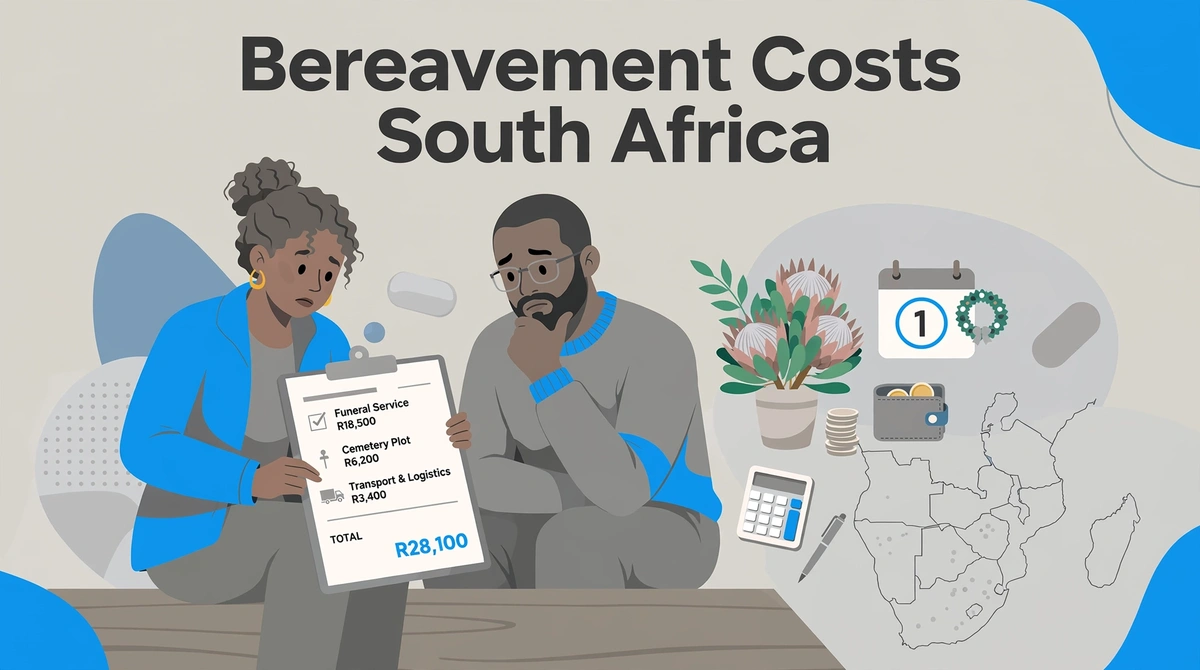
The estate cannot pay, because the estate has no executor yet and no bank account yet. So a spouse, a child, a sibling or a burial society covers a bill that commonly runs from R7 500 to R25 000, within days, in the worst week of their life.
The estate will pay it back. Funeral, tombstone and deathbed expenses are recoverable from the estate, and they are a deductible expense under section 4(a) of the Estate Duty Act. If a family member paid, that family member can be refunded by the estate.
Two conditions, and both matter:
- Keep every receipt. The undertaker’s invoice, the catering, the grave, the transport, the death notice advertisement. If it is not documented, it is not reimbursed.
- The costs must be reasonable. SARS will not allow a deduction for expenses it considers extravagant, and the Master may query them in the liquidation and distribution account.
And the reimbursement comes when the estate has cash and an executor. Which is months away.
What pays fast, and what does not
This is the most useful table on this page, and it is decided long before anybody dies.
| Asset | Falls into the estate? | Executor’s 3.5% fee? | When the family sees it |
|---|---|---|---|
| Funeral policy | No | No | 48 hours to a few days |
| Life policy with a named beneficiary | No | No | Weeks |
| Life policy payable to “the estate” | Yes | Yes | 9 to 24 months |
| Retirement fund, pension, provident, RA | No, distributed by the fund’s trustees | No | Weeks to 12 months |
| Bank accounts in the deceased’s name | Yes | Yes | 9 to 24 months |
| The house | Yes | Yes | 9 to 24 months |
| Vehicles, investments, shares | Yes | Yes | 9 to 24 months |
The line on the form is worth tens of thousands of rand.
Take R1 million of life cover. Name your spouse as the beneficiary, and the insurer pays her directly, in weeks, and no executor’s fee is charged on it. Make it payable to your estate instead, and the same R1 million falls into the estate, attracts the executor’s fee of 3.5% plus VAT, which is about R40 250, and your spouse waits a year for the balance.
Same policy. Same premium. One line on a beneficiary nomination form.
Retirement funds work differently again. Money in a pension, provident fund, retirement annuity or living annuity is not estate property. It is distributed by the fund’s trustees under the Pension Funds Act, and they are obliged to trace and consider all financial dependants, which is why it can still take up to twelve months. But it does not attract the executor’s fee, and it is not subject to estate duty.
What the estate swallows before anyone inherits
Even once the executor is appointed, the heirs are last in the queue.
The order is: creditors, then SARS, then administration costs, then the heirs. Whatever is left over is what gets distributed.
On a R2 million estate, before a single cent reaches an heir:
| Cost | Amount |
|---|---|
| Executor’s fee, at the prescribed maximum | R70 000, or R80 500 with VAT |
| Master’s Office fee | R3 800 |
| Bond of security, if the executor is not exempt | Around 0.5% of gross assets, per year |
| Advertising, two notices | About R2 300 plus VAT |
| Estate late bank account | Around R600 to open, plus monthly charges |
| Conveyancing, if the house transfers | On the guideline scale |
| Income tax to date of death, and after | Whatever SARS assesses |
| Capital gains tax on the deemed disposal | Whatever SARS assesses |
The executor’s fee alone is the single biggest number, and it is the only one on that list you could have reduced. See executor fees in South Africa for the two clauses in a will that cut it.
The liquidity trap
Here is where families lose the house.
The estate must pay the executor, the Master, SARS and the creditors in cash. If the estate does not have enough cash, the executor will first ask the heirs whether they are willing to pay the shortfall into the estate.
If the heirs cannot, or will not, the executor sells estate assets to raise the money.
That is how a family that inherited a paid-off house ends up not inheriting it. There was R2 million in property and R30 000 in the bank, and the bill was R120 000. Nobody had the cash. The house went.
This is what estate planning is actually for. Not tax avoidance. Liquidity. Making sure there is enough cash in, or payable to, the estate to cover what the estate owes, so that the assets you meant to leave behind are still there to leave.
Ask one question of your own affairs: if I died tomorrow, is there enough cash to pay the executor, the Master and SARS without selling anything? If the answer is no, that is the problem to fix.
How long it really takes
| Step | Time |
|---|---|
| Report the death to the Master | Within 14 days of death |
| Master issues Letters of Executorship | 4 to 8 weeks, sometimes up to 3 months |
| Executor collects assets, notifies institutions | Ongoing |
| Advertise for creditors, Gazette and newspaper | Creditors get 30 days |
| Draft and lodge the L&D account | Within 6 months of Letters |
| Master examines and raises queries | Query sheet, roughly 15 business days |
| Advertise the L&D, account lies open | 21 days for objections |
| Magistrate issues certificate of non-objection | |
| Executor distributes to heirs | Within 2 months of the inspection period closing |
Straightforward estate: under 12 months. Anything complicated: 18 to 24 months, sometimes longer.
The most common causes of delay are outstanding tax affairs, a contested will, immovable property that must be transferred or sold, foreign assets, and an estate reported without complete documents.
What to do in the first fourteen days
- Get the death certificate. The first issue is free. See Home Affairs certificate fees.
- Report the death to the Master of the High Court within 14 days, at the office where the deceased was ordinarily resident.
- Find the will. If there is none, the Intestate Succession Act decides who inherits, and the heirs nominate an executor.
- Claim the funeral policy immediately. It is the fastest money available, and it does not wait for an executor.
- Tell the bank, and if you were married in community of property, arrange access to an account before yours is closed.
- Keep every receipt for funeral and related costs. The estate reimburses them, but only what is documented and reasonable.
- Do not agree an executor’s fee under pressure. Whoever is appointed, ask what they will charge, and remember that 3.5% is a maximum, not a price.
Frequently asked questions
Are bank accounts frozen when someone dies in South Africa? Yes, immediately. Nobody can access them until the Master of the High Court issues Letters of Executorship, which takes four to eight weeks at best.
Will my own account be frozen if my spouse dies? If you were married in community of property, yes. There is one joint estate, and half of it now belongs to a deceased person. Speak to your bank about keeping an account open.
Who pays for the funeral if the accounts are frozen? A living person, out of pocket, or a funeral policy or burial society. The estate reimburses funeral and tombstone costs later, provided they are documented and reasonable.
How long does it take to wind up an estate in South Africa? Under twelve months where there are no complications. Eighteen to twenty four months where there are. The heirs are paid last.
How can my family get money quickly after I die? Nominate a beneficiary on your life policy. Assets with a named beneficiary bypass the estate entirely, pay out in weeks, and attract no executor’s fee. Assets payable to “the estate” do not.
Do retirement funds form part of my estate? No. Pension, provident, retirement annuity and living annuity money is distributed by the fund’s trustees, not by your will. It attracts no executor’s fee and no estate duty, though trustees may take up to twelve months to trace dependants.
Can the executor sell our house to pay the estate’s costs? Yes, if there is not enough cash in the estate to settle what it owes and the heirs cannot make up the shortfall. This is the most common way families lose an asset they expected to inherit.
Do beneficiaries pay tax on an inheritance? No. South Africa has no inheritance tax. The estate pays estate duty before distribution, but what you receive is a capital receipt and is not taxed in your hands.
Methodology
The timelines and processes on this page derive from the Administration of Estates Act 66 of 1965 and its Regulations, which govern the reporting of estates, the issuing of Letters of Executorship, the advertising of creditors, and the lodging and inspection of the liquidation and distribution account. Funeral, tombstone and deathbed expenses are deductible under section 4(a) of the Estate Duty Act. Retirement fund benefits are distributed under the Pension Funds Act by the fund’s trustees.
Executor’s remuneration and Master’s Office fees are prescribed tariffs, set out in full on our executor fees and Master’s Office fees pages.
Turnaround times are indicative. The Master’s offices process a high volume of estates and actual timelines vary.
Related
- Funeral cost in South Africa — what the funeral itself costs, line by line
- Executor fees in South Africa — the 3.5% maximum, and how to cap it
- Master’s Office fees — the prescribed scale
- Home Affairs certificate fees — death certificate tariffs
Disclaimer
Searchis is not a law firm or a financial services provider, and this is not legal or financial advice.
Beneficiary nominations, estate liquidity and will drafting are decisions with significant consequences and should be taken with a qualified professional. The timelines on this page are indicative and vary by estate and by Master’s office.