



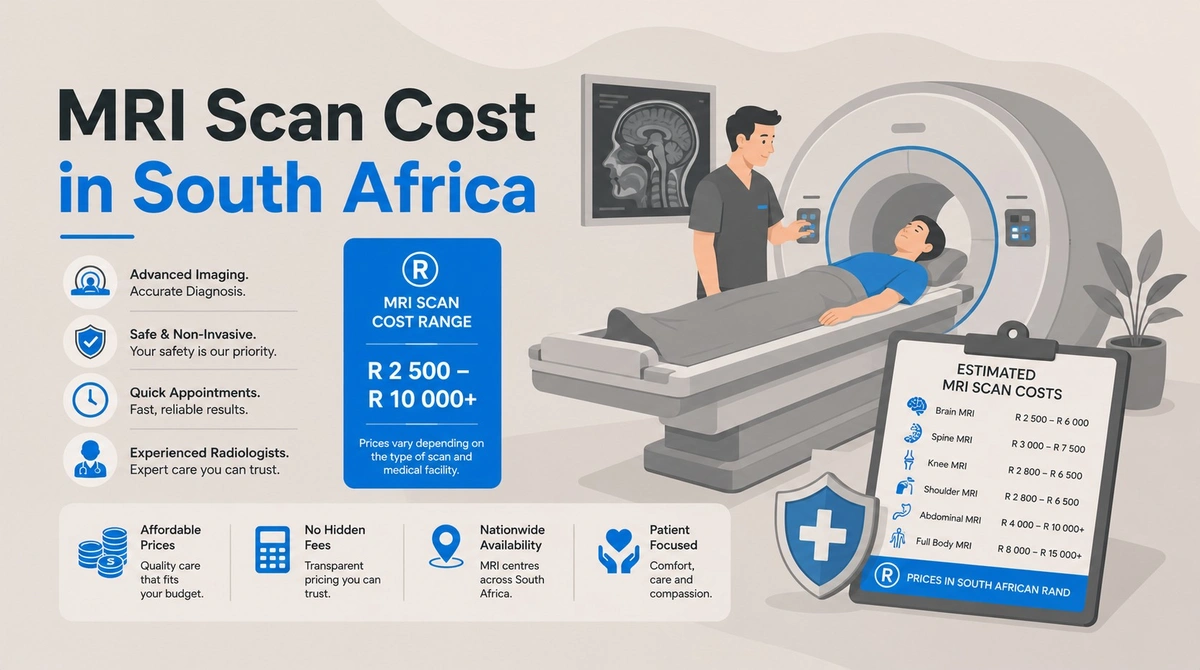
A private MRI scan in South Africa costs roughly R6 000 to R18 000 in 2026, depending on the body part, the practice and whether contrast is used. If you are on a medical aid, the number that matters is not the price. It is the co-payment, which commonly lands between R2 000 and R3 000. Public hospitals charge on a means-tested government schedule instead.
Quick facts
| Item | 2026 position |
|---|---|
| Typical private range | R6 000 to R18 000 |
| Common medical aid co-payment | Around R2 000 to R3 000 |
| Public hospital | Means-tested under the Uniform Patient Fee Schedule |
| Do private practices publish prices? | Almost none do |
| What they charge instead | Your medical scheme’s rate, or their own private rate |
| Pre-authorisation needed? | Yes, for MRI in almost every scheme |
| Same-day settlement discount | Offered by some practices |
| What you need for a quote | Referral form, body part, ICD-10 code, contrast yes or no |
Why you cannot find an MRI price online
This is the real problem, and it is worth explaining before any number.
South African radiology practices generally do not publish MRI prices. Morton and Partners state that they charge the rate set by your medical scheme, and that private-paying patients are billed at their standard private rate. Cape Radiology says the same, and asks patients to phone the accounts office for an estimate. Nuclear Med tells patients to phone their medical aid for authorisation and quotes only approximate costs. None of them puts a rand figure on a public page.
That is not evasiveness. It is how the billing works. A radiologist bills against a procedure code, and the amount paid depends on which medical scheme you belong to, which plan you are on, and what that scheme has negotiated. There is no single price to publish, because there is no single price.
The consequence is that every page you find quoting a neat MRI figure is guessing, or repeating a guess. Two of the pages currently ranking for this search are automated content with no named source at all. One quotes a 2012 international survey.
What people actually pay
Here is the distinction almost nobody draws.
If you have medical aid, you are not paying the price of the scan. Your scheme pays its rate, and you pay the shortfall. Lake, Smit and Partners publish a worked example that makes this concrete: on a scan where the medical aid pays R6 000, the patient co-payment is R2 700, and the scheme settles the R4 300 balance. The co-payment is the number to budget for, and it is a fraction of the headline price.
Co-payments on MRI are common because most schemes treat advanced imaging as a managed benefit. Whether you pay one, and how much, depends on your plan and whether the practice is a designated service provider for your scheme.
If you are paying cash, you pay the practice’s private rate, and that is where the R6 000 to R18 000 band sits. Bergman Ross and Partners, a radiology group in the Western Cape, is one of the few to state a range publicly, putting an MRI at anywhere from R6 000 to R18 000 or more.
If you use a public hospital, you are billed under the Uniform Patient Fee Schedule, which is a different system entirely. See below.
The figures we found
| Source | What it says | Date |
|---|---|---|
| Bergman Ross and Partners | R6 000 to R18 000 or more for an MRI | 2024 |
| Lake, Smit and Partners | Worked example: scheme rate R6 000, patient co-payment R2 700 | 2026 |
| Morton and Partners | Charges the scheme rate; private patients billed at standard private rate; reduced preferential rate for same-day settlement | 2024 |
| Cape Radiology | Charges the scheme rate; phone accounts for an estimate | 2024 |
| Nuclear Med | Approximate costs supplied on request; fees vary | Undated |
| International Federation of Health Plans, via News24 | South African private MRI averaged around R8 800, the most expensive of nine countries surveyed | 2012 data |
Estimate range based on advertised and published figures from six sources across Gauteng, the Western Cape and KwaZulu-Natal, surveyed July 2026. Prices are set by individual practices and are not published as a rule. Get a written quote before you book.
The public hospital route
Public hospitals do not use private pricing. They bill under the Uniform Patient Fee Schedule, a national schedule published by the Department of Health and gazetted province by province.
How it works:
- Every patient is classified by a means test. The categories run from H0, which is free, through H1, H2 and H3, up to full-paying and private patients.
- Every radiological procedure carries a cost code from A to E, from least to most expensive. Radiology procedures are listed in a separate Radiology Code Book.
- Your fee is a percentage of the full tariff, set by your category. Low-income patients often pay nothing.
- Provinces gazette their own tariffs annually. Gauteng applied a 4.4 percent increase across all patient categories with effect from 1 April 2025. The Free State gazetted its 2026/2027 tariffs in March 2026.
The trade-off is waiting time. Public MRI lists are long, and urgent cases are prioritised. If your scan is not urgent, the wait can run into months.
How to get your actual number
You will not get a useful figure by searching. You will get one by asking, and the quality of the answer depends on what you bring to the call.
Have these ready:
- The referral form from your doctor. The practice needs it to quote.
- The exact body part. A knee is not a brain. A spine MRI may be cervical, thoracic or lumbar, and each is priced separately.
- The ICD-10 code on the referral. Your medical aid will ask for it.
- Whether contrast is required. Contrast adds to the cost, and your doctor decides this, not you.
- Your scheme and plan name.
Then ask the practice three questions:
- What is the scheme rate for this code, and what is my co-payment?
- What is your private rate if I pay cash?
- Do you offer a reduced rate for settling on the day?
That last question is worth asking. Morton and Partners publish a reduced preferential rate for accounts settled in full on the day of the procedure, or on the day of discharge if you were admitted. Not every practice advertises this, but several operate it.
Finally, phone your medical aid separately and get the pre-authorisation. MRI almost always requires it, and the practice’s authorisation department will usually do this for you. Pre-authorisation is not a guarantee of payment. It confirms the scan is covered, not that the whole amount is.
What moves the price
Body part and complexity. A single joint without contrast sits at the bottom of the range. A brain or full spine with contrast sits at the top.
Contrast. Gadolinium contrast adds cost and adds time.
Public versus private. This is the single largest swing. A means-tested public patient may pay nothing. A cash-paying private patient in a metro may pay R18 000 for the same imaging.
Whether the practice is your scheme’s designated provider. Going outside the network is a common cause of a large co-payment.
Metro versus rural. Practices in Johannesburg and Cape Town carry higher overheads and generally charge more.
Hospital admission. If the scan happens while you are admitted, the radiology account is billed separately from the hospital account. People are routinely caught out by this.
Frequently asked questions
How much is an MRI scan in South Africa? Privately, roughly R6 000 to R18 000 in 2026, depending on the body part and whether contrast is used. On medical aid, the amount you personally pay is the co-payment, commonly R2 000 to R3 000.
Why will radiologists not tell me the price? Because they bill against your medical scheme’s rate, and that rate differs by scheme and plan. There is no single price to publish. Send them your referral form and they will quote you.
Is an MRI free at a public hospital? It can be. Public hospitals bill under the Uniform Patient Fee Schedule, which means-tests patients. The lowest income category is treated free of charge. Waiting times are the trade-off.
Do I need a referral for an MRI? You need one to claim from a medical aid. You are free to use any qualified radiology practice; you are not obliged to use the one your doctor suggests.
Does medical aid cover an MRI in full? Rarely. Most schemes treat advanced imaging as a managed benefit and require pre-authorisation. A co-payment is common, and it is larger if the practice is not a designated service provider for your scheme.
Is an MRI cheaper than a CT scan? No. MRI is generally more expensive than CT, takes longer, and is used for different clinical reasons. Which one you need is a decision for your doctor, not a budgeting choice.
Can I negotiate the price? You can ask for the cash rate and for a same-day settlement discount, and some practices apply one. You cannot negotiate your medical scheme’s rate.
Methodology
South Africa has no published national price for a private MRI, because private radiology practices set their own rates and bill against medical scheme tariffs rather than a public list. The figures above are therefore an estimate range compiled from advertised and published statements by named radiology practices, surveyed in July 2026, and are labelled as estimates throughout.
The public sector figures are different in kind. They come from the Uniform Patient Fee Schedule, published by the National Department of Health and gazetted by each province, and they are statutory rather than estimated.
We have kept those two sources separate on purpose, because they are not the same kind of number and should not be averaged together.
Disclaimer
This page is about cost, not clinical need. Whether you require an MRI, which body part is scanned, and whether contrast is used are medical decisions for your doctor.
The private figures are an estimate range, not a quotation. Prices are set by individual practices and vary by scheme, plan, body part and region. Public sector tariffs are gazetted annually and change. Always obtain a written quote from the radiology practice and confirm pre-authorisation with your medical scheme before booking.