



AARTO is the biggest change to South African traffic law in decades. It replaces the old system, where a traffic fine was a once-off payment you could ignore or challenge in court, with an administrative process that adds fees automatically, blocks your licence renewals if you do nothing, and, from September 2026, records demerit points against your name. This guide explains the whole system in plain terms and links to the detail on each stage.
What AARTO is
AARTO stands for the Administrative Adjudication of Road Traffic Offences. Its purpose is to take ordinary traffic matters out of the criminal courts and handle them administratively, through the Road Traffic Infringement Agency (RTIA), while adding a demerit points system aimed at repeat offenders.
The key split is between infringements and offences. Most everyday violations, such as speeding, not wearing a seatbelt or using a phone while driving, are treated as infringements and handled administratively by the RTIA. Serious matters, such as reckless or drunk driving, remain offences and still go through the courts. This distinction decides which process applies to you.
The AARTO process, step by step
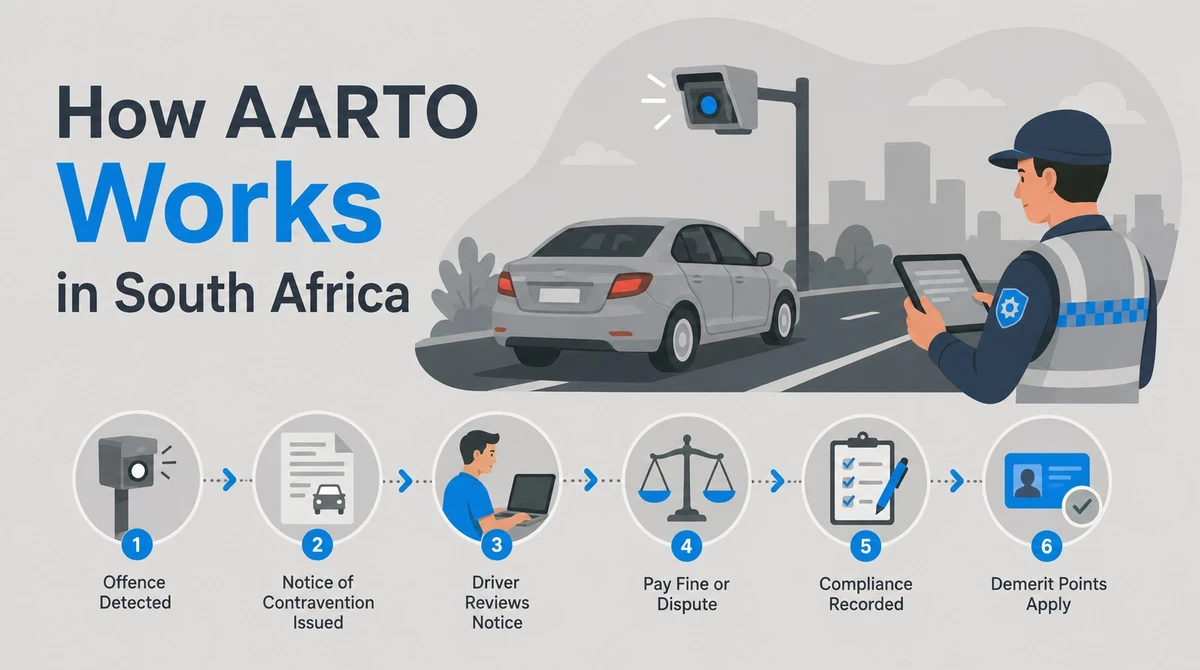
If you commit an infringement, the process runs through a fixed sequence, and each stage gives you a fresh 32-day window while adding cost if you ignore it.
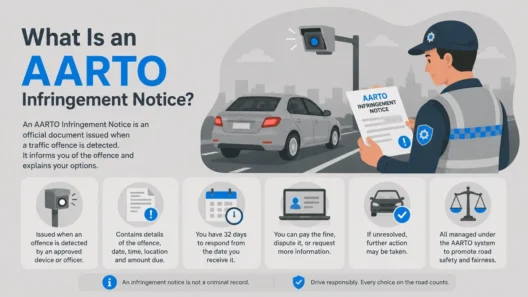
- Infringement notice. This is the fine itself. You have 32 days to pay at a 50% discount, nominate the actual driver, make a representation, or elect to go to court. The full detail, including how notices are served and the four options, is in our guide to the AARTO infringement notice.
- Courtesy letter. Ignore the notice for 32 days and a courtesy letter is issued. The discount falls away, a R100 fee is added, and you can no longer nominate a driver.
- Enforcement order. Ignore the courtesy letter for another 32 days and an enforcement order follows. It adds another R100, allocates your demerit points, and electronically blocks your driving licence and vehicle disc renewals until it is cleared.
- Warrant. Ignore the enforcement order and the RTIA registrar may issue a warrant.
At any point where you believe a fine is wrong, the route is to dispute it with a representation rather than simply not paying. A valid representation freezes the process while it is considered, which is why it is the strongest move available to you.
The demerit points system
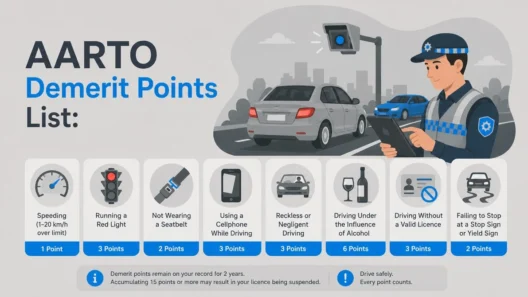
The part of AARTO that changes driving for good is demerit points. Every driver starts at zero, and each offence adds points, from one or two for minor infringements up to six for serious ones. Paying the fine does not avoid the points.
There is a threshold you can reach before your licence is suspended: 15 points for a fully licensed driver, 6 for a learner, and 12 for an operator card. Go over it and your licence is suspended for three months for every point above the threshold. A third time over the threshold cancels the licence entirely. Points fall away slowly, at one point for every three months of clean driving. Our AARTO demerit points list sets out how many points each offence carries and works through the suspension maths, and you can test a scenario with the AARTO demerit points simulator.
Crucially, demerit points are only allocated from 1 September 2026. Fines from before that date do not add points, but they still have to be paid, and unpaid ones can still escalate to an enforcement order that blocks your renewals.
How fines are set under AARTO
AARTO replaces municipality-by-municipality fine amounts with nationally standardised penalties set in Schedule 3 of the AARTO Regulations. Speeding, for example, is banded by how far over the limit you are, across three road types, urban, rural and freeway, with a tolerance of roughly 10 km/h before any fine applies. Fines start at around R400 for driving 11 to 12 km/h over the limit and rise from there. At the top end, exceeding the limit by 30 km/h or more in an urban area, or 40 km/h or more on a freeway or rural road, stops being an administrative infringement and becomes a criminal offence that can lead to arrest.
The rollout
AARTO has been delayed many times. It was piloted in the Johannesburg and Tshwane metros in a limited form, and is now rolling out nationally in phases through 2026, starting with the largest municipalities and extending to the rest, with a further batch of municipalities added on 1 October 2026. The demerit points system switches on separately, from 1 September 2026. Because the dates have shifted repeatedly, check our AARTO rollout guide for the current position in your municipality.
What this means for you
In practical terms, AARTO means you can no longer ignore a traffic fine and expect nothing to happen. Doing nothing now adds fees, records points, and eventually blocks your driver’s licence and professional driving permit renewals. The safe habits under AARTO are simple: check your status regularly on the official AARTO portal, act within the 32-day windows, and dispute fines you believe are wrong rather than leaving them.
Frequently asked questions
What does AARTO stand for? AARTO stands for the Administrative Adjudication of Road Traffic Offences. It is the system that handles most traffic fines administratively through the RTIA, rather than as criminal matters in court, and introduces a demerit points system.
How is AARTO different from the old traffic fine system? Under the old Criminal Procedure Act system, a fine was a once-off penalty set by each municipality. Under AARTO, fines are nationally standardised, escalate through added fees if ignored, can block your licence renewals, and add demerit points to your record.
When does AARTO start? AARTO is rolling out nationally in phases through 2026, having been piloted in Johannesburg and Tshwane. The demerit points system activates from 1 September 2026. Exact dates by municipality have changed repeatedly.
What happens if I ignore an AARTO fine? It escalates on a fixed timeline: a courtesy letter adds R100 and removes the discount, then an enforcement order adds another R100, records your demerit points and blocks your licence and disc renewals, and finally a warrant may be issued.
How many demerit points suspend your licence? A fully licensed driver is suspended once points exceed 15. The threshold is 6 for a learner driver and 12 for an operator card, with a three-month suspension for every point over the threshold.