



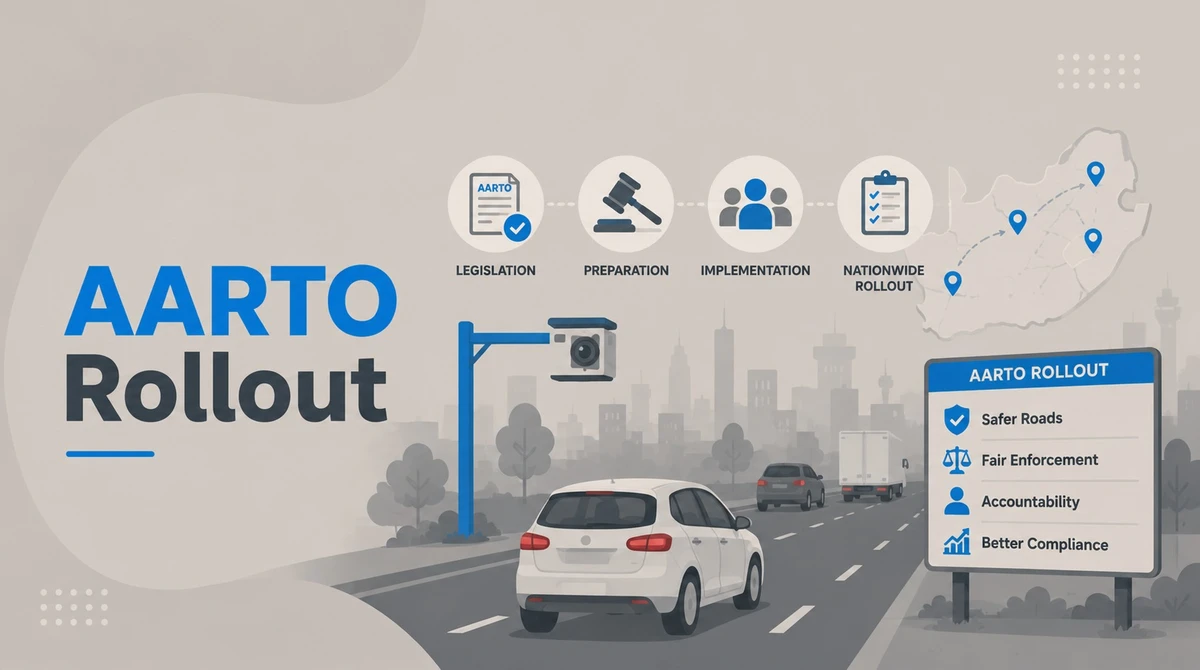
AARTO has been promised, and delayed, for the better part of two decades. In 2026 it is finally rolling out nationally, but in phases, municipality by municipality, and the demerit points system switches on separately from the fine process. This page sets out where things actually stand, what is live now, and how to check your own area, because the dates have moved so many times that only the current position is worth trusting.
The short version
As of mid-2026, the AARTO fine process is going live across the country in batches, starting with the largest municipalities and extending to the rest. The full demerit points system is scheduled to switch on separately, targeted for 1 September 2026, though even that date has been subject to slippage. Until demerit points activate, the infringement notice process, the 32-day windows, the fees and representations already apply in active municipalities.
How the timeline got here
- 2008. AARTO was piloted in Tshwane and Johannesburg, in a limited form that excluded the demerit points system.
- 2019. The AARTO Amendment Act was signed, setting up the national framework, but without an immediate commencement date.
- 2020 onward. A planned national rollout was repeatedly delayed, first by the pandemic and the RTIA’s capacity, then by legal challenges and municipalities that were not ready.
- The Constitutional Court. An earlier ruling that parts of AARTO were unconstitutional was overturned, and the Constitutional Court confirmed the system as valid, clearing the way for national rollout.
The 2026 phased rollout
The rollout is being done in batches of municipalities rather than all at once. In mid-2026 the government gazetted a large group of additional municipalities into the AARTO framework, bringing the number of active areas to more than sixty, with the largest municipalities going first. A further batch of municipalities is scheduled to be added on 1 October 2026, extending AARTO toward full national coverage.
If you receive a fine in an active municipality, it is no longer processed under the old Criminal Procedure Act. It enters the AARTO administrative process run by the RTIA, with its fixed timeline of infringement notice, courtesy letter and enforcement order.
When demerit points start
The part of AARTO that records points against your licence is being switched on separately from the fine process, and is targeted for 1 September 2026. Fines you receive before that date do not add points, but they must still be paid, and unpaid ones can still escalate to an enforcement order that blocks your renewals. Because this activation date has slipped before, treat it as a target rather than a certainty, and confirm the current position before assuming points are live.
How to check your area and your fines
The rollout is uneven, so the reliable way to know where you stand is to check directly. On the official AARTO portal, use the “Query my Fine” function and enter your ID or driving licence number. If you are checking a company vehicle, you need the business registration number and the ID of the nominated proxy. Checking regularly, especially before you renew a licence or disc, is the surest way to avoid being caught out by a fine you never saw.
Frequently asked questions
When does AARTO start in South Africa? AARTO is rolling out nationally in phases through 2026, starting with the largest municipalities and extending to the rest, with a further batch scheduled for 1 October 2026. The demerit points system is targeted to start separately on 1 September 2026.
Is AARTO already active where I live? It depends on your municipality, because the rollout is phased. The reliable way to check is the “Query my Fine” function on the official AARTO portal.
When do AARTO demerit points start? Demerit points are targeted to activate on 1 September 2026, separately from the fine process. This date has been delayed before, so confirm the current position rather than assuming points are already live.
Why has AARTO been delayed so many times? The national rollout was held up by the pandemic, the RTIA’s capacity, legal challenges, and municipalities that were not ready to implement it. The Constitutional Court has since confirmed the system as valid.