



Your licence disc expired last week, and you are still driving. You have heard there is a grace period. You are not sure whether it is 21 days or 22, whether it stops the fine or only the penalty, or what it will cost you once it runs out.
The grace period is real, and it is written into the National Road Traffic Regulations. It is not at the discretion of the officer who pulls you over. What it protects you from is narrower than most people assume, and the amounts that land on you once it lapses are set out in two separate regulations that almost nobody reads.
What the grace period actually covers
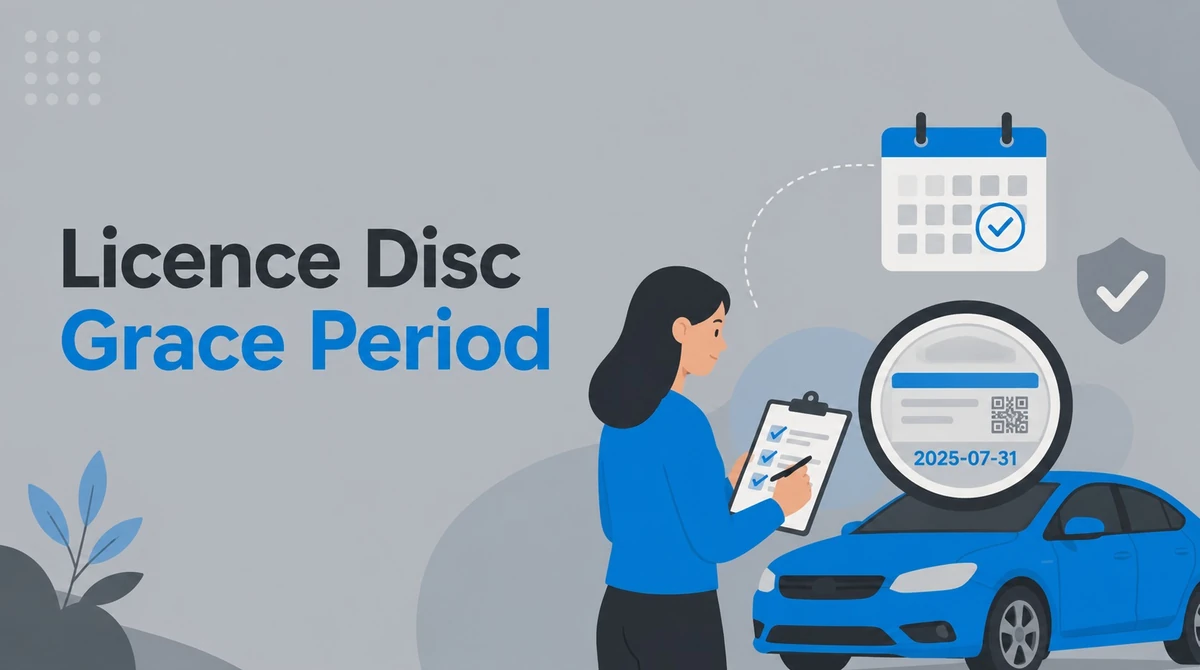
South African vehicle owners have 21 days to license the vehicle after liability for licensing arises. During that period the vehicle may continue to be used on a public road, provided the licence number and the expired licence disc are still displayed as required.
That is the whole of the protection. It is permission to keep using the vehicle while you attend to the renewal. It is not a suspension of the licence fee, and it is not immunity from what you owe.
The regulations run this in two places. Regulation 23 of the National Road Traffic Regulations, 2000 sets the date on which a motor vehicle is to be licensed. Regulation 60 is headed Period of grace. The parallel provision for registration, in Regulation 7(2), spells the mechanism out plainly: the vehicle may be operated on a public road for 21 days after the date of liability, while the licence number and licence disc are displayed as required.
Why the official form says 22
This is the source of the confusion, and it is not a blogger’s counting error. It comes from the government’s own paperwork.
The Application for Licensing of Motor Vehicle, the form usually called the ALV or MVL1, carries a note on its face stating that if the application is made after the 22nd day of the month following the expiry date of the current licence, penalties for late licensing become payable, and that if the application is made in the following month or thereafter, arrear licence fees become payable as well.
Read alongside the 21-day rule, the two line up exactly. Where a licence expires at the end of a month, liability arises on the first day of the next month, the 21 days run from there, and the 22nd is the first day on which penalties attach. The 22nd is not the last day you are covered. It is the first day you are not.
The Road Freight Association uses the same arithmetic in its worked example: a licence expiring on 30 September carries a grace period from 1 to 21 October, with exposure to prosecution from 22 October.
The three amounts, and where each one comes from
The annual licence fee. You still owe the full fee for the year ahead. Late renewal does not reduce it and does not pro-rate it.
Arrear licence fees. Charged under Regulation 59 at one twelfth of the annual fee for each month the vehicle sat unlicensed. On the ALV form’s wording, arrears attach later than penalties do, from the month after the penalty trigger.
The late penalty. Charged under Regulation 57 at 10 percent per month, to a maximum of 100 percent per annum.
That 100 percent ceiling matters. It means the penalty stops compounding after ten months, though the arrears do not stop, and neither does the offence.
The rand amounts are provincial. Licence fees are set by the MEC of each province against the vehicle’s tare weight, which is the unladen mass printed on the registration certificate. Two identical vehicles licensed in different provinces will not owe the same arrears.
How it stacks up
Take a vehicle with an annual licence fee of R600, renewed three months after the penalty trigger. The figure below is illustrative, since your actual fee depends on province and tare.
| Item | Basis | Amount |
|---|---|---|
| Annual licence fee | Full year ahead | R600 |
| Arrear licence fees | One twelfth per month, three months | R150 |
| Late penalty | 10 percent per month, three months | R180 |
| Total | R930 |
The consequence nobody mentions
Regulation 26A is headed Consequences of failure to licence motor vehicle, and the regulations elsewhere provide for the registration of a motor vehicle that has been deregistered due to not being licensed.
In other words, leaving a vehicle unlicensed long enough does not simply accumulate a bill. It can put the vehicle’s registration at risk, and getting it back on the register afterwards is a separate application with its own requirements, including a mass measuring certificate and a police clearance.
An expired disc is not an expired driving licence
Two different documents, two different processes, and confusing them is expensive.
The licence disc belongs to the vehicle. It is renewed annually through a registering authority, a participating post office, a bank, or online. The driving licence card belongs to you. It is renewed at a driving licence testing centre on its own cycle, with its own rules and its own penalties. Renewing one does nothing for the other.
If it is the card that has lapsed rather than the disc, read what happens when you drive on an expired driver’s licence, then work through how to renew your driver’s licence in South Africa.
Heavy vehicles and trailers: a live dispute
There is a persistent belief, including among some traffic officers, that the grace period applies only to light vehicles and that anything above 3 500 kg is excluded.
The Road Freight Association disputes this on behalf of its operator members. Its position is that nothing in the grace period provision limits it by gross vehicle mass or gross combination mass, and that the statutory definition of motor vehicle includes trailers. The Association also takes the view that the grace extends to the roadworthy certificate and the operator card.
This is an industry body’s reading of the regulations, argued because operators keep being told otherwise at the roadside. It is not a court ruling. If you operate heavy vehicles, it is worth knowing the argument exists and knowing which regulations it rests on.
What can block the renewal entirely
The grace period assumes you can complete the renewal. An AARTO enforcement order can block transactions on the national traffic information system, and a licence disc renewal is one of those transactions. That makes it a problem to resolve before the disc expires rather than during the 21 days.
If a notice has already reached you, start with the four options open at the infringement stage. If it has gone further, see what an AARTO courtesy letter means and how to revoke an enforcement order before it blocks anything else. For the system as a whole, see how AARTO works in South Africa.
Can you be fined during the grace period?
Not for the expired disc itself, provided you are inside the 21 days and the expired disc and licence number are still displayed. The grace period is a regulatory provision, not an officer’s discretion.
Once it lapses, operating the vehicle is an offence in its own right, separate from and additional to the arrears and the penalty. Under AARTO that attaches to your infringement record, and repeat infringements feed into the AARTO demerit points list and the point at which you lose your licence.
The vehicle that is not being driven
Standing a vehicle in a garage or up on blocks does not switch off the licence fee. The regulations require every motor vehicle in the Republic to be licensed by its owner whether or not it is operated on a public road. Provincial transport departments list the opposite belief among the common fallacies precisely because so many owners hold it.
Taking a vehicle off the licensing obligation is a formal process through the registering authority, not something achieved by leaving it parked.
Staying ahead of it
Renewal notices go to the address held on the national traffic information system. If you have moved and not updated your particulars, the notice goes to the old address, and you hear nothing. You remain liable either way.
A missing notice is not a reason you cannot renew. The renewal can be done on the Application for Licensing of Motor Vehicle, available from any registering authority and from selected post offices, together with your current disc or your registration certificate.
Frequently asked questions
How long is the licence disc grace period in South Africa? Twenty-one days. During that period the vehicle may be used on a public road provided the licence number and the expired disc are still displayed as required.
Is it 21 days or 22 days? Both figures describe the same rule. The official application form refers to the 22nd day of the month following expiry, which is the first day penalties attach, not the last day you are covered.
What does it cost if I miss it? Three amounts: the full annual fee, arrear licence fees at one twelfth of the annual fee per month, and a late penalty of 10 percent per month capped at 100 percent per annum.
Can I be fined during the grace period? Not for the expired disc, provided you are inside the 21 days, and the disc is still displayed.
Does the grace period apply to trailers and heavy vehicles? The Road Freight Association argues that it does, on the basis that the provision is not limited by vehicle mass and that the definition of motor vehicle includes trailers. Some traffic officers take a different view.
Is this the same grace period as my driving licence? No. The disc belongs to the vehicle and the card belongs to the driver. They are renewed separately under different rules.
What happens if I leave it unlicensed for a long time? Beyond the arrears and penalty, the regulations provide for the consequences of failure to licence a motor vehicle, including deregistration, after which re-registration is a separate application.
What if I never received a renewal notice? You remain liable. Renew on the Application for Licensing of Motor Vehicle, obtainable from a registering authority or selected post office.