



A disciplinary hearing is not a formality your employer runs before doing what it already decided to do. It is the procedure that makes a dismissal fair, and when it is done badly, the dismissal is unfair even if you did the thing you are accused of.
That is worth sitting with. A sound reason plus a broken process still costs your employer compensation.
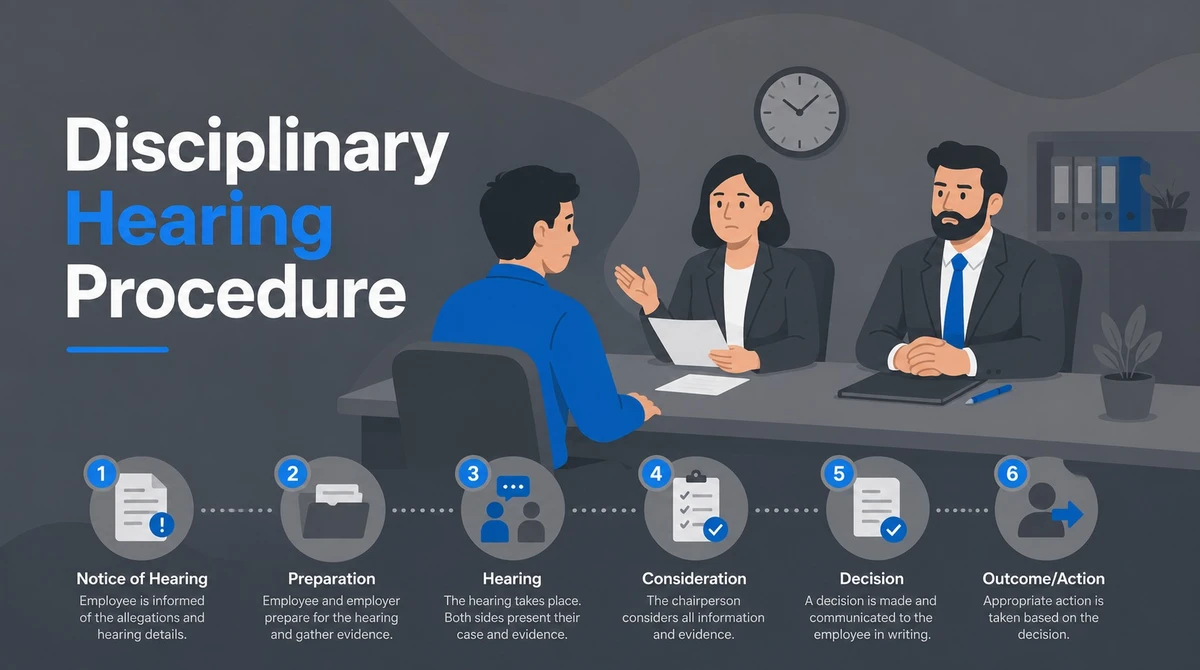
Here is what must happen, and what you are entitled to.
Before the hearing
1. An investigation. Your employer must investigate before charging you. It cannot decide first and investigate afterwards.
2. Written notice of the allegations. You must be told what you are accused of, in a form and language you can reasonably understand. Vague charges are a real problem for an employer. “Misconduct” is not a charge. “Insubordination, in that on 4 June you refused a lawful instruction from X to do Y” is.
3. Reasonable time to prepare. Not a notice on Monday for a hearing on Tuesday. What is reasonable depends on the complexity, but you are entitled to enough time to gather your side and speak to witnesses.
4. The evidence against you. Ask for it in writing if it is not offered. You cannot answer a case you have not seen.
5. Promptness. The enquiry should be held as soon as reasonably possible after your employer becomes aware of the alleged misconduct. An employer that sat on an allegation for six months and then charged you has a problem.
At the hearing
6. The right to be assisted. By a fellow employee or a trade union representative. Not, as a rule, by an outside attorney, unless your employer’s code allows it or the case is exceptional.
7. The right to state your case. Your employer leads its evidence first. You then get to respond, present your own evidence, call your own witnesses, and cross examine theirs. Cross examination is a right, not a courtesy, and it is where most weak employer cases fall apart.
The chairperson must be impartial. The person who investigated, or your direct manager who is the complainant, should not be chairing the hearing. This happens constantly and it is a strong ground of attack.
The standard of proof is the balance of probabilities. Not “beyond a reasonable doubt.” Your employer only has to show it is more likely than not.
Submissions on sanction. If the chairperson finds you guilty, both sides should be invited to make submissions on the appropriate sanction before it is decided. This is your chance to raise long service, a clean record, remorse, personal circumstances. It is frequently skipped, and skipping it is a procedural defect.
After the hearing
The outcome must be communicated to you, preferably in writing, with reasons.
If you are dismissed, you should be told of your right to refer the dispute. Your employer’s code may give you an internal appeal. If there is no appeal process, you go straight to the CCMA.
You have 30 days. See unfair dismissal.
If you do not attend
If you fail to attend without good cause, the hearing can continue in your absence and you can be dismissed in absentia.
Do not boycott a hearing as a protest. If you cannot attend for a legitimate reason, say so in writing, in advance, with proof, and ask for a postponement.
Do you always get a hearing first?
Almost always. But the law does not require a fixed number of warnings, and dismissal can be fair on a first offence where the misconduct is serious enough.
Offences that have justified dismissal at the first instance include theft, fraud, assault, gross dishonesty, wilful damage to property, wilfully endangering safety, and gross insubordination. The question is whether the conduct has broken the trust relationship, not whether you have been warned before.
For everything less serious, progressive discipline applies: counselling, then warnings, then dismissal. See how long a written warning is valid, because a warning your employer is relying on may have expired, or may relate to a completely different type of offence.
A disciplinary enquiry can be dispensed with only in exceptional cases, for example where the employee has absconded, or where holding one would endanger people or property.
Suspension pending the hearing
You can be suspended while the matter is investigated. A precautionary suspension must normally be on full pay. It is not a punishment and it is not a finding of guilt.
If you have been suspended without pay before any hearing, that is very likely an unfair labour practice, and it has its own referral route.
The procedural failures worth attacking
Go through this list against your own hearing:
- Charges that were vague, or changed at the hearing
- No time to prepare
- Evidence withheld until the day
- The chairperson was not impartial (your manager, the investigator, the complainant)
- You were refused a representative
- You were not allowed to cross examine the employer’s witnesses
- No submissions on sanction were invited before dismissal
- The decision was clearly pre-made and the hearing was theatre
- An expired warning, or a warning for a different offence, was used to justify dismissal
- Inconsistency: someone else did the same thing and was not dismissed
Inconsistency is a strong argument and employers hate it. If a colleague did the same thing last year and got a written warning, say so, and name them.
Frequently asked questions
What is the disciplinary hearing procedure in South Africa? Your employer must investigate, give you written notice of the allegations in a language you understand, allow reasonable time to prepare, let you state your case and be assisted by a fellow employee or union representative, and then communicate the outcome, preferably in writing.
Can I bring a lawyer to a disciplinary hearing? Usually not. You are entitled to a fellow employee or a trade union representative. External legal representation depends on your employer’s code or the exceptional complexity of the case.
Can I be dismissed without a warning? Yes, for serious misconduct such as theft, assault or gross dishonesty. The law does not require a specific number of warnings.
What if the chairperson is my manager? That is a strong ground of procedural unfairness. The chairperson should be impartial and should not be the complainant or the investigator.
Can a disciplinary hearing go ahead without me? Yes, if you fail to attend without good cause.
Must I be suspended with pay? A precautionary suspension pending a hearing should normally be on full pay. Unpaid suspension before any finding is likely an unfair labour practice.
What if the process was unfair but I was actually guilty? The dismissal can still be found procedurally unfair, which attracts compensation, though not reinstatement.
Sources
- CCMA, Disciplinary procedures
- CCMA, Disciplinary Procedures information sheet
This is general information, not legal advice.