



An AARTO infringement notice is the formal name for a traffic fine issued under the Administrative Adjudication of Road Traffic Offences (AARTO) Act, the system that is replacing the old criminal traffic fine process across South Africa through 2026. If you have received one, the single most important thing to understand is the 32-day clock attached to it: act inside that window and you can settle at half price, ignore it and the amount climbs through a fixed chain of fees before it blocks your licence renewals.
This page sets out exactly what the notice is, how it reaches you, the four responses open to you, and precisely what each fee is, verified against the Road Traffic Infringement Agency (RTIA) rather than the outdated figures still repeated on many sites.
What an AARTO infringement notice actually is
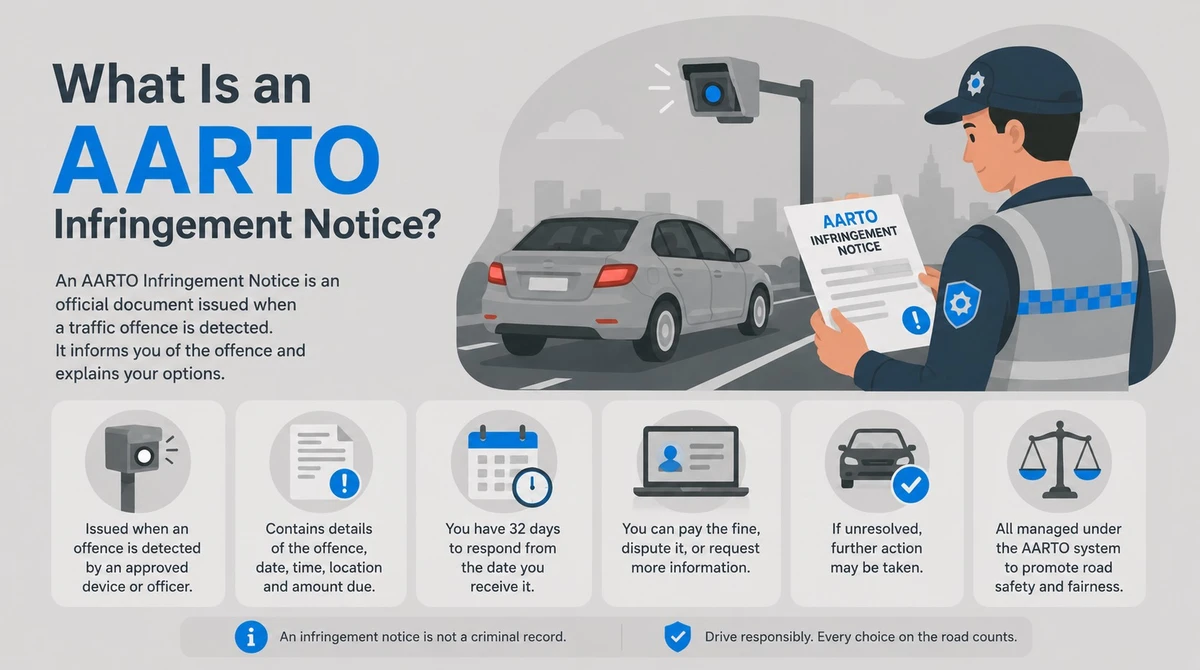
An infringement notice is issued when a traffic authority alleges that you have committed a road traffic offence. It is the AARTO equivalent of a traffic fine, but it carries more than a rand amount. Every notice sets out the offence code, the details of the vehicle, the penalty amount, and, once the demerit points system is live, the number of demerit points the offence attracts.
The notice is issued by an issuing authority, which is your local or provincial traffic department, while the wider process from the courtesy letter stage onward is administered by the RTIA. Under AARTO, most ordinary traffic offences are treated as infringements handled administratively, rather than as criminal matters that go to court. That is the core shift from the Criminal Procedure Act system that AARTO replaces.
How and when the notice is served on you
How the notice reaches you determines when your 32-day clock starts, so it is worth knowing the rules:
- Roadside stop or roadblock. If a traffic officer stops you and issues the notice in person, you sign for it and are served immediately, so the clock starts that day.
- Camera or after-the-fact offence. If the offence is caught on camera or issued after the fact, the traffic authority has 40 days from the date of the offence to issue the notice. Miss that window and the notice is invalid. A camera notice cannot be served in person: it must go by registered mail or electronically.
- When a posted notice counts as served. A notice sent by registered mail is deemed served 10 days after it is posted, and your 32-day clock runs from that deemed date, not from the day you actually open it.
- Electronic service now binds you. Since the national rollout, notices delivered by email, SMS or WhatsApp are legally binding, so the argument that you never received the fine no longer protects you.
AARTO also works on the concept of presumed service. If a notice is sent to your registered address or contact details, the law can treat it as served even if you did not personally open it, and your 32 days can run from that presumed date. This is why keeping your details current on the national traffic register matters.
Your four options within 32 days
Once you are served, you have 32 days to choose one of four responses. Choosing nothing is itself a choice, and the most expensive one.
- Pay the penalty and take the 50% discount. Settle within 32 days and you pay half the penalty amount. Once the demerit points system is active, paying the fine also allocates the demerit points for that offence to your name.
- Nominate the actual driver. If you were not driving, you may nominate the person who was, using form AARTO 07, together with a clear copy of that driver’s licence. This must be done within the first 32 days. Once a courtesy letter has been issued, you lose the right to nominate another driver.
- Make a representation. If you believe you should not be held liable, you may submit a written representation using form AARTO 08, setting out your grounds. The form must be signed before a Commissioner of Oaths to be valid. An independent representations officer then considers it.
- Elect to be tried in court. You may choose to have the matter heard in court instead. The issuing authority then cancels the infringement notice and a summons is issued for you to appear.
The fees, explained correctly
This is where most guides get the numbers wrong. The figures below reflect the RTIA’s current position.
| Stage | Fee added | Discount available |
|---|---|---|
| Infringement notice (pay within 32 days) | Penalty only | 50% off the penalty |
| Infringement Penalty Levy (IPL) | R100, no discount, paid in full | None |
| Courtesy letter | R100 | Discount falls away |
| Enforcement order | R100 | None |
The Infringement Penalty Levy is a R100 administrative charge the RTIA raises when it follows a notice up through its administrative processes. It is never discounted and must be paid in full. Note that some sites still quote a R60 courtesy letter fee. That figure is outdated: the RTIA’s own guidance sets the courtesy letter fee at R100.
The practical effect of waiting is steep. If you let the notice run all the way to an enforcement order, you pay the full penalty with no discount, plus R100 for the IPL, plus R100 for the courtesy letter, plus R100 for the enforcement order, which is R300 on top of the original fine.
What happens if you ignore the notice
Ignoring an infringement notice sets off a fixed escalation chain. Each stage gives you a fresh 32-day window and adds cost:
- Courtesy letter. If you do not act within 32 days of the infringement notice, the RTIA issues a courtesy letter. Your 50% discount falls away, R100 is added, and you can no longer nominate a driver. Full detail is set out in our guide to the AARTO courtesy letter.
- Enforcement order. If you do not act within 32 days of the courtesy letter, an enforcement order is issued. It adds a further R100, allocates the demerit points to your name, and electronically blocks transactions on the national traffic register, meaning no driving licence, professional driving permit or vehicle licence disc can be issued to you until it is cleared, so even a routine driver’s licence renewal is stopped. See our guide to the AARTO enforcement order.
- Warrant of execution. If an enforcement order is ignored, the RTIA registrar may issue a warrant.
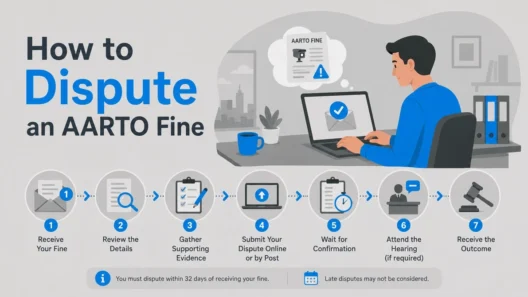
If you want to challenge a fine rather than pay it, read our step-by-step guide on how to dispute an AARTO infringement notice.
The AARTO timeline, day by day
For a camera offence the clock runs longer than most people expect. Counting from the day of the offence:
- Day 0. The offence is committed.
- Within 40 days. The traffic authority must issue and post the infringement notice, or it is invalid.
- Day 50. Ten days after posting, the notice is deemed served and your 32-day window opens.
- By day 82. Pay inside these 32 days for the 50% discount, or exercise one of your other options.
- Day 114. Miss that window and a courtesy letter is issued, adding R100 and removing the discount.
- Day 146. Ignore the courtesy letter and an enforcement order follows, adding another R100, allocating demerit points and blocking your licence and disc renewals.
End to end, a single ignored camera fine runs about six months from offence to enforcement order. A roadside notice follows the same course but starts its clock immediately, on the day you sign.
How the notice links to demerit points
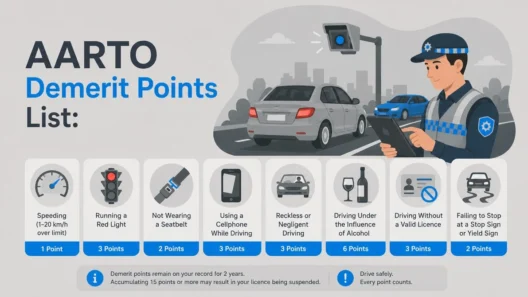
Under the demerit points system, each infringement carries a set number of points, from 1 to 6 depending on severity, as listed in the AARTO demerit points list. Points attach to you when the fine is paid, when an enforcement order is issued, or on an unsuccessful court election, among other triggers. A driver’s licence is suspended once the points against it climb past 15, with different thresholds set for learners and operators. You can estimate where you stand with our AARTO demerit points simulator.
Two timing points matter. Demerit points are only allocated from 1 September 2026, when that part of the system switches on. Traffic fines you received before that date do not add points, but they still have to be paid, and unpaid pre-September fines can still escalate to an enforcement order that blocks your licence renewals.
The things most guides get wrong
- The courtesy letter fee is R100, not R60. The lower figure is an old number several sites have never updated.
- The Appeals Tribunal is currently not operational. If your representation is rejected, the independent appeal route that is meant to follow does not have a functioning tribunal at present, so the usual safeguard is not available. Keep every submission receipt as proof that you acted in time.
- Electronic notices now count. Since the 2026 rollout, a notice by email, SMS or WhatsApp is legally binding, so the “I never saw it” defence is gone.
- Check for stealth fines. Because service can be presumed, fines can accumulate against your ID without your knowledge. Checking your status proactively on the official AARTO portal is safer than waiting for a letter.
Frequently asked questions
Is an AARTO infringement notice the same as a normal traffic fine? Yes. It is a traffic fine issued under the AARTO Act. The difference is the administrative process and, once live, the demerit points attached to it, rather than the criminal court route of the old system.
How long do I have to pay an AARTO fine? You have 32 days from the date the notice is served, or presumed served, to pay at the 50% discount or to choose another option. After 32 days without action, a courtesy letter is issued and the discount falls away.
What is the 50% discount on AARTO fines? If you pay the penalty within 32 days of the infringement notice, you pay only half the penalty amount. The discount does not apply to the Infringement Penalty Levy, and it is lost entirely once a courtesy letter is issued.
What happens if I was not the driver? You may nominate the actual driver using form AARTO 07 within 32 days, together with a copy of that driver’s licence. You cannot nominate a driver once a courtesy letter has been issued.
Can I be arrested for not paying an AARTO fine? The RTIA states you cannot be arrested for failing to pay AARTO infringements alone. The consequence is administrative: added fees, demerit points where applicable, and a block on your licence and vehicle documents through an enforcement order.
Do old traffic fines count toward demerit points? No. Fines issued before 1 September 2026 do not add demerit points, but they must still be paid, and if left unpaid they can still escalate to an enforcement order.