



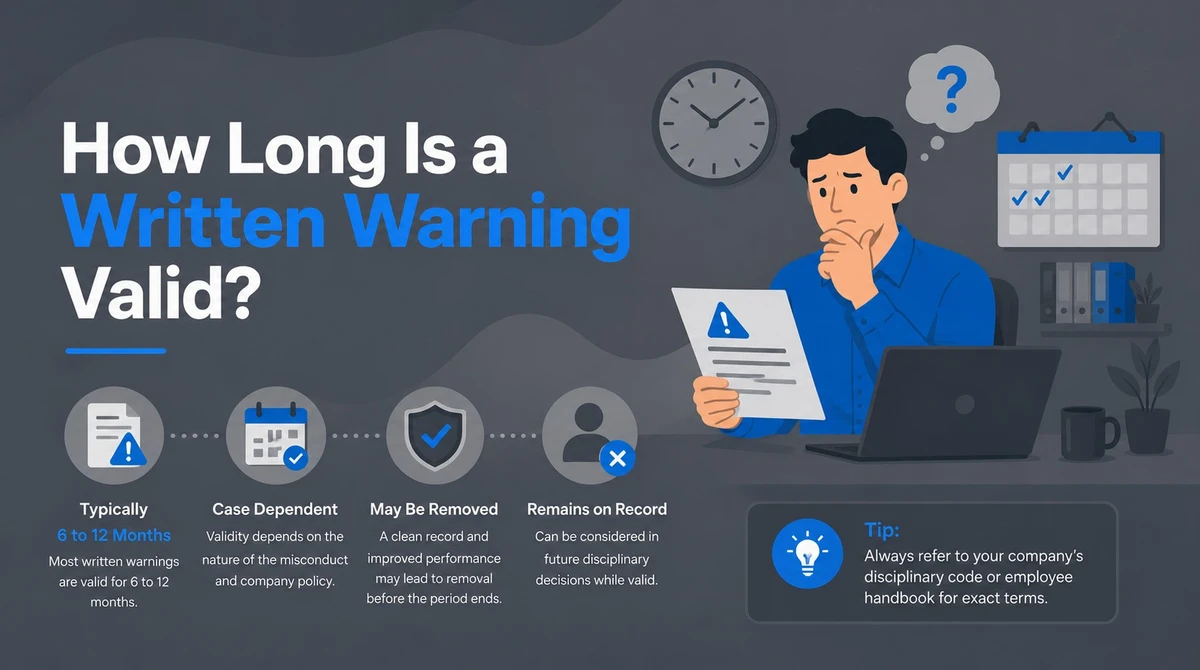
There is no statutory validity period for a disciplinary warning in South Africa. Not in the Labour Relations Act, not in the Code of Good Practice, nowhere.
The period comes from your employer’s disciplinary code. Ask for a copy. You are entitled to one, and you cannot check whether a warning has expired without it.
The usual periods
The CCMA’s own guidance says that, depending on the employer’s policy, written warnings usually remain valid for 3 to 6 months and final written warnings for 12 months.
That is a description of common practice, not a rule of law. Typical codes look like this:
| Warning | Usual validity |
|---|---|
| Verbal warning | 3 months |
| First or second written warning | 3 to 6 months |
| Serious written warning | 6 to 9 months |
| Final written warning | 12 months |
Your code may say something different, and if it does, your code governs. But a validity period that is excessively long can itself be attacked as unreasonable, because the point of progressive discipline is to let you correct your behaviour and start fresh, not to hang a permanent threat over you.
Validity runs from the date the warning was issued
Not from the date of the offence. A written warning issued on 1 March with six months’ validity expires at the end of August, whatever date the underlying incident happened.
Check the date on the document.
The rule that wins cases
Here is the one almost nobody knows, and it comes straight from the CCMA.
A warning for one type of contravention is not applicable to another type of offence.
A first written warning for late coming cannot be used to escalate discipline for poor work quality. They are different offences. Your employer cannot stack unrelated warnings to build a case for dismissal.
If your employer is relying on a warning for something unconnected to what you are now charged with, say so, clearly, at the hearing and on the record.
What an expired warning can and cannot do
It cannot be the basis for escalating discipline. If your written warning for lateness lapsed last month and you are late again today, your employer should treat that as a fresh first offence, not issue a final written warning.
But it does not vanish entirely. Expired warnings may still be considered as part of your overall disciplinary history when a chairperson assesses whether dismissal is an appropriate sanction, particularly where a clear pattern of the same behaviour is established.
So an expired warning is a shield, not an eraser. It stops the escalation. It does not wipe the slate in the mind of the person deciding your fate.
Refusing to sign changes nothing
If you refuse to sign a warning, it remains valid. A witness will sign instead, confirming that the warning was explained to you and that you declined to accept it.
Refusing to sign is not a strategy. It is a gesture, and it costs you nothing but also gains you nothing.
Signing is not an admission of guilt. It acknowledges receipt. If you are worried, write “received, contents disputed” next to your signature. Then use the proper route.
What a valid warning must contain
A warning that is missing these is vulnerable:
- The nature and date of the misconduct
- The required corrective action and by when
- The consequences of further misconduct
- The validity period of the warning itself
- Acknowledgement of receipt, or a witness signature
And it should only be issued after a fair procedure in which you had the opportunity to state your case. Even a written warning cannot simply be handed to you without a hearing of some kind. If it was, that is an unfair labour practice.
How to challenge a warning
- Internal appeal, if your employer’s code provides one. Use it, in writing, within the time limit in the code.
- If there is no appeal process, or it fails, refer an unfair labour practice dispute to the CCMA.
Note the different clock. An unfair labour practice must be referred within 90 days of the act complained of, not 30. That is a different deadline from an unfair dismissal, which is 30 days.
Warnings are not always required
The law does not prescribe a number of warnings before dismissal, and dismissal can be fair on a first offence for serious misconduct: theft, fraud, assault, gross dishonesty, gross insubordination.
Where the misconduct is that serious, warning validity is irrelevant. The question is the gravity of the act and whether trust has broken down, not whether a pattern exists. See disciplinary hearing procedure.
Frequently asked questions
How long is a written warning valid in South Africa? There is no legal period. It is set by your employer’s disciplinary code. In practice, written warnings usually run 3 to 6 months and final written warnings 12 months.
Does the law set a validity period for warnings? No. The LRA and the Code of Good Practice are silent. The employer’s code determines it.
Can an expired warning still be used against me? It cannot be used to escalate discipline, but it may be considered as part of your overall disciplinary history when a chairperson assesses the appropriate sanction.
Can a warning for lateness be used for a different offence? No. The CCMA is clear that a warning for one type of contravention does not apply to another type of offence.
What happens if I refuse to sign a warning? Nothing. It remains valid. A witness signs to confirm that you refused and that it was explained to you.
How do I challenge a warning I think is unfair? Appeal internally if your code allows, then refer an unfair labour practice dispute to the CCMA within 90 days.
Can I be dismissed while a final written warning is valid? Yes, if you commit further misconduct during the validity period. That is what a final written warning means.
Sources
- CCMA, Disciplinary procedures
This is general information, not legal advice.