



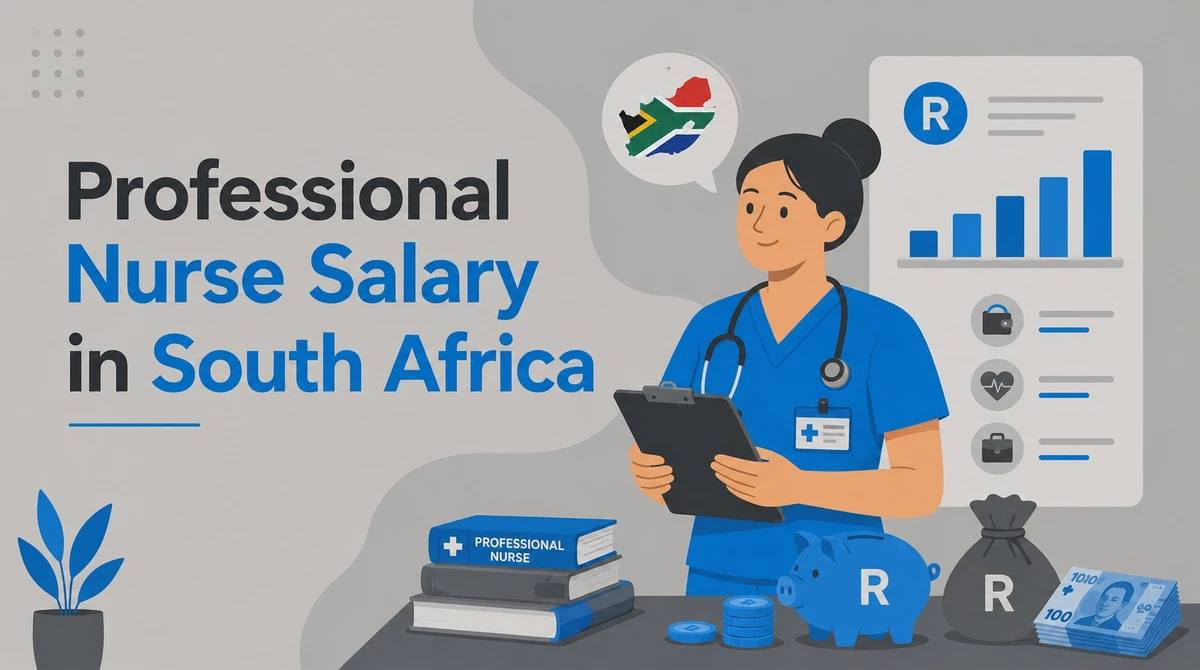
A professional nurse in the public service earns R28 113.25 a month at entry in 2026, rising to R52 924.00 a month at the top of Grade 3. If you hold a post-basic specialty qualification, you start at R41 285.25 a month instead. These are the exact notches in Annexure B to DPSA Circular No. 15 of 2026, effective 1 April 2026, not survey estimates.
The number that surprises most people is the specialty gap. A post-basic qualification is worth roughly R13 000 a month the day you qualify, which is a bigger return than a decade of general service.
Quick facts
| Item | Detail |
|---|---|
| Entry salary, Grade 1 | R28 113.25 a month (R337 359 a year) |
| Top of Grade 3 | R52 924.00 a month (R635 088 a year) |
| Community service year | R23 343.25 a month (R280 119 a year) |
| Specialty entry | R41 285.25 a month (R495 423 a year) |
| Grade 1 | Under 10 years after SANC registration |
| Grade 2 | 10 to 20 years |
| Grade 3 | 20 years or more |
| 2026 increase | 4.0%, effective 1 April 2026 |
| Source | DPSA Circular 15 of 2026, Annexure B, PERSAL Tables 298 and 299 |
| Registration | South African Nursing Council, professional nurse category |
General nursing stream
| Post | Monthly (2026) | Annual (2026) |
|---|---|---|
| Professional Nurse (Community Service) | R23 343.25 | R280 119 |
| Professional Nurse Grade 1 | R28 113.25 to R33 116.00 | R337 359 to R397 392 |
| Professional Nurse Grade 2 | R34 331.50 to R40 440.75 | R411 978 to R485 289 |
| Professional Nurse Grade 3 | R41 285.25 to R52 924.00 | R495 423 to R635 088 |
Grade 1 has 12 notches, Grade 2 has 12, and Grade 3 has 18. You move up roughly one notch a year on satisfactory service, and you move between grades on experience alone.
Specialty nursing stream
| Post | Monthly (2026) | Annual (2026) |
|---|---|---|
| Professional Nurse Grade 1 (Specialty) | R41 285.25 to R43 171.25 | R495 423 to R518 055 |
| Professional Nurse Grade 2 (Specialty) | R50 612.50 to R52 924.00 | R607 350 to R635 088 |
| Clinical Nurse Practitioner Grade 1 (PHC) | R43 818.75 to R48 494.25 | R525 825 to R581 931 |
| Clinical Nurse Practitioner Grade 2 (PHC) | R53 717.75 to R62 742.75 | R644 613 to R752 913 |
Specialty Grade 1 requires a post-basic qualification plus at least 4 years of experience after registration as a professional nurse.
Specialty Grade 2 requires a post-basic qualification plus at least 14 years of experience, of which 10 must be in the specialty after obtaining the post-basic qualification.
ICU, theatre, trauma, oncology and advanced midwifery sit here. So does primary health care, which has its own scale as a clinical nurse practitioner and is the better-paid of the two routes at senior level.
Do the arithmetic on the post-basic
Take two professional nurses who registered in the same year.
Nurse A works general wards. After 4 years she is Grade 1, several notches up, earning somewhere in the region of R30 000 a month. She reaches R33 116.00 at the top of Grade 1, then crosses to Grade 2 at 10 years and earns R34 331.50.
Nurse B completes a post-basic qualification and moves into a specialty unit. At 4 years she is Specialty Grade 1, earning R41 285.25 a month.
At the same seniority, Nurse B is roughly R11 000 a month ahead. It takes Nurse A until 20 years of service to reach Specialty Grade 1’s entry point.
That gap is the single most important financial fact in a South African nursing career, and it is not visible on any of the salary aggregator sites.
Community service is not a stipend
You will see the community service year described as a stipend worth R17 000 to R22 000 a month. That is wrong, and it is worth correcting.
Community service professional nurses sit on a published OSD notch of R280 119 a year, which is R23 343.25 a month. It is a salary, not an allowance, and it carries the normal public service benefits. It sits below the Grade 1 entry notch because you are not yet counted as having independent experience, and you move onto Grade 1 the following year.
Nursing management
Once you leave the bedside, the scale changes shape.
| Post | Monthly (2026) | Annual (2026) |
|---|---|---|
| Operational Manager Nursing Grade 1 (General Unit) | R47 596.75 to R51 371.50 | R571 161 to R616 458 |
| Operational Manager Nursing (Specialty Unit) | R60 068.25 to R62 742.75 | R720 819 to R752 913 |
| Assistant Manager Nursing (Head of Nursing Services) | R63 683.50 to R70 523.50 | R764 202 to R846 282 |
| Deputy Manager Nursing (Level 1 and 2 Hospitals) | R89 101.25 to R101 610.25 | R1 069 215 to R1 219 323 |
| Manager Nursing (Level 3 and Specialised Hospitals) | R100 108.50 to R114 463.50 | R1 201 302 to R1 373 562 |
The step from Assistant Manager to Deputy Manager is the sharpest in the whole dispensation, from around R70 500 to R89 100 a month. Deputy Manager and above are paid on total cost to employer packages, which is why the figure jumps rather than steps.
Sessional and contract work
If you take sessional shifts in the public sector, you are paid hourly. The rate is derived from the minimum notch of the equivalent full-time post with 37% added in lieu of benefits.
| Experience | Sessional professional nurse |
|---|---|
| Under 10 years | R223 an hour |
| 10 to 20 years | R272 an hour |
| 20 years or more | R327 an hour |
| Specialty, 4 years post-basic | R327 an hour |
| Specialty, 14 years post-basic | R401 an hour |
These are worth knowing even if you take private agency shifts, because they tell you what the state values your hour at with benefits priced in.
What sits on top of the notch
The figures above are basic salary. Public sector professional nurses also receive a 13th cheque equal to one month’s salary paid in their birthday month, a housing allowance if they own a home, GEPF membership with the state contributing 13% against your 7.5%, and GEMS medical aid with the state paying a large share of the contribution. Rural and scarce skills allowances apply in hard-to-staff facilities.
PAYE, UIF, your GEPF contribution and your medical aid share come off. Your take-home will be well below the notch.
Related tools and reading
- Nurse salary in South Africa: full OSD pay scales
- Enrolled nurse and staff nurse salary
- Student nurse stipend
- Take-home pay calculator
Frequently asked questions
How much does a professional nurse earn per month in South Africa? R28 113.25 a month at entry in the public service, rising to R52 924.00 at the top of Grade 3. Specialty professional nurses start at R41 285.25 a month.
What is the difference between Grade 1, 2 and 3? Experience after SANC registration. Grade 1 is under 10 years, Grade 2 is 10 to 20 years, and Grade 3 is 20 years or more. Progression is automatic on experience.
What does a community service nurse earn? R23 343.25 a month. It is an OSD salary notch of R280 119 a year, not a stipend.
How much more does a specialty nurse earn? Specialty Grade 1 starts at R41 285.25 a month against R28 113.25 for general Grade 1. At comparable seniority the gap is roughly R11 000 a month.
What does an ICU nurse earn in South Africa? With the post-basic qualification and placement in the unit, from R41 285.25 a month in Specialty Grade 1, rising to R52 924.00 in Specialty Grade 2.
What increase did professional nurses get in 2026? 4.0%, effective 1 April 2026, under DPSA Circular No. 15 of 2026.
What does an operational manager nursing earn? R47 596.75 to R51 371.50 a month in a general unit at Grade 1, and R60 068.25 to R62 742.75 in a specialty unit.
Methodology and sources
All salary figures come from Annexure B to DPSA Circular No. 15 of 2026, the translation key for PERSAL Tables 298 and 299 covering the OSD for Professional Nurses, Staff Nurses and Nursing Assistants, effective 1 April 2026. Grade criteria and sessional hourly rates come from Annexure J3 to the same circular.
The 4.0% adjustment gives effect to PSCBC Resolution 1 of 2025. Annual figures are the published full-time notches. Monthly figures are the annual notch divided by 12, before deductions.
This page was last reviewed on 12 July 2026.
Disclaimer
These are the published public service salary scales. Your actual placement depends on your grade, notch, recognised experience and applicable allowances. Private hospital groups set their own pay and are not bound by the OSD. For your exact notch, ask your departmental human resources office, which can confirm your PERSAL placement.