



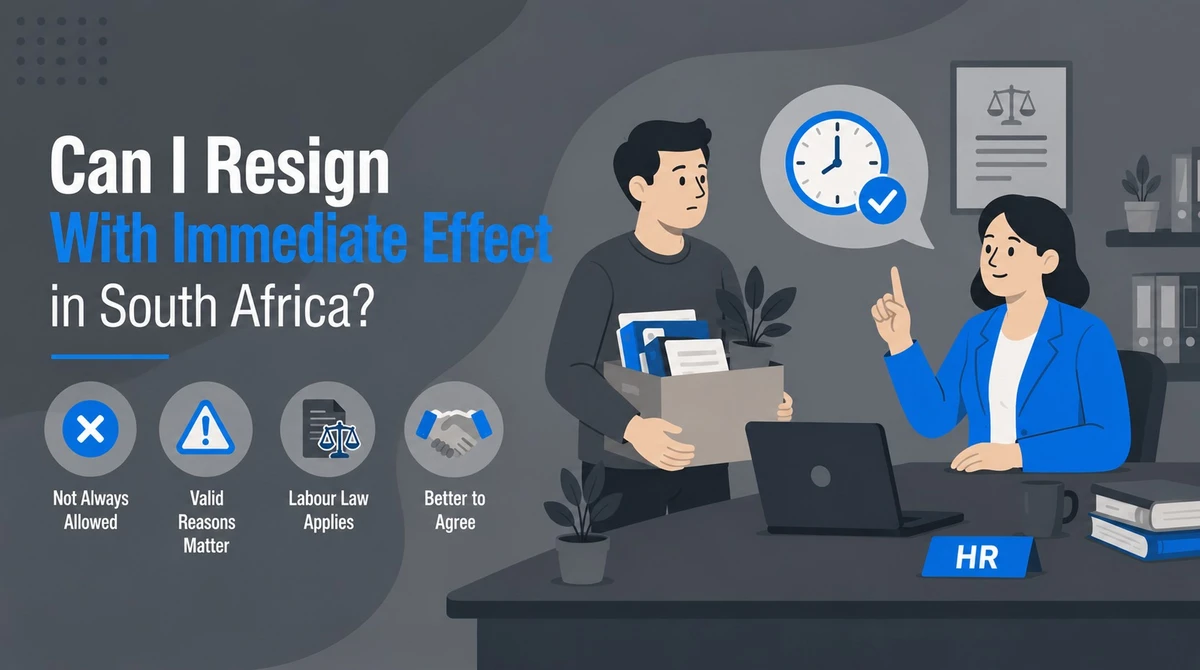
You can physically walk out at any time, but in almost every case it is a breach of contract. South African law recognises only one clean route to a lawful immediate resignation: constructive dismissal, where conditions at work have become genuinely intolerable. Everything else leaves you exposed, and on a salary of R18 000 a month, four unserved weeks is R18 000 your employer can legally chase.
The short version: resigning is always within your power. Resigning without notice, and without consequences, usually is not.
Quick facts
| Question | Answer |
|---|---|
| Can you legally resign without notice? | Only where you can prove constructive dismissal |
| What happens otherwise? | Breach of contract. Your employer may claim the value of unserved notice |
| Can they deduct it from your final pay? | No, not without your written consent (BCEA section 34) |
| Do they have to accept your resignation? | No. Resignation is unilateral and takes effect on delivery |
| Can they withhold your certificate of service? | No. It is due regardless |
| Do you still get your leave payout? | Yes. Outstanding annual leave is always paid out |
| Who must prove intolerable conditions? | You do. The burden sits with the employee |
What the law actually requires
Section 37 of the Basic Conditions of Employment Act sets out the minimum notice you owe: one week under six months of service, two weeks from six months to a year, and four weeks after a year. The Act makes no provision at all for a notice period shorter than one week.
That is the starting point. Your contract may extend those periods, and if it does, the longer period applies. What no contract can do is take you below the statutory floor.
So when you write “with immediate effect” on a resignation letter, you are not exercising a right the Act gives you. You are electing not to perform a contractual obligation, and the law treats that as a breach.
The one real exception: constructive dismissal
Constructive dismissal is the legal escape hatch. It applies where your employer has made continued employment intolerable, and resignation was the only reasonable option left to you.
Genuine examples include sustained harassment that management refused to act on, unilateral cuts to your pay or role, or a working environment that puts your health at serious risk. Resigning with immediate effect because of intolerable stress can qualify.
The catch is the burden of proof. It sits with you, not your employer. You have to show that the conditions were objectively intolerable, that you raised them, and that your employer failed to fix them. A bad manager, an unpleasant week, or a missed promotion will not clear that bar.
If you have a real constructive dismissal case, you are not just resigning. You are referring an unfair dismissal dispute, and the clock on that is short. Get advice before you resign, not after, because your resignation letter becomes evidence.
What it costs if you just walk out
Three things happen, in rising order of seriousness.
Your employer stops paying you. If you refuse to serve the notice period, they are not obliged to pay you for the days you did not work. That part is straightforward.
They may claim the value of the unserved notice. In principle they can sue you in civil court for the salary equivalent of the notice you owed. In practice this is rare, because it is slow and expensive, and most employers decide it is not worth it for junior staff. It becomes considerably less rare when the employee is senior, when the departure caused real operational damage, or when the employee walked straight to a competitor.
They cannot take it off your payslip. Section 34 of the BCEA prohibits deductions from wages without your written consent. If your final payslip comes back short and you signed nothing, that is unlawful, regardless of what you did. Whether an employer may withhold money in lieu of notice even where a written agreement exists remains legally unsettled, so do not assume signing something makes it valid.
The fourth cost is not legal at all, and it is often the one that bites. Reference checks. A recruiter calling your previous employer will hear that you left without notice, and in a market where most placements go through agencies, that follows you.
Once you resign, you cannot take it back
A resignation is a unilateral act. It does not need to be accepted to be effective. The moment your written notice reaches your employer, the employment relationship is on its way out, and your employer is under no obligation to let you withdraw it.
They often will, particularly if you resigned in a moment of anger and they want to keep you. But that is a favour, not a right.
There is a strategic wrinkle here that matters if you are facing a disciplinary process. If you resign with immediate effect while a hearing is pending, and the employment relationship genuinely ends that day, your employer cannot compel you to attend the hearing and cannot dismiss you. If you resign with notice instead, they can run the hearing to conclusion during your notice period. That difference has driven a lot of immediate resignations, and the Labour Court has looked at it closely.
What you are still owed
Walking out early does not forfeit your accrued entitlements.
Outstanding annual leave must be paid out. This is not discretionary and it does not depend on how you left.
Pro-rata salary for the days you actually worked is due.
Your certificate of service must be issued. Your employer cannot hold it hostage over an unserved notice period.
Your pension or provident fund is yours, subject to the fund rules. Note that the Pension Funds Act does allow an employer to recover money you owe them from your fund in specific circumstances, so this is one place where a debt can follow you.
What you do not get is UIF, in most cases. Resignation is generally not a qualifying reason for unemployment benefits. Constructive dismissal, properly established, is a different matter.
A safer alternative: negotiate a shorter notice
Before you write “immediate effect”, ask.
Section 37 sets a minimum, but nothing stops an employer from agreeing to release you early. If you have handed over cleanly, if your replacement is lined up, or if your employer would rather not have a disengaged person in the building, they frequently say yes.
Ask in writing. Get the agreed last day confirmed in writing. That converts a breach of contract into a mutually agreed termination, and it costs you nothing but an email.
Related tools and reading
- Notice period in South Africa: full BCEA guide and calculator
- Notice period during probation
- Leave payout on resignation
- UIF benefits calculator
Frequently asked questions
Can I resign with immediate effect in South Africa? You can hand in the letter, but unless you can prove constructive dismissal, it is a breach of contract. The BCEA makes no provision for notice shorter than one week.
Can my employer refuse my resignation? No. Resignation is a unilateral act and takes effect when your employer receives it. They cannot refuse it, and equally they do not have to let you withdraw it.
Can my employer deduct the unserved notice from my final salary? Not without your written consent. Section 34 of the BCEA prohibits it. They would have to sue you in civil court.
Will I still get my leave payout if I resign with immediate effect? Yes. Outstanding annual leave must be paid out regardless of how the employment ended.
Can I claim UIF if I resign? Generally no. Resignation is not usually a qualifying reason. A successful constructive dismissal claim changes the position.
What counts as constructive dismissal? Conditions so intolerable that resignation was the only reasonable option, such as sustained harassment or unilateral changes to your pay or role. You carry the burden of proving it.
Can they still discipline me if I resign with immediate effect? If the employment relationship genuinely ends that day, they cannot compel you to attend a hearing. If you resign with notice, they can complete the hearing during your notice period.
Methodology and sources
Notice periods are drawn from section 37 of the Basic Conditions of Employment Act 75 of 1997. The deduction rule comes from section 34 of the same Act, and leave payout from section 40. Constructive dismissal and unfair dismissal procedures reference the Labour Relations Act 66 of 1995 and CCMA rules. Guidance on resignation as a unilateral act reflects Labour Appeal Court authority, including Standard Bank of South Africa v Chiloane.
Figures and provisions were verified against the Department of Employment and Labour and the published Government Gazette. This page was last reviewed on 12 July 2026.
Disclaimer
This guide explains South African labour legislation in general terms and is not legal advice. Constructive dismissal is fact-specific and difficult to prove. If you are considering resigning because conditions at work have become intolerable, speak to a labour lawyer or the CCMA before you hand in your letter, not after.