



You can earn up to R9 350 a month and still get the Older Persons, Disability or War Veterans Grant if you are single, or R18 700 combined if you are married. For the Child Support Grant the limit is far lower, at R5 800 a month single and R11 600 married. These figures took effect on 1 April 2026.
| Quick facts | |
|---|---|
| Old age, disability, war veterans (single) | R9 350 per month |
| Old age, disability, war veterans (married) | R18 700 per month combined |
| Child Support Grant (single) | R5 800 per month |
| Child Support Grant (married) | R11 600 per month combined |
| SRD grant | R624 per month |
| Foster Child Grant | No income limit |
| Effective from | 1 April 2026 |
Earning under the limit does not mean you receive the full grant. That is the part most people miss, and we come back to it below.
The income limits in full
Every grant has its own ceiling. Going over it by even a small amount means the application is declined.
Older Persons Grant, Disability Grant and War Veterans Grant
| Per month | Per year | |
|---|---|---|
| Single | R9 350 | R112 200 |
| Married (combined) | R18 700 | R224 400 |
There is also an asset limit on these three grants: R1 584 000 if you are single, R3 168 000 if you are married.
Child Support Grant
| Per month | Per year | |
|---|---|---|
| Single | R5 800 | R69 600 |
| Married (combined) | R11 600 | R139 200 |
No asset test applies to the Child Support Grant. The income limit is calculated as ten times the grant value for a single caregiver and twenty times for a married couple, so it rises automatically whenever the grant rises.
SRD grant
A flat R624 a month, from any source, with no asset test. SASSA verifies this against SARS, UIF, NSFAS and bank records.
To check your own position against all of these at once, use our SASSA means test calculator.
If you are married, your spouse’s income counts
This is where most people come unstuck.
SASSA does not assess you alone. It combines your income with your spouse’s, and it does this whether you are married in community of property or out of community of property. A person earning nothing at all can be declined because their partner earns R20 000 a month.
The one relief is that a social grant your spouse already receives is not counted as income against your application.
Earning under the limit does not mean you get the full amount
The Older Persons, Disability and War Veterans grants are paid on a sliding scale.
Passing the means test gets you in the door. It does not hand you R2 400. The more private income you have, the less SASSA contributes. Somebody with no other income at all receives the maximum. Somebody earning R8 000 a month qualifies, but receives considerably less than the full grant.
The Child Support Grant does not work this way. It pays a flat R580 per child, whether you earn nothing or R5 700.
What SASSA counts as income
Far more than a salary:
- Wages, whether formal, informal, part time or casual
- A pension from a former employer, or a retirement annuity
- Rent from property you own
- Interest and dividends from savings or investments
- Payments from a trust
- Maintenance you receive
- Compensation from the UIF, the Road Accident Fund, or the Compensation for Occupational Injuries and Diseases Fund
You may deduct pension fund, retirement annuity and medical scheme contributions before your income is assessed. If you are trying to work out what your gross salary actually leaves you with each month, our take-home pay calculator handles it, and SARS tax brackets explains the deductions themselves.
SASSA reads three months of bank statements. Undeclared deposits can get an application declined or an existing grant suspended, with the money reclaimed and interest added.
What if you earn too much?
You have three options.
Reapply later. If your circumstances change materially, for instance you stop working or your income drops, you can apply again.
Appeal. If you believe SASSA assessed you incorrectly, you have 90 days from the date of notification to appeal to the Minister of Social Development.
Check whether you are at the wrong door. If you lost a job you were previously paying into, the UIF, not SASSA, is the right route. UIF is contributory rather than means tested, so what you get depends on what you and your employer paid in. Work it out with our UIF calculator, then read how to claim UIF. If a claim has already been refused, UIF claim rejected sets out the reasons and how to appeal each one.
Grants with no income limit at all
The Foster Child Grant. It is awarded on a court order placing the child in your care. Your income is not assessed.
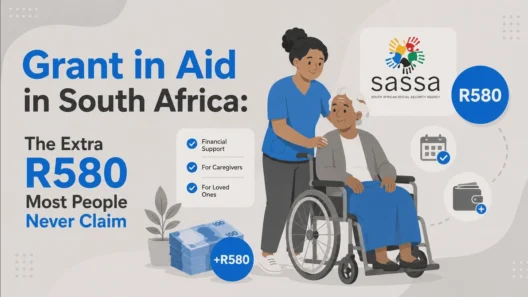
The Grant in Aid. It is an extra R580 paid on top of an Older Persons, Disability or War Veterans grant when you need full time care from another person. Because you have already passed a means test to hold the underlying grant, SASSA does not run a second one.
How we worked this out
Income thresholds and grant values on this page are taken from the 2026 Budget Review published by National Treasury, statements from Parliament and the Department of Social Development, and the SASSA means test explainer issued in April 2026. Where secondary reporting conflicted with government publications, the government figures were used.
Frequently asked questions
Can I work part time and still receive a SASSA grant? Yes, provided your total income stays under the limit for your grant. Casual and informal earnings count towards it.
Does my spouse’s salary really count if I earn nothing? Yes, and it is the single most common reason a means test is failed. Both incomes are combined regardless of the marriage regime.
Does the grant my spouse receives count as income? No. An existing SASSA grant held by your spouse is excluded.
If I earn R9 000 a month, do I get the full R2 400? No. You would pass the means test, but the Older Persons Grant is paid on a sliding scale, so your payment would be well below the maximum.
Do these limits change? Yes, usually on 1 April and sometimes again on 1 October, in line with the Budget. The figures here took effect on 1 April 2026.
This page is a guide. SASSA makes the final assessment on every application. Figures reflect the thresholds effective 1 April 2026 and may be adjusted on 1 October 2026.