



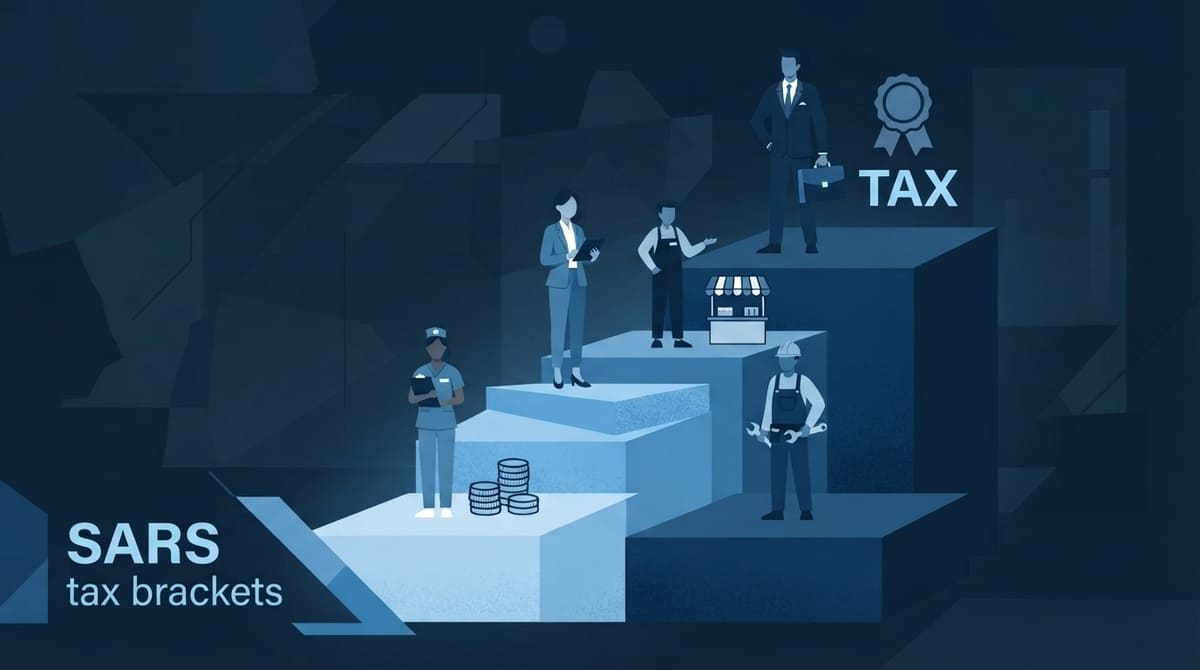
South Africa has seven income tax brackets for the 2026/2027 tax year, starting at 18% on taxable income up to R245 100 and rising to 45% on income above R1 878 600. If you are under 65, you pay no income tax at all on taxable income below R99 000 a year, thanks to the primary rebate of R17 820.
These figures come directly from the SARS Rates of Tax for Individuals page and apply to the 2027 tax year, which runs from 1 March 2026 to 28 February 2027. They were announced in the Budget Speech on 25 February 2026 and reflect a 3.4% inflationary adjustment, the first increase to the brackets since the 2024 tax year.
Quick Facts: SARS Tax Brackets 2026/2027
| Item | 2026/2027 figure |
|---|---|
| Number of brackets | 7 |
| Lowest rate | 18% (income up to R245 100) |
| Highest rate | 45% (income above R1 878 601) |
| Primary rebate (all taxpayers) | R17 820 |
| Tax threshold (under 65) | R99 000 |
| Tax threshold (65 to 74) | R153 250 |
| Tax threshold (75 and older) | R171 300 |
| Tax year | 1 March 2026 to 28 February 2027 |
| Source | SARS, updated 17 March 2026 |
The Full SARS Tax Table for 2026/2027
This is the official individuals’ tax table published by SARS for the 2027 tax year.
| Taxable income (R) | Rates of tax (R) |
|---|---|
| 1 to 245 100 | 18% of taxable income |
| 245 101 to 383 100 | 44 118 + 26% of taxable income above 245 100 |
| 383 101 to 530 200 | 79 998 + 31% of taxable income above 383 100 |
| 530 201 to 695 800 | 125 599 + 36% of taxable income above 530 200 |
| 695 801 to 887 000 | 185 215 + 39% of taxable income above 695 800 |
| 887 001 to 1 878 600 | 259 783 + 41% of taxable income above 887 000 |
| 1 878 601 and above | 666 339 + 45% of taxable income above 1 878 600 |
Source: SARS Rates of Tax for Individuals, 25 February 2026.
How the Brackets Actually Work
South Africa uses a progressive, marginal tax system. That means you never pay your top rate on your whole salary. Your income is taxed in layers.
If your taxable income is R400 000, you do not pay 31% on all of it. You pay:
- 18% on the first R245 100
- 26% on the portion from R245 101 to R383 100
- 31% only on the R16 900 that sits above R383 100
The “Rates of tax” column in the table does this maths for you. The fixed amount at the start of each row (for example, R79 998 in the third bracket) is the total tax already owed on all the lower layers.
Worked Example: R400 000 a Year, Under 65
- Find the bracket: R400 000 falls in the R383 101 to R530 200 row.
- Apply the formula: R79 998 + 31% of (R400 000 minus R383 100) = R79 998 + R5 239 = R85 237.
- Subtract the primary rebate: R85 237 minus R17 820 = R67 417 for the year.
- Divide by 12 for the monthly PAYE equivalent: roughly R5 618 a month, before medical tax credits or retirement deductions.
Your effective rate on R400 000 is about 16.9%, well below the 31% marginal rate. This is the single most misunderstood part of the tax tables.
To see your own figure, including UIF and retirement deductions, use our take-home pay calculator, which is built on these exact SARS 2026/2027 brackets.
Tax Rebates for 2026/2027
A rebate is a flat amount subtracted from your calculated tax, not from your income. Everyone gets the primary rebate. Older taxpayers get additional rebates on top of it.
| Rebate | 2026/2027 amount |
|---|---|
| Primary (all individuals) | R17 820 |
| Secondary (65 and older, added to primary) | R9 765 |
| Tertiary (75 and older, added to both) | R3 249 |
A 70-year-old therefore gets R27 585 in total rebates (R17 820 + R9 765), and a 76-year-old gets R30 834.
Tax Thresholds: How Much Must You Earn to Pay Tax?
The threshold is the income level below which the rebates cancel out your tax completely.
| Age | You pay no tax below |
|---|---|
| Under 65 | R99 000 a year (about R8 250 a month) |
| 65 to 74 | R153 250 a year |
| 75 and older | R171 300 a year |
If you earn below the threshold for your age, no income tax is payable. Note that your employer may still deduct UIF, which is a separate contribution and not income tax.
What Changed From the 2025/2026 Tax Year
The 2026 tax year (1 March 2025 to 28 February 2026) carried no adjustments, and neither did the year before it. Budget 2026 finally moved the tables by 3.4%:
- The first bracket ceiling rose from R237 100 to R245 100.
- The top bracket entry point rose from R1 817 000 to R1 878 600.
- The primary rebate rose from R17 235 to R17 820.
- The under-65 threshold rose from R95 750 to R99 000.
Because salaries generally rose faster than 3.4% in 2026, many taxpayers still experience some bracket creep: a raise pushes more of your income into a higher band even though your buying power barely moved. The adjustment softens this but does not remove it.
When Do the New Brackets Apply?
The 2026/2027 table applies to all income earned from 1 March 2026 onwards. If you are employed, your employer should have used the new brackets for PAYE from your March 2026 payslip. If your PAYE still looks like it is running on the old table, query it with your payroll department, because over-deducted PAYE is only refunded after you file your return.
FAQ
What are the SARS tax brackets for 2026/2027? There are seven brackets: 18% up to R245 100, 26% to R383 100, 31% to R530 200, 36% to R695 800, 39% to R887 000, 41% to R1 878 600, and 45% above that. Rebates then reduce the calculated tax.
How much must I earn before I pay tax in South Africa? If you are under 65, you pay no income tax on taxable income below R99 000 a year for the 2026/2027 tax year. The threshold is R153 250 if you are 65 to 74, and R171 300 if you are 75 or older.
Is the 2026/2027 tax year the same as the 2027 tax year? Yes. SARS names each year of assessment by its end year, so the 2027 tax year is the period from 1 March 2026 to 28 February 2027. Most people call it 2026/2027.
Do I pay my bracket’s rate on my whole salary? No. The rate for your bracket only applies to the portion of income inside that band. Everything below it is taxed at the lower rates, which is why your effective rate is always lower than your marginal rate.
Where do these figures come from? All tables on this page are taken from the SARS Rates of Tax for Individuals page, published on 25 February 2026 and last updated by SARS on 17 March 2026.
Sources: SARS Rates of Tax for Individuals (sars.gov.za/tax-rates/income-tax/rates-of-tax-for-individuals), National Treasury Budget 2026.
Disclaimer: This article is for general information only and explains the published SARS tax tables. It is not tax, financial, or legal advice, and it does not account for your personal deductions, credits, or circumstances. Always verify current figures on the official SARS website and consult a registered tax practitioner for advice on your own affairs.