



Search for the section 189 process and you will find checklists, playbooks and compliance guides, all of them written for employers. Very little is written for the person whose job is on the list.
This page is for you.
Retrenchment is a dismissal. The fact that a cheque comes with it does not make it fair, and an unfair one can be challenged no matter how large the package. Section 189 of the Labour Relations Act sets out what your employer must actually do. Most of what it requires is a genuine conversation, and a great many employers skip it.
Retrenchment is a no fault dismissal
Misconduct and incapacity dismissals start with you. You did something, or you could not do something.
Retrenchment starts with the employer. It is based on operational requirements, which the LRA defines as economic, technological, structural or similar needs of the business. You have done nothing wrong.
That distinction places the burden squarely on your employer. It must show both that the reason is genuine, and that the process was fair.
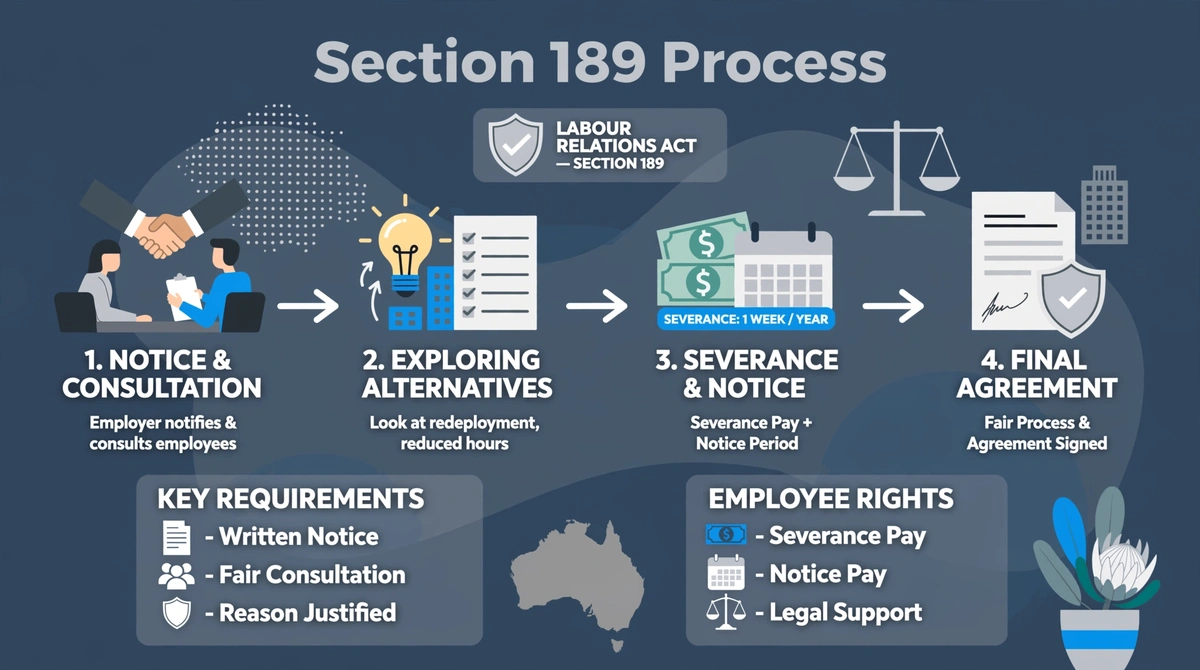
Step one: the section 189(3) notice
Your employer must issue a written notice inviting you, or your union, to consult. This is the formal start of the process and the Labour Court has called the requirement to issue it peremptory.
The notice must disclose, in writing, all relevant information, including:
- (a) the reasons for the proposed dismissals
- (b) the alternatives the employer considered, and why it rejected each of them
- (c) the number of employees likely to be affected, and their job categories
- (d) the proposed method for selecting who goes
- (e) when the dismissals are likely to take effect
- (f) the severance pay proposed
- (g) any assistance the employer is offering
- (h) the possibility of future re-employment
- (i) the number of employees the employer employs
- (j) the number it has already retrenched in the preceding 12 months
Read that list against whatever letter you were handed. If half of it is missing, say so in writing, at the first consultation.
Note item (b) in particular. It is not enough for your employer to say alternatives were considered. It must say which ones, and why each was rejected. That is where most notices are thin, and it is the most productive thing to push on.
One caveat, honestly stated. In one case the Labour Court accepted that an employer had substantially complied with section 189 despite never issuing the written notice, because the union was fully informed and never asked for it. But the Court went out of its way to say this was not a precedent. The prevailing position remains that the notice is mandatory. If you did not get one, that is a real problem for your employer, not for you.
Step two: consultation must be genuine
The Act requires a meaningful joint consensus seeking process. Not an announcement. Not a briefing. Not a tick box exercise.
You and your employer must genuinely attempt to reach consensus on:
- Measures to avoid the dismissals altogether
- Measures to minimise the number of dismissals
- Measures to change the timing
- Measures to mitigate the adverse effects
- The method of selecting who goes
- The severance pay
This is the heart of it. Come with alternatives: reduced hours, a pay cut across the team, redeployment, unpaid leave, deferred bonuses, a vacancy elsewhere in the business, voluntary packages. Put them in writing. Your employer must engage with them properly and give reasons for rejecting them.
A checklist approach is not consultation. In one recent case, an employer went through the motions without genuinely engaging on alternatives or selection criteria, rejected the employee’s proposals out of hand, and treated his legitimate questions as obstruction. The Labour Court found the dismissal both procedurally and substantively unfair, and awarded him eight months’ remuneration. Three months for the flawed process, five for the flawed reason.
That is what a badly run section 189 is worth. It is worth participating properly.
Step three: selection criteria
Your employer must select using criteria that are either:
- Agreed between the consulting parties, or
- If not agreed, criteria that are fair and objective
LIFO, or last in first out, is the classic. It is commonly used but it is not the only lawful criterion and it is not compulsory. Skills, qualifications, disciplinary record and attendance can all be fair and objective.
What is not fair and objective is anything that dresses up a decision the employer had already made about a particular person. If the criteria appear to have been reverse engineered so that exactly one name falls out, say so during consultation and put it on the record.
Selection is one of the things you are entitled to consult on. It is not something your employer simply announces.
Large scale retrenchments: section 189A
If your employer is bigger and the cuts are deeper, extra protection kicks in.
Section 189A applies where the employer employs more than 50 people and intends to dismiss at least:
| Employees at the business | Retrenchments that trigger 189A |
|---|---|
| Up to 200 | 10 |
| 201 to 300 | 20 |
| 301 to 400 | 30 |
| 401 to 500 | 40 |
| More than 500 | 50 |
Where it applies:
A 60 day period must pass from the section 189(3) notice before your employer may issue any notice of termination. If you were handed a termination letter inside 60 days of a large scale 189(3) notice, something has gone wrong.
A CCMA facilitator can be appointed to chair the consultation. The employer can request one in its 189(3) notice, and so can consulting parties representing the majority of the affected employees. A facilitator changes the dynamic considerably, and unions request them for good reason.
You get a choice of weapon. In a large scale retrenchment, employees may either strike over the retrenchment or take the dispute to the Labour Court. That option does not exist in a small scale retrenchment, and it is the single biggest reason employers dislike section 189A.
What you should actually do
- Do not resign. Resigning during a consultation forfeits your severance, your UIF and your right to challenge anything. See retrenchment vs resignation.
- Do not sign anything on the day. Especially not a mutual separation agreement, which waives your claims and can cost you your UIF.
- Check the 189(3) notice against the list above. Ask in writing for anything missing.
- Propose alternatives in writing. Force your employer to reject them in writing, with reasons.
- Interrogate the selection criteria. Ask how they were arrived at and how they were applied to you.
- Check the numbers. Run the offer through our retrenchment package calculator and confirm the severance was built on total remuneration, not basic salary. See severance pay.
- Check your notice and leave. Your employer may not absorb accrued leave into your notice period. See notice pay on retrenchment.
- Claim your UIF. Start with how to claim UIF and check your UI-19 form.
- Get advice if the process looks thin. A union or a labour lawyer, early.
If the process was unfair
You have 30 days from the date of dismissal to refer an unfair dismissal dispute. Do not sit on it.
For a small scale retrenchment, the dispute goes to the CCMA or your bargaining council for conciliation, and then to the Labour Court. For a large scale one, section 189A gives you the strike or Labour Court election described above.
Remember what unfairness can look like. It is not only “they had no good reason.” A perfectly sound business reason, run through a sham consultation, is still an unfair dismissal, and the Labour Court has awarded months of remuneration for exactly that.
Frequently asked questions
What is the section 189 process? The procedure in the Labour Relations Act that an employer must follow before dismissing employees for operational requirements. It requires a written 189(3) notice, a meaningful joint consensus seeking consultation, and fair and objective selection criteria.
How long does a section 189 process take? There is no fixed period for a small scale retrenchment, beyond the requirement that consultation be meaningful. For a large scale retrenchment under section 189A, 60 days must pass from the 189(3) notice before notice of termination can be given.
Can I refuse to be retrenched? You cannot veto it, but you can consult on it, propose alternatives, challenge the selection criteria, and take an unfair dismissal dispute to the CCMA or Labour Court afterwards.
What must be in a section 189(3) notice? Ten categories of information, from the reasons for the dismissals through to the number of employees retrenched in the previous 12 months. The alternatives considered, and the reasons each was rejected, must be set out in writing.
Is a retrenchment unfair if consultation was a formality? It can be. The Labour Court has found dismissals unfair where the employer ran a checklist exercise instead of genuinely engaging, and has awarded substantial compensation for it.
Do I still get severance if I challenge the retrenchment? Yes. Your severance entitlement under section 41 of the BCEA is separate from any unfair dismissal claim.
Sources
- CCMA, Retrenchment in terms of section 189A of the LRA
- CCMA, Facilitations in terms of section 189
This is general information, not legal advice. If you are in a consultation process and the numbers or the procedure look wrong, speak to your union or a labour lawyer while the process is still running, not after it ends.