



The lunch break law in South Africa is section 14 of the Basic Conditions of Employment Act, and it is shorter than you would think.
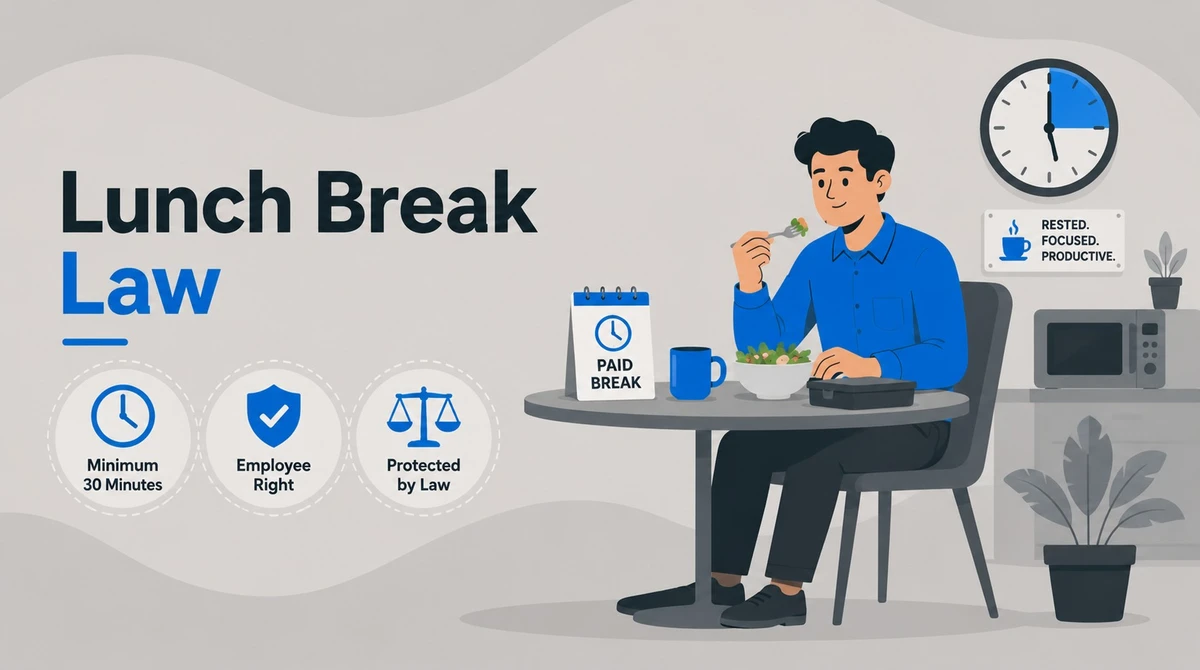
After five continuous hours of work, you are entitled to a meal interval of at least one continuous hour.
That is the rule. Everything else is an exception to it.
The three things the Act actually says
One continuous hour. Not two half hours. Not four fifteen minute breaks bundled together. A continuous interval.
After five hours. Your employer cannot make you work six or seven straight hours and then give you lunch. The break falls due at the five hour mark. And for this purpose, work counts as continuous unless it is broken by an interval of at least 60 minutes.
It is unpaid, unless you work through it. A meal interval is your own time. But if your employer requires you to work during it, or requires you to be available for work during it, then your employer must pay you for it.
That last point is the one that matters most, and we will come back to it.
The two ways it can be changed
Both require a written agreement. Not a verbal instruction, not a notice on the wall.
It can be reduced to 30 minutes. By written agreement, the hour can become half an hour.
It can be dispensed with entirely, but only if you work fewer than six hours a day. By written agreement, someone on a short shift can skip the meal interval and go home an hour earlier.
If your employer has cut your lunch to half an hour and there is no written agreement, that is a contravention. Ask to see the agreement.
Working through lunch
This is where employees lose money without noticing.
If you are required to work during your meal interval, or required to be available for work during it, you must be paid for that time.
Being available is the key phrase. The retail assistant who eats lunch behind the till and serves anyone who walks up is not on a meal interval. She is at work, and she must be paid. The same goes for the receptionist who has to answer the phone at her desk, the security guard who eats at his post, and the nurse who must remain contactable on the ward.
A meal interval you are not free to leave is not a meal interval. It is working time.
If this describes your job, work out what you are owed with the overtime and premium pay calculator, because those hours may push you into overtime as well.
Tea breaks are not a legal right
This surprises people. The BCEA does not regulate tea breaks or smoke breaks at all.
There is no statutory right to a mid morning fifteen minutes. If your employer gives you one, it is a matter of contract, policy or custom, not law. And if your employer withdraws it, you have no BCEA complaint, though a long standing practice may have become a term of your employment by custom.
Meal intervals are regulated. Everything shorter is not.
Your rest periods, which are separate
Section 15 is the other half of this, and it gives you two things:
- A daily rest period of 12 consecutive hours between ending one shift and starting the next
- A weekly rest period of 36 consecutive hours, which must include a Sunday unless otherwise agreed
The daily one is the one to watch. If you finish at 22:00 and are rostered back at 06:00, that is eight hours, and it is a contravention.
Both can be varied by agreement within limits, and the weekly rest period can be extended to 60 consecutive hours every two weeks by agreement.
The earnings threshold takes all of this away
Sections 14 and 15 do not apply to employees earning above the earnings threshold, which from 1 May 2026 is R269 600.90 a year, or R22 466.74 a month.
Above that line you have no statutory right to a lunch break, and no statutory right to a rest period between shifts. Your employer may require any reasonable hours needed to do the job.
That is a startling thing to discover at R23 000 a month, but it is the law, and it is exactly why the threshold matters more than any other number in South African employment law. See our guide to the overtime rate for the full list of what falls away.
Your contract may of course still give you a lunch break, and if it does, it is enforceable.
If your employer will not comply
Being denied a meal interval, or being made to work through one unpaid, is a contravention of the BCEA.
- Raise it in writing, citing section 14 and the dates.
- Complain to the Department of Employment and Labour. An inspector can investigate and issue a compliance order. This is a good route for a working conditions contravention, as opposed to a pure money claim.
- Refer a monetary claim to the CCMA under section 73A for the unpaid time itself.
Frequently asked questions
How long is a lunch break by law in South Africa? At least one continuous hour after five continuous hours of work, under section 14 of the BCEA. It can be reduced to 30 minutes by written agreement.
Do I have to be paid for my lunch break? Not normally. But you must be paid if your employer requires you to work during it, or requires you to be available for work during it.
Can my employer make me work through lunch? Only if you are paid for that time. A meal interval during which you must remain available is working time.
Am I entitled to a tea break? Not by law. The BCEA regulates meal intervals only. Tea and smoke breaks are a matter of contract, policy or custom.
Can my lunch break be split into two shorter breaks? No. The Act requires a continuous interval.
Do I get a lunch break if I earn a high salary? Not as of right. Section 14 does not apply above the earnings threshold of R269 600.90 a year. Your contract may still provide one.
How much rest do I get between shifts? Twelve consecutive hours daily, and 36 consecutive hours weekly which must include a Sunday, unless otherwise agreed.
Sources
- Department of Employment and Labour, Basic Conditions of Employment Act 75 of 1997
This is general information, not legal advice.