



You have been told a restructure is coming. You can see where it is going. A recruiter has been in touch and part of you would rather leave on your own terms than sit through a consultation process with your name on a list.
Before you write that letter, understand what resigning costs you. In most cases it is a great deal of money.
The short answer
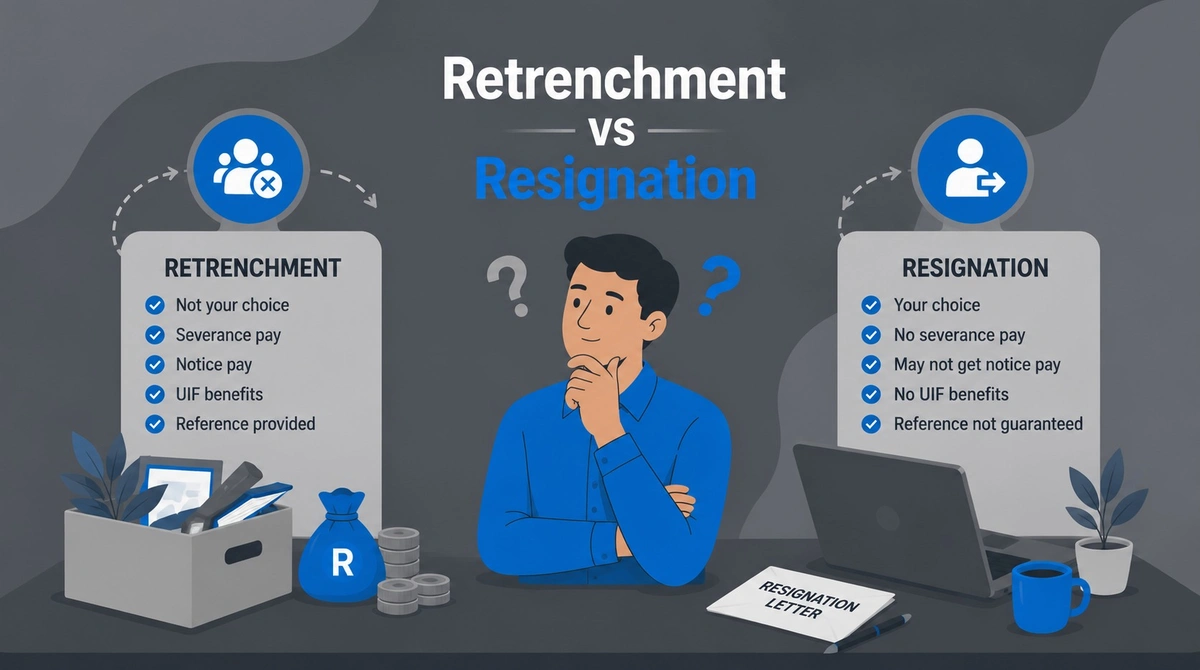
| Retrenched | Resigned | |
|---|---|---|
| Severance pay | Yes, minimum one week per completed year | None |
| UIF unemployment benefit | Yes | Generally no |
| Tax break on the lump sum | First R550 000 at 0 percent | None |
| Notice pay | Yes, or you work it | You give notice |
| Leave payout | Yes | Yes |
| Unfair dismissal claim | Available at the CCMA | None |
Leave payout is the only line that survives a resignation intact. Everything else is either reduced or gone.
You lose your severance pay
Severance under section 41 of the Basic Conditions of Employment Act is payable on dismissal for operational requirements. A resignation is not a dismissal. There is no statutory severance, and your employer has no obligation to pay you a cent beyond your leave.
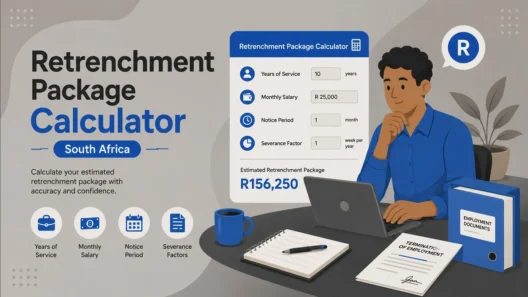
On ten years of service and a R30 000 package, that is roughly R69 231 you have handed back. Run your own number through the retrenchment package calculator before you decide.
You probably lose your UIF
This is the one that hurts most, and the one people discover too late.
You generally cannot claim UIF unemployment benefits if you resigned voluntarily. The fund exists to cover involuntary loss of income. Retrenchment qualifies. Walking out does not.
The reason for termination is recorded by your employer on the UI-19 form. If that form says you resigned, your claim will be refused, and reversing it means proving the true reason after the fact. See how to claim UIF, the UI-19 form and UIF claim rejected for what that fight looks like.
You lose the tax break
A qualifying severance benefit is taxed on the SARS lump sum table, where the first R550 000 is taxed at 0 percent. That concession applies to lump sums paid because the employer is ceasing operations or reducing staff.
A payment made because you resigned does not qualify. If your employer hands you a goodwill amount on your way out, it is taxed as ordinary income at your marginal rate, which can be 45 percent at the top end.
So the same R400 000 can reach you tax free as severance, or reach you as roughly R220 000 after tax as a resignation gratuity. The label on the payment is worth more than most people’s annual bonus.
You lose your recourse
Retrenchment is a dismissal, and an unfair one can be challenged at the CCMA. If your employer skipped consultation, used arbitrary selection criteria, or targeted you for reasons that had nothing to do with operational requirements, you have somewhere to take that.
Resign and you have waived it. You cannot be unfairly dismissed from a job you left.
The one case where resigning can make sense
If you have a firm written offer in hand, starting soon, at materially better pay, then the calculation changes. A new salary starting next month is usually worth more than a severance package plus months of job hunting.
Even then, do the arithmetic rather than the vibe:
- What is your severance actually worth, after tax? Often more than people assume, because the first R550 000 is untaxed.
- How long is the gap before the new job starts? UIF might have covered it.
- Is the new offer signed, or is it a conversation? Never resign on a conversation.
If the numbers are close, the retrenchment usually wins, because it also carries the UIF safety net if the new job falls through.
What to do instead of resigning
Ask to be considered for retrenchment. If a voluntary severance package is being offered as part of a genuine restructure, taking it is very different from resigning. A voluntary severance package concluded inside a real retrenchment process can still qualify for the severance tax table, because the underlying reason for the termination is the employer’s operational requirements.
Do not accept a mutual separation agreement without understanding it. It is not the same thing as a voluntary retrenchment, and it can quietly strip your UIF eligibility. Read mutual separation agreement before you sign anything.
Participate in the consultation. The section 189 process is where selection criteria and severance rates get argued over. Walking out of it is the one move that guarantees you get nothing.
What about constructive dismissal?
If your employer has made your working life intolerable in order to push you out, resigning may amount to a constructive dismissal, which is treated as a dismissal and can be taken to the CCMA.
That bar is high. It is not enough that your manager is unpleasant, that you were passed over, or that a restructure has made your role uncomfortable. You must show the employer made continued employment genuinely intolerable and that resigning was your only reasonable option.
Constructive dismissal cases are difficult to win and they are not a workaround for wanting to leave. Get advice before you rely on it.
Frequently asked questions
Can I claim UIF if I resign? Generally no. UIF unemployment benefits are for involuntary loss of income. Resignation is voluntary, and your employer will record it as such on the UI-19.
Do I get severance pay if I resign? No. Statutory severance under section 41 of the BCEA applies to dismissal for operational requirements, not to resignation.
Is it better to resign or be retrenched? Financially, retrenchment is almost always better. You keep your severance, your UIF eligibility, the R550 000 tax free band and your right to challenge an unfair process. Resignation makes sense mainly when you have a firm, better offer starting soon.
Can I resign during a retrenchment consultation? You can, but you will usually forfeit your severance and your UIF by doing so. If you want out early, ask whether a voluntary severance package is available instead.
Will resigning look better on my CV than being retrenched? Retrenchment is a business decision, not a performance one, and employers in South Africa understand that. It carries little stigma. Do not pay tens of thousands of rands to avoid an awkward interview question.
Sources
- SARS, Tax and Retrenchment
- CCMA, Facilitations in terms of section 189
This is general information, not legal or tax advice. If you are weighing up a resignation during a restructure, speak to a labour lawyer or your union first.