



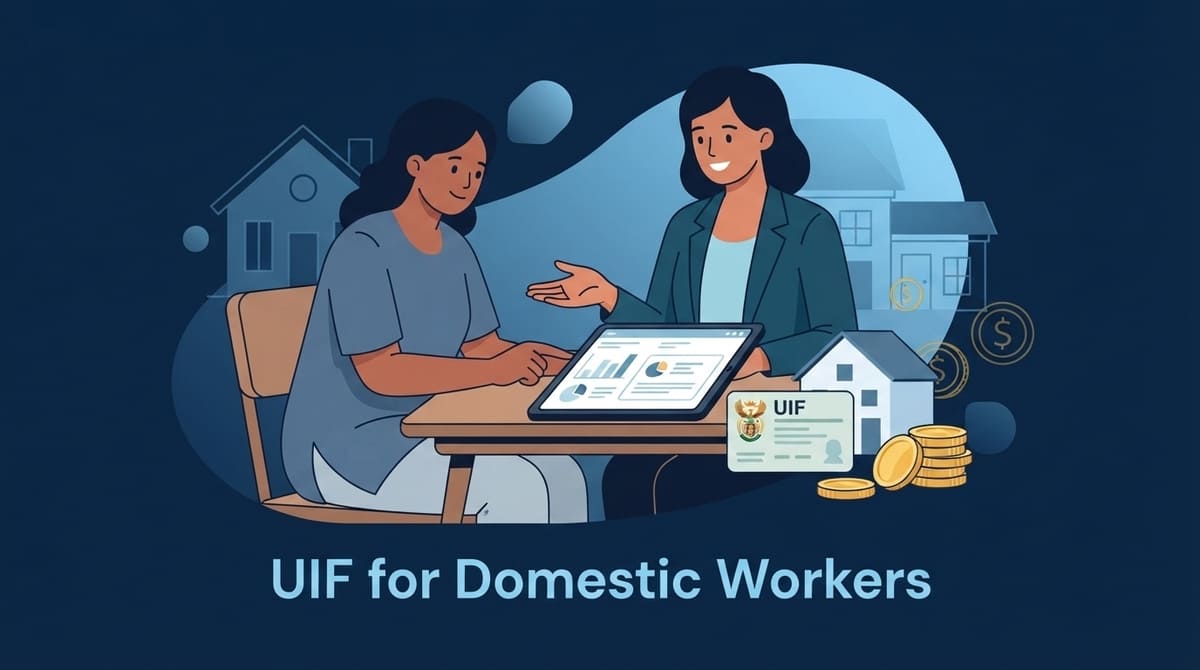
Any domestic worker who works for you for more than 24 hours a month must be registered with the Unemployment Insurance Fund. You register as a household employer using the UI-8D form and declare the worker on a UI-19, then pay a monthly contribution of 2% of their wage, split equally: 1% deducted from the worker and 1% paid by you as the employer.
This applies to cleaners, nannies, gardeners, drivers, au pairs and caregivers working in a private household. It protects the worker with unemployment, maternity, illness, parental and dependants’ benefits, and it protects you from penalties and back-payment liability.
Quick facts: domestic worker UIF
| Question | Answer |
|---|---|
| Who must be registered | Any domestic worker doing more than 24 hours a month for one employer |
| Registration forms | UI-8D (employer) and UI-19 (employee declaration) |
| Contribution | 2% of gross wage: 1% employee, 1% employer |
| Contribution ceiling | Capped on earnings of R17 712 per month (max R177.12 + R177.12) |
| Monthly deadline | Declarations and payment by the 7th of the following month |
| Registration channels | uFiling online, email, telephonically on 012 337 1680, or any Labour Centre |
| Cost to register | Free |
Who counts as a domestic worker for UIF
The 24-hour threshold is measured per month across all the worker’s time with you, not per visit. A cleaner who comes two full days a week comfortably exceeds 24 hours a month, so registration is compulsory. A worker who genuinely works fewer than 24 hours a month for you falls outside the Acts, but if hours fluctuate near that line, keep careful records rather than assuming the exemption applies.
A domestic worker with more than one employer is registered by each employer separately. If she loses one of those jobs, she can claim a partial benefit for the lost income while keeping the other job, which is a protection unique to multi-employer domestic work.
How much the contributions cost
The total contribution is 2% of the worker’s gross remuneration each month. You may only deduct 1% from the worker’s wage. The other 1% is your own cost as the employer, and the deduction must show on the worker’s payslip.
Worked examples at common wage levels:
- Wage of R3 500 per month: R70 total, R35 deducted from the worker and R35 from you
- Wage of R5 000 per month: R100 total, R50 and R50
- Wage of R6 000 per month: R120 total, R60 and R60
Contributions are capped at the insurable earnings ceiling of R17 712 per month, so the maximum possible contribution is R177.12 from each side. Almost all domestic wages fall below the ceiling.
Remember that the wage itself has a legal floor. The national minimum wage, which fully covers domestic workers, is R30.23 per hour from 1 March 2026. See our full guide to the domestic worker minimum wage for what that means per day and per month.
How to register a domestic worker for UIF: 4 steps
- Gather the details. Your ID number, address and contact details, plus the worker’s 13-digit ID (or valid passport and work permit), start date, agreed wage and weekly working hours.
- Register yourself as an employer. The quickest route is the uFiling portal, which handles domestic employer registration, declarations and payments online. Alternatively complete the UI-8D employer registration form and the UI-19 employee declaration and submit them by email to the fund’s domestics address, telephonically on 012 337 1680, or at your nearest Labour Centre, as set out on the official government guidance. You will receive a UIF employer reference number.
- Declare the worker. Add the worker’s details and wage on uFiling or on the UI-19 form. This starts the contribution history that any future claim is assessed against.
- Declare and pay every month. Monthly returns and the 2% payment are due by the 7th of the following month. Registration alone is not compliance. A registered worker with no contribution history still cannot claim.
What a registered domestic worker can claim
A domestic worker with contributions on record claims exactly like any other employee, through the current benefit channels described in our guide on how to claim UIF. The benefits include:
- Unemployment, when the job ends through retrenchment, dismissal or contract expiry, and including the death of the domestic employer, which has its own termination code on the UI-19
- Maternity, for up to 17.32 weeks, claimable while still employed
- Illness, when the worker cannot work on medical grounds
- Parental and adoption benefits
- Dependants’ benefits, paid to the family if the worker passes away
The payout is a sliding-scale percentage of the declared wage. To see what a claim would pay on any given salary and contribution period, use our UIF calculator.
What happens if you never registered
Non-compliance carries real consequences. The Department of Employment and Labour inspects domestic employment and can impose penalties, and a worker who was never registered can pursue the unpaid contributions and lost benefits, including through the CCMA. In practice, an unregistered worker’s claim fails at the first hurdle, and the liability for what she would have received can land on the employer, together with arrear contributions.
If you are behind, the practical fix is to register now, declare the true employment start date, and settle the arrear contributions with the fund rather than waiting for a claim or an inspection to force the issue.
FAQ
Is UIF compulsory for a part-time domestic worker?
Yes, if the worker does more than 24 hours a month for you in total. The threshold is monthly hours across all visits, not hours per day or per visit, so even two days a week triggers the duty.
Can I deduct the full 2% from my domestic worker’s wage?
No. You may deduct only 1% from the wage. The other 1% is the employer’s own contribution, and deducting the full 2% from the worker is unlawful.
Can a domestic worker claim UIF if she resigns?
Generally no, resignation does not qualify for the unemployment benefit. She can still claim maternity, illness, parental and adoption benefits while contributions are on record, and dependants can claim if she passes away.
What is the UI-8D form?
The UI-8D is the registration form a private household uses to register as a domestic employer with the UIF. It works together with the UI-19, which declares the worker’s details and wage.
Does UIF registration also cover injuries at work?
No. UIF covers unemployment-type benefits. Injuries and occupational diseases fall under COIDA, the Compensation Fund, which requires its own registration by the employer.
What is the minimum wage for a domestic worker in 2026?
The national minimum wage of R30.23 per hour applies in full to domestic workers from 1 March 2026. UIF contributions are then calculated on the actual gross wage you pay.
Methodology and sources: This guide is based on the South African Government’s domestic worker UIF guidance (gov.za), the Department of Employment and Labour’s uFiling portal and UIF forms, SARS UIF contribution guidance including the R17 712 insurable earnings ceiling, and the Unemployment Insurance Act and Unemployment Insurance Contributions Act.
Disclaimer: This article is general information, not legal, tax or payroll advice. Contribution rules, thresholds and registration channels can change. Confirm the latest requirements with the Department of Employment and Labour before acting.