



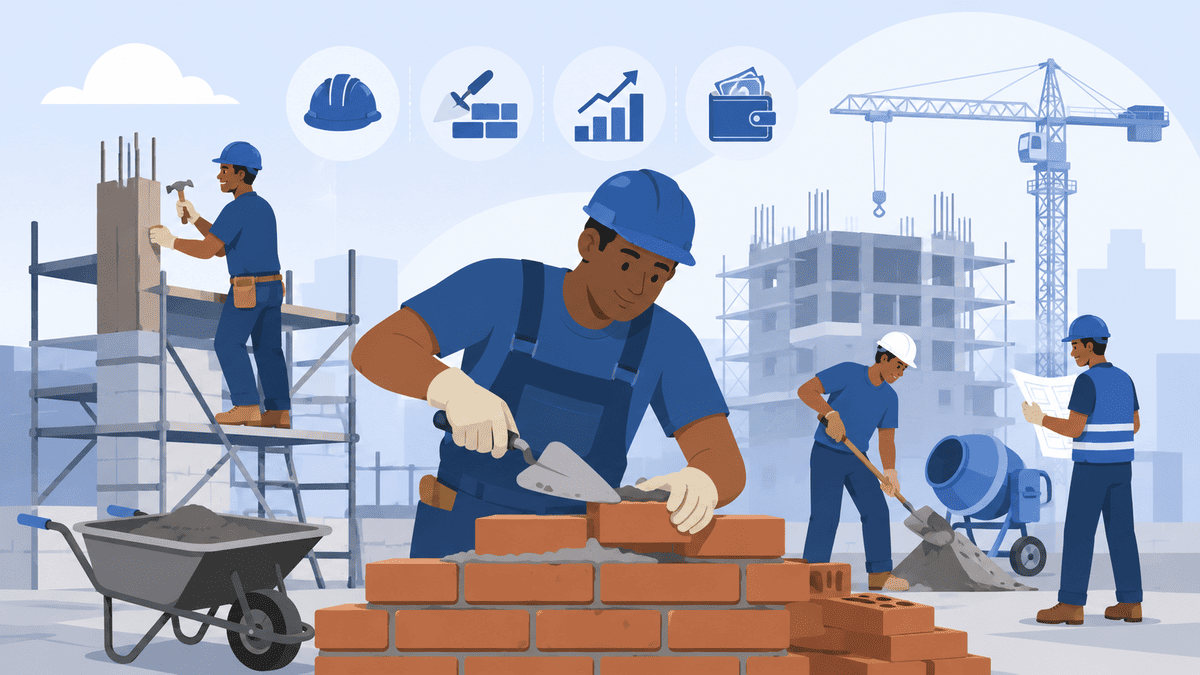
A bricklayer in South Africa earns roughly R8 000 to R29 000 per month in 2026, depending on skill and experience. Entry-level bricklayers earn about R8 000 to R13 000, experienced bricklayers R13 000 to R20 000, and senior or specialist artisans R20 000 to R29 000 and more. General construction workers and labourers earn a bit less, from about R7 900 to R19 000 a month. The national minimum wage of R30.23 per hour is the legal floor for all of them.
Quick facts: bricklayer and construction pay
| Role | Monthly salary (estimate) |
|---|---|
| Entry-level bricklayer | R8 000 to R13 000 |
| Experienced bricklayer | R13 000 to R20 000 |
| Senior / specialist bricklayer | R20 000 to R29 000+ |
| General construction worker | R7 900 to R19 000 |
| Minimum wage floor | R30.23 per hour |
How much does a bricklayer earn per month in 2026?
A bricklayer’s pay depends on skill, employer and the type of project. The typical range is R8 000 to R29 000 per month, with an average often reported around R15 500. Bricklayers who work quickly while keeping neat, level, accurate brickwork are valuable on site and earn at the higher end. Commercial, civil and specialised masonry work generally pays more than small residential jobs.
Bricklayer salary per day
Many bricklayers are paid a daily rate rather than a fixed monthly salary, especially on smaller sites. Based on typical hourly pay of about R35 to R45 an hour, a bricklayer’s day rate works out to roughly R280 to R360 for an eight-hour day at entry level, and more for skilled and specialist bricklayers. Always confirm whether a day rate includes travel or is for site hours only.
General construction worker and labourer pay
General building and construction labourers earn about R7 900 to R19 000 per month, below the bricklayer range because bricklaying is a skilled trade. Labourers who build skills and move into a trade such as bricklaying, plastering or tiling can raise their pay meaningfully.
Minimum wage in construction
Construction pay is governed by the national minimum wage of R30.23 per hour (from 1 March 2026). There is no lower separate rate for the sector, so no construction worker may lawfully be paid below the national minimum. See our domestic worker minimum wage guide for how the national minimum wage works.
What lifts a bricklayer’s pay
Pay rises with speed, accuracy and reliability on site, with a recognised trade qualification, and with moving into supervisory or team-leader roles. Specialised masonry, such as refractory or face-brick work, and larger commercial and civil projects pay more than general residential building. Compare related trades in our welder salary guide, and see all jobs in our South African salary guide. Check your net pay with our take-home pay calculator.
How we worked this out
The figures on this page are estimates based on construction salary survey data and industry pay guides for 2026, with the national minimum wage as the legal floor. Bricklayer pay varies by experience, employer, project type and location, so treat these as guide ranges and confirm the figure in the specific vacancy or contract.
Frequently asked questions
How much does a bricklayer earn per month in South Africa in 2026? Roughly R8 000 to R29 000 per month. Entry-level bricklayers earn about R8 000 to R13 000, experienced bricklayers R13 000 to R20 000, and senior or specialist artisans R20 000 and more.
How much does a bricklayer earn per day? Roughly R280 to R360 for an eight-hour day at entry level, based on hourly rates of about R35 to R45, and more for skilled bricklayers.
How much does a general construction worker earn? About R7 900 to R19 000 per month, below the bricklayer range because bricklaying is a skilled trade.
What is the minimum wage for construction workers? The national minimum wage of R30.23 per hour, effective 1 March 2026. No construction worker may lawfully be paid below this.
How do I earn more as a bricklayer? Build speed and accuracy, get a recognised trade qualification, take on specialist masonry, and move into supervisory or team-leader roles