



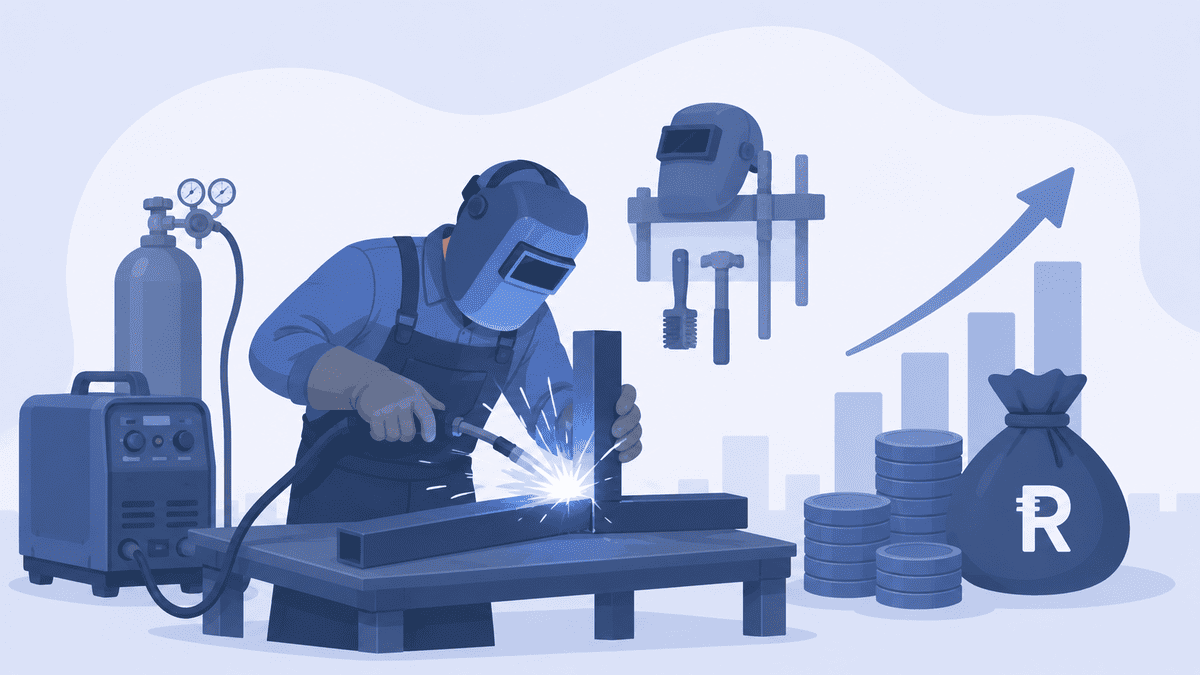
A welder in South Africa earns on average about R12 000 to R15 000 per month in 2026, but pay ranges widely with skill. Semi-skilled welders start around R7 500 a month, while qualified welders earn up to R19 000. Red Seal and coded welders earn far more, from R25 000 to R45 000, and specialised pipe or offshore welders can exceed R80 000 a month. The single biggest pay lever is getting your Red Seal or coded status.
Quick facts: welder salary
| Level | Monthly salary (estimate) |
|---|---|
| Semi-skilled / assistant | R7 500 to R12 000 |
| Qualified welder | R12 000 to R19 000 |
| Red Seal / coded welder | R25 000 to R45 000 |
| Specialised (pipe, offshore) | R80 000+ |
| Boilermaker (average) | About R17 900 |
| Hourly range | About R50 to R100+ |
How much does a welder earn per month in 2026?
The average welder earns roughly R12 000 to R15 000 per month, or about R50 to R100 an hour depending on experience. Entry-level welders with less than a year’s experience earn around R50 an hour, mid-career welders about R65, and experienced welders about R81 or more. The wide range comes down to qualifications, the type of welding and the industry.
To see your pay after deductions, use our take-home pay calculator.
Welder salary by skill level
- Semi-skilled welders and assistants earn about R7 500 to R12 000 a month. This is where most welders start.
- Qualified welders with an N3 and a trade certificate earn about R12 000 to R19 000.
- Red Seal and coded welders earn about R25 000 to R45 000, because certified work is in high demand.
- Specialised welders, such as pipe and offshore welders, can earn R80 000 a month or more.
Boilermaker salary comparison
Boilermakers do closely related work and earn an average of about R17 900 per month, with an hourly benchmark near R100 (ranging from about R40 to R170). As with welding, a large part of a boilermaker’s pay often comes from overtime, shutdown work and shift premiums, so two people on the same base rate can take home very different amounts.
What lifts a welder’s pay
The clearest way to raise your welding pay is certification. A Red Seal or coded (for example Section 26D) qualification can move you from a semi-skilled rate into the R25 000-plus band. Other levers include specialising in high-demand work like pipe or pressure welding, taking on shutdown and heavy-industry contracts, and working in Gauteng or the Western Cape where demand is strongest.
How to become a Red Seal welder
The Southern African Institute of Welding (SAIW) sets welding standards and provides training. The typical path is an N3 plus a welding trade test, but experienced welders can fast-track through the Artisan Recognition of Prior Learning (ARPL) route to a trade test without going back to full-time study. Compare other trades in our bricklayer and construction salary guide and our South African salary guide.
How we worked this out
The figures on this page are estimates based on welding salary survey data, industry pay guides and trade-training sources for 2026. Welder pay varies widely by qualification, welding type, industry and overtime, so treat these as guide ranges and confirm the figure in the specific vacancy or contract.
Frequently asked questions
How much does a welder earn per month in South Africa in 2026? On average about R12 000 to R15 000 per month. Semi-skilled welders start around R7 500, qualified welders earn up to R19 000, and Red Seal or coded welders earn R25 000 to R45 000.
How much does a Red Seal or coded welder earn? About R25 000 to R45 000 per month, and specialised pipe or offshore welders can exceed R80 000. Certification is the biggest pay lever in welding.
What is the hourly rate for a welder? About R50 an hour for entry level, R65 mid-career and R81 or more for experienced welders, with top professionals reaching R100 an hour.
How much does a boilermaker earn compared to a welder? A boilermaker earns an average of about R17 900 a month, often higher than a general welder, with a large part of pay coming from overtime and shutdown work.
How do I earn more as a welder? Get your Red Seal or coded certification, specialise in high-demand work like pipe or pressure welding, and take on shutdown and heavy-industry contracts.