



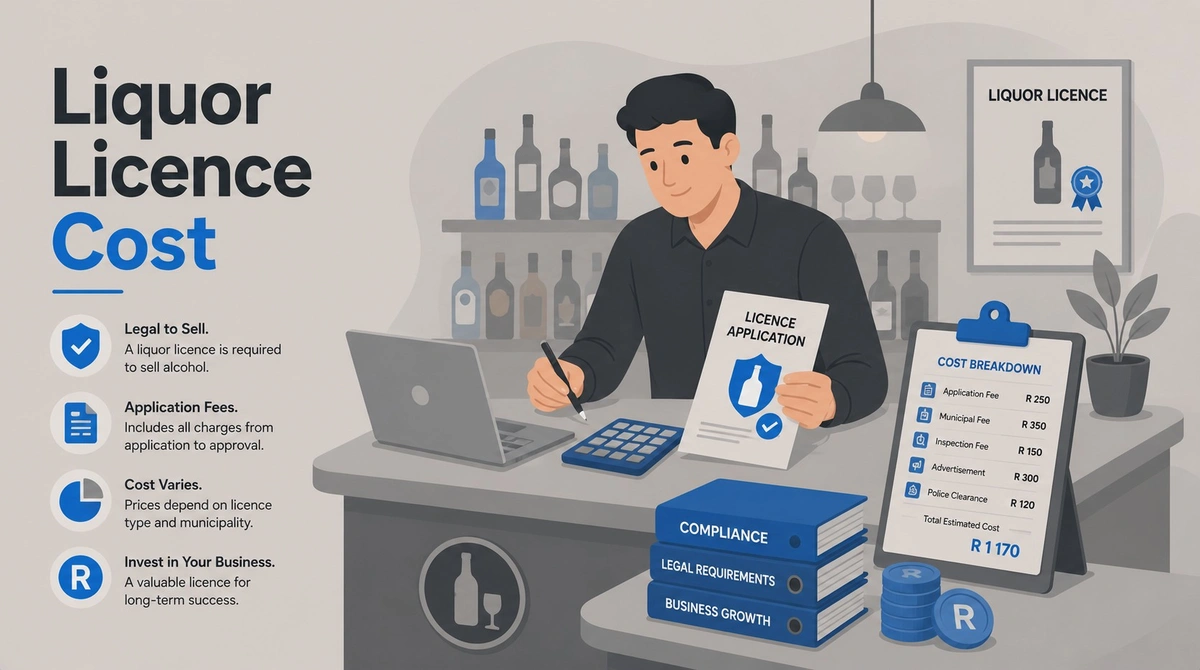
Every page you will find says a liquor licence costs R20 000 to R45 000. That is not the state’s fee. The provincial authority’s application fee is R2 000 to R10 000. The rest, R5 000 to R25 000 of it, is the consultant or attorney who lodges the application for you. Knowing which is which is the whole point.
Quick facts
| Item | 2026 amount | Set by |
|---|---|---|
| Provincial application fee | R2 000 to R10 000 | Provincial liquor authority (gazetted) |
| Granting fee, payable on approval | Separate from the application fee | Provincial liquor authority (gazetted) |
| Annual renewal | R1 000 to R5 000 | Provincial liquor authority (gazetted) |
| National Liquor Authority application | R500 | thedtic (macro manufacture and distribution only) |
| Shebeen manager appointment, Gauteng | R50 per manager, non-refundable | Gauteng Liquor Act regulations |
| Public notice in a newspaper | R500 to R2 500 | Publication (market) |
| Zoning certificate and premises plan | R1 500 to R5 000 | Municipality and draughtsman |
| Professional fees, special event | From R5 000 | Attorney or consultant (market) |
| Professional fees, on or off consumption | From R15 000 | Attorney or consultant (market) |
| Total, commonly quoted | R20 000 to R45 000 | Everything above, bundled |
There is no national price, and there are two systems
This trips up almost everyone.
Retail liquor licences are provincial. A tavern, pub, bottle store, restaurant, hotel or micro-manufacturer applies to the liquor authority or board of its own province. Nine provinces, nine liquor acts, nine gazetted fee schedules. There is no single national fee, and any page that gives you one is guessing.
The Western Cape Liquor Authority publishes its schedule openly, with new licensing fees effective from 1 December 2025. Other provincial authorities gazette theirs. These are published documents. If you want the real number for your province, this is where it lives, and not one page currently ranking for this search points you there.
Manufacture and distribution at scale is national. Macro manufacturers and distributors register with the National Liquor Authority under the Liquor Act 59 of 2003, administered by the dtic. The NLA application fee is R500, paid on lodgement, with the fee relevant to your projected annual turnover. Renewal is annual, on form NLA 28.
If you are opening a bottle store, you are in the provincial system. If you are building a distillery to supply the trade, you may be in both.
What the state actually charges
| Fee | Amount | Note |
|---|---|---|
| Provincial application fee | R2 000 to R10 000 | Varies by licence type and province |
| Granting fee | Separate | Payable only if the application is approved |
| Annual renewal | R1 000 to R5 000 | Rises with each new gazetted schedule |
| National Liquor Authority application | R500 | Macro manufacture or distribution only |
| Shebeen manager appointment, Gauteng | R50 per manager | Plus a police clearance certificate for the proposed manager |
The granting fee catches people. The Western Cape Liquor Authority is explicit that granting fees are payable only on approval of an application, and are communicated formally once granted. So you pay to apply, and you pay again if you succeed. Budget for both.
What the consultants charge
These are market prices, set by each firm.
| Source | What it states |
|---|---|
| SD Law | Professional fees from R5 000 for a special event licence. From R15 000 for on or off consumption. From R15 000 for micro-manufacture. Excluding disbursements. |
| Burger Huyser Attorneys | Professional assistance R5 000 to R25 000. Average total cost R20 000 to R45 000. Public notice R1 000 to R2 500. Renewal R1 000 to R5 000. |
| Leon Slotow Attorneys | Total typically R25 000 to R45 000 |
| Status Check | Application fees R2 000 to R10 000. Publication R500 to R2 000. Zoning certificate and premises plan R1 500 to R5 000. Professional fees R5 000 to R25 000. |
Estimate range based on published figures from five named sources across the Western Cape and Gauteng, surveyed July 2026. Professional fees are market prices, not a published tariff. Every source above is a law firm or consultancy selling the service.
To their credit, SD Law says openly that the neat R20 000 to R45 000 range circulating online hides the moving parts, and that a firm quote is only possible once the premises, zoning and risk profile have been seen. That is the honest position.
The full cost stack
Build it in this order:
- Zoning certificate, from your municipality. R1 500 to R5 000 with the premises plan.
- Provincial application fee. R2 000 to R10 000.
- Public notice in a local newspaper, so objections can be lodged. R500 to R2 500.
- Premises compliance, inspections and reports. Variable, and the single biggest source of unbudgeted cost.
- Professional fees, if you use an attorney or consultant. R5 000 to R25 000.
- Granting fee, if approved.
- Annual renewal, thereafter.
Four traps
Get the zoning certificate before you sign the lease. This is the one that ruins people. If the premises is not correctly zoned for the sale of alcohol, no licence will be granted, and you will be holding a lease on a building you cannot trade from. Confirm zoning before you commit to anything, before the fit-out, before the opening date.
A refusal locks you out for twelve months. Where an application is refused, no new application may be made in respect of the same premises within one year of the refusal, except by special leave of the Board. A rushed, badly prepared application does not just cost you the fee. It costs you the year.
The granting fee is separate. You pay to apply. You pay again when granted.
Renewal is annual, and it rises. The Western Cape’s renewal fees move to the new amounts for all licence types with each new schedule. This is an ongoing cost of trading, not a once-off.
The four licence types
On-consumption. Alcohol consumed on the premises. Restaurants, bars, pubs, taverns, hotels, nightclubs.
Off-consumption. Alcohol sold to be consumed elsewhere. Bottle stores, liquor stores, supermarkets.
Micro-manufacture. Craft breweries, distilleries, wine farms and cellars. Often carries on and off consumption components too.
Special event or temporary. Festivals, markets, weddings, charity events and once-off functions. The cheapest by a wide margin, with professional fees from around R5 000.
Choosing the wrong category is one of the most common reasons applications fail.
What you need
- CIPC registration. The business must be registered with the Companies and Intellectual Property Commission.
- Zoning certificate from the municipality, confirming the premises may be used for the sale of alcohol.
- Premises plan, showing where alcohol will be sold and consumed.
- Public notice published in a local newspaper, allowing objections.
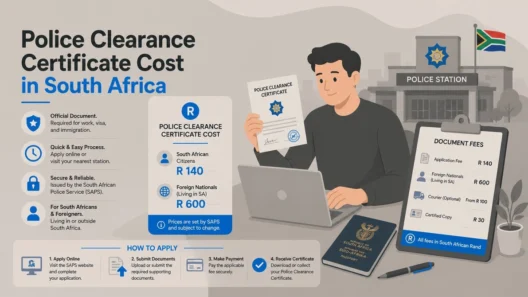
- Police clearance for the proposed manager, where required. See our guide to the police clearance certificate cost.
- Proof of payment of the application fee.
Frequently asked questions
How much does a liquor licence cost in South Africa? Commonly quoted at R20 000 to R45 000 all in. But the provincial application fee is only R2 000 to R10 000. The bulk of that figure is professional fees of R5 000 to R25 000, plus advertising, zoning and compliance.
Is there a national liquor licence fee? No. Retail licences are provincial, and each of the nine provinces gazettes its own fee schedule. Only macro manufacture and distribution is national, through the National Liquor Authority, where the application fee is R500.
Can I apply myself, without an attorney? Yes. The application fee is the same. What you are buying from a consultant is the drafting, the compliance work and the handling of objections. Whether that is worth R15 000 depends on your premises and your risk profile.
How much is a liquor licence renewal? Roughly R1 000 to R5 000 a year, set by the provincial authority and adjusted with each new gazetted schedule.
What happens if my application is refused? No new application may be made for the same premises within one year of the refusal, except by special leave of the Board. Prepare properly the first time.
Do I pay anything else if the licence is granted? Yes. A granting fee, separate from the application fee, is payable on approval.
What is the cheapest liquor licence? A special event or temporary licence, for a festival, market or once-off function. Professional fees start around R5 000.
Methodology
This page contains two different kinds of figure and keeps them separate.
Authority fees are statutory. Retail liquor licence fees are set by each provincial liquor authority and published in gazetted fee schedules. The Western Cape Liquor Authority’s schedule takes effect from 1 December 2025. The National Liquor Authority application fee of R500, for macro manufacture and distribution, is published by the dtic. The R50 per manager appointment fee is set out in the Gauteng Liquor Act regulations. Provincial fees differ, and the figures shown are indicative ranges across provinces.
Professional fees are market prices. No body sets or publishes them as a tariff. The figures above are an estimate range compiled from published statements by named law firms and consultancies, surveyed in July 2026, and labelled as estimates throughout. Every one of those sources sells the service.
For the exact fee in your province, consult your provincial liquor authority’s published schedule directly.
Related
- Lawyer fees in South Africa — hourly rates and court tariffs
- Police clearance certificate cost — required for the proposed manager
Disclaimer
Searchis is not a law firm and this is not legal advice.
Provincial liquor authority fees are gazetted and are adjusted from time to time. The professional fees are an estimate range, not a quotation. Confirm the current fee with your provincial liquor authority, and obtain a written quotation before instructing an attorney or consultant.