



Severance pay is the money you receive for losing the job itself. It is separate from your notice pay and separate from your leave payout, and it is the part of a retrenchment package most likely to be calculated wrongly.
The rule sounds simple. The detail is where the money hides.
The statutory minimum
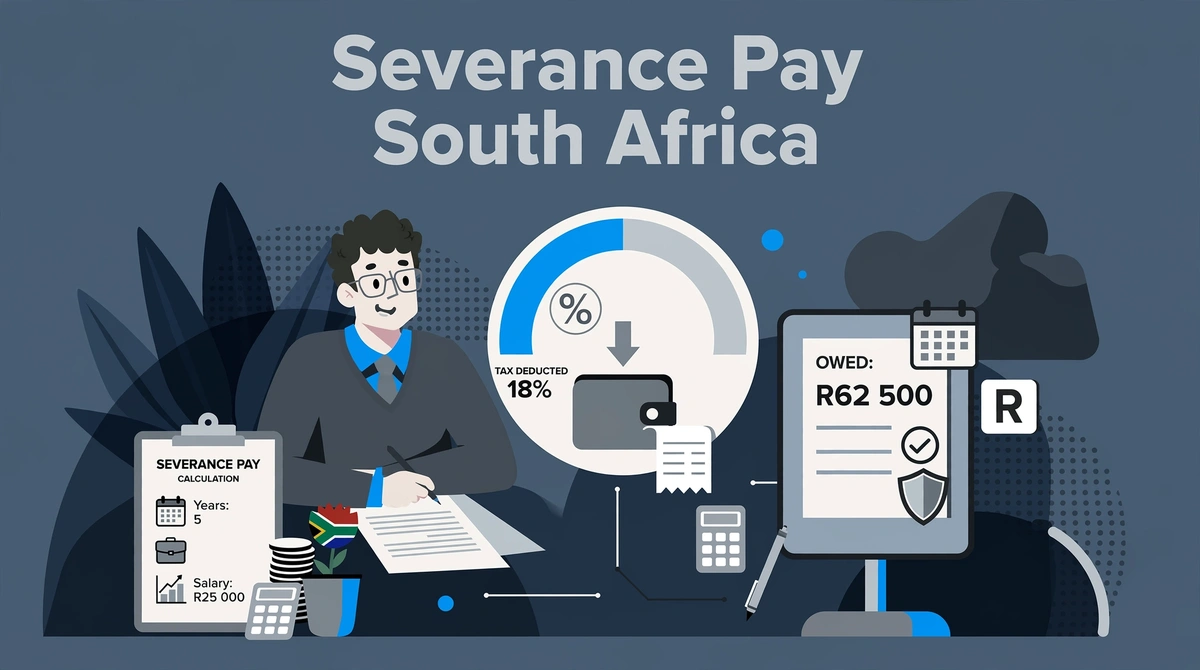
Section 41 of the Basic Conditions of Employment Act says your employer must pay you at least one week’s remuneration for every completed year of continuous service with that employer.
Weekly remuneration is monthly remuneration times 12, divided by 52. On a package of R30 000 a month with 10 completed years behind you, that is roughly R69 231.
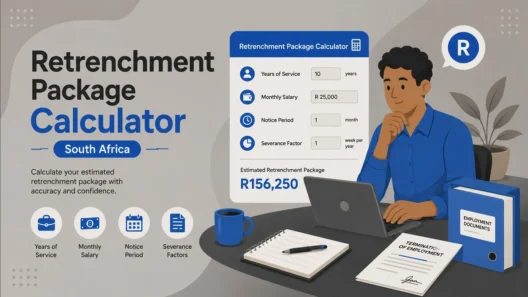
You can work your own figure out with our retrenchment package calculator, which also shows the tax.
“Completed” means completed
Seven years and eleven months is seven years. Part years are not rounded up and they are not pro rated. If your service anniversary falls a month after your termination date, you lose a full week of severance, and there is nothing unlawful about that.
It does mean that if you are within a month or two of an anniversary, the termination date is worth negotiating over. Employers will often move it.
You also need at least one completed year before any statutory severance is due at all. Eleven months of service earns you notice pay and a leave payout, but no severance.
“Remuneration” is not your basic salary
This is the single most common underpayment, and it is worth reading twice.
For the purpose of calculating severance, the Minister of Employment and Labour has determined what counts as remuneration. It includes the cash value of:
- Employer contributions to your medical aid
- Employer contributions to your pension or provident fund
- Housing or accommodation allowances, and accommodation provided in kind
- Car allowances, or the value of a company car provided for private use
- Shift, standby and similar allowances
It excludes things like reimbursements for travel to and from work, relocation allowances, tips, gratuities, entertainment allowances, and payments for equipment or tools.
So if your basic is R25 000 but your total cost to company is R32 000 once the employer’s medical aid and provident fund contributions are counted, your severance should be built on something much closer to the second number.
Employers calculate on basic salary all the time. Sometimes it is deliberate. More often the payroll clerk simply used the wrong field. Either way, ask in writing which figure was used. On ten years of service, that difference is worth over R16 000.
One week per year is a floor, not a ceiling
Section 41 sets a minimum. Anything above it is a matter of contract.
Check three places:
- Your employment contract. Two weeks per completed year is common at management level.
- Your company’s retrenchment policy. These are often more generous than the contract and are frequently forgotten by the people applying them.
- Your bargaining council’s collective agreement. If you fall under one, its terms are binding. Several councils add ex gratia weeks for long service on top of the statutory formula.
If any of these gives you more than one week per year, that is what you are owed. The calculator lets you switch between one, two, three and four weeks per year so you can see what a better rate is actually worth.
When you can lose your severance pay
Section 41(4) is the trapdoor. An employee who unreasonably refuses an offer of alternative employment with the same employer or with any other employer is not entitled to severance pay.
The alternative job does not have to be identical to the one you are losing. Courts have taken a fairly generous view of what counts as the employer securing alternative work for you, and “the new role is a bit of a step down” is not on its own an automatic defence.
If you are offered an alternative and you intend to turn it down, put your reasons in writing at the time, and make them concrete: the salary is materially lower, the location is unworkable, the role is not comparable to your skills. A documented, reasonable refusal protects your severance. A shrug does not.
The other disqualifier is more mundane. If the termination is not genuinely an operational requirements dismissal, section 41 does not apply at all. A resignation earns no severance, and neither does a dismissal for misconduct.
How SARS taxes severance pay
Severance is taxed on the retirement and severance lump sum table, not on the ordinary income tax tables. For the 2027 tax year, which runs from 1 March 2026 to 28 February 2027:
| Severance benefit | Tax |
|---|---|
| R0 to R550 000 | 0 percent |
| R550 001 to R770 000 | 18 percent of the amount above R550 000 |
| R770 001 to R1 155 000 | R39 600 plus 27 percent of the amount above R770 000 |
| R1 155 001 and above | R143 550 plus 36 percent of the amount above R1 155 000 |
Three things about that table that catch people out.
It is a lifetime band, not an annual one. SARS aggregates every retirement fund lump sum you have taken since October 2007 and every severance benefit since March 2011 before applying it. A R300 000 tax free payout five years ago leaves you R250 000 today.
It does not cover your notice pay or leave payout. SARS is explicit that those do not form part of a severance benefit. They are added to your normal income and taxed at your marginal rate. See notice pay on retrenchment for why this matters when an employer offers to restructure your package.
The figure is R550 000, not R500 000. A remarkable number of South African websites, including law firm blogs, still publish the older number. R500 000 was correct from 1 March 2014 and expired on 28 February 2023. If a source still says R500 000 it has not been updated in over three years.
You may not qualify at all
If you have ever held more than 5 percent of the issued shares or member’s interest in the company paying you, you do not get the severance tax concession. The lump sum is taxed as normal income instead. This catches owner managers and long serving executives with share incentive holdings.
The tax directive is the real number
Your employer must apply to SARS for an IRP3(a) tax directive before paying you a cent. Only the employer can submit it. SARS then tells the employer exactly how much tax to withhold.
Ask for a copy. Our calculator gives you an estimate to sanity check the offer against, but the directive is the authoritative figure, and seeing it is the fastest way to confirm your employer classified the payment correctly.
Before you accept the offer
- Was severance calculated on total remuneration or only on basic salary?
- Were completed years counted correctly, including earlier service with the same employer?
- Does your contract, company policy or bargaining council entitle you to more than one week per year?
- Has money been shifted out of severance and into notice or leave, where it is taxed far more heavily?
- Have you asked for the IRP3(a) directive?
If any answer is wrong, raise it during consultation. That is precisely what the section 189 process exists for.
And remember that your package and your UIF benefit are two different things. Being paid out does not stop you claiming. Start with how to claim UIF.
Frequently asked questions
Is severance pay compulsory in South Africa? Yes, where the dismissal is for operational requirements and you have at least one completed year of continuous service. The minimum is one week’s remuneration per completed year under section 41 of the BCEA.
Is severance pay based on basic salary or total package? On remuneration, which includes the cash value of employer contributions to medical aid and retirement funds, plus housing, car and similar allowances. It is usually well above basic salary.
How much of my severance is tax free? The first R550 000, but only if you have not already used part of that lifetime band on earlier lump sums since 2007.
Can my employer refuse to pay severance? Mainly in one situation: if you unreasonably refused a reasonable offer of alternative employment, under section 41(4).
Sources
Figures are current for the 2027 tax year. This is general information, not legal or tax advice.