



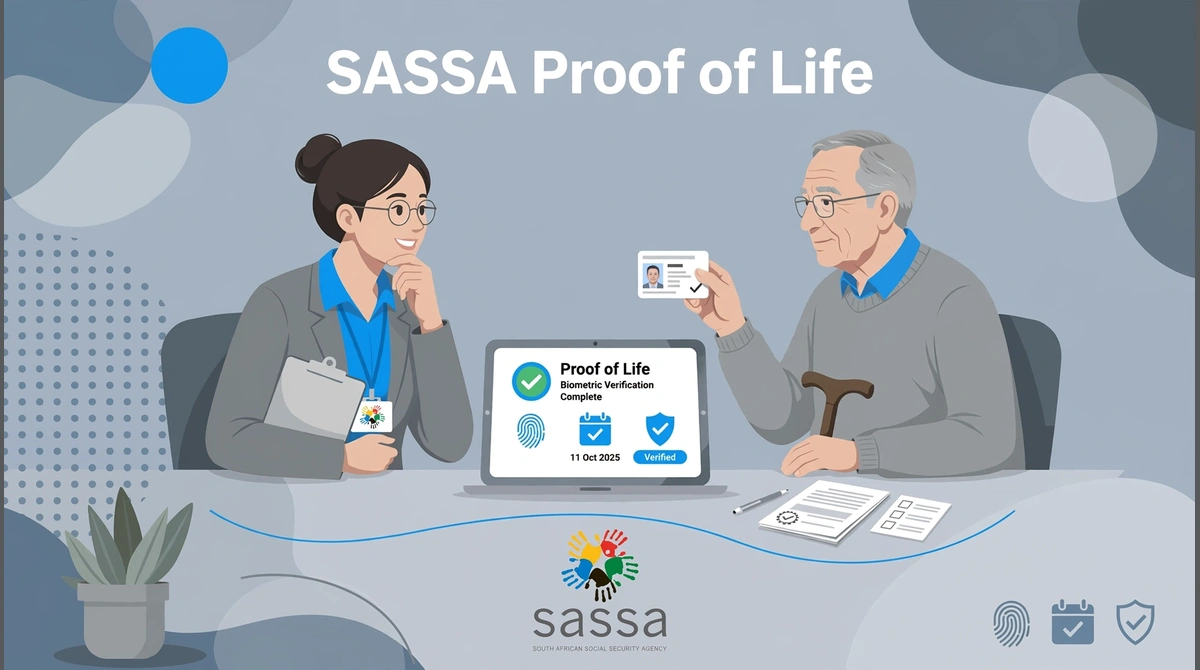
SASSA proof of life, also called a life certificate, is a periodic check confirming that a grant beneficiary is still alive and still living in South Africa. You only need to complete it when SASSA asks you to. If you are asked and you ignore it, your grant is suspended, because SASSA may read the silence as meaning you have died.
| Quick facts | |
|---|---|
| Also called | Life certificate, life certification, e-Life Certification |
| Who must do it | Only beneficiaries SASSA specifically notifies |
| Legal basis | The Social Assistance Act |
| Cost | Free |
| Online option | The SASSA Services Portal, using a face scan |
| If you miss it | Payments suspended, not cancelled |
| Call centre | 0800 60 10 11 |
Who actually has to do this
Not everybody, and this is where the confusion starts.
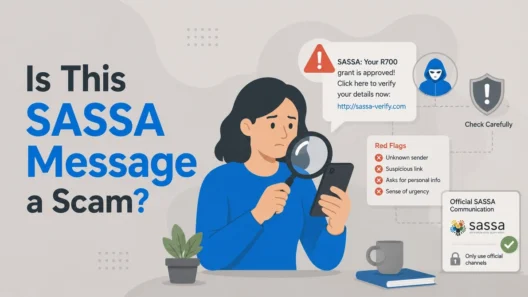
You must complete life certification only if SASSA has specifically notified you. If you have not been contacted, there is usually nothing to do. Scammers exploit the confusion, so treat any message demanding payment or asking you to use an unofficial website as fraudulent.
You are more likely to be asked if you fall into one of these groups.
- You collect your grant in cash at a paypoint
- Your money is paid through a bank, an institution or a procurator, in which case a life certificate is generally required each year
- SASSA cannot verify you through banking activity or other records
- You have been flagged in a routine review
Most older persons paid into a bank account in their own name are verified quietly through banking activity and never hear about it.
When a life certificate or a review is due, SASSA notifies you three months in advance.
The five ways to complete it
1. Online, through e-Life Certification. This is the route SASSA now pushes. e-Life Certification is a self service platform on the SASSA Services Portal that lets you certify from home. It uses the electronic Know Your Client system, which performs a live face scan and checks it against Department of Home Affairs records. You need a smartphone or computer with a working front camera and a stable internet connection. Beneficiaries who can use the portal are encouraged to certify annually.
2. At a SASSA office. Bring your original ID and your SASSA card. If SASSA sent you a form, bring it. If not, the office will give you one.
3. At your local police station. Any SAPS member who is a commissioner of oaths can sign the form.
4. At a magistrates court. Commissioners of oaths there can sign it too.
5. At your cash paypoint. SASSA officials at the paypoint can verify and stamp the form on collection day. For anyone already collecting cash, this is usually the easiest option.
If you are bedridden or housebound, none of the above is realistic, so phone 0800 60 10 11 and arrange a home visit. A family member can make the call on your behalf.
The process is free through every one of these channels.
What happens if you do not do it
Your grant is suspended, not cancelled. That distinction matters.
SASSA has been explicit that beneficiaries who fail to certify when directed face payment delays or suspension, because non-compliance can be interpreted as an indication that the beneficiary has died or is no longer legitimate. In serious cases a grant can lapse entirely.
To restart a suspended grant, go to your nearest SASSA office with your ID and your SASSA card, complete the life certificate, and explain why you missed the deadline. Illness, travel, or simply never receiving the SMS are all accepted reasons. Payments are generally reinstated within one to two payment cycles, and the missed months are back paid.
Keep your contact details current
This is the quiet cause of most suspensions.
SASSA notifies you by SMS or letter. If the cellphone number or address on your file is out of date, you never see the request, you miss the deadline, and the grant stops without you understanding why. Updating your details at a SASSA office costs nothing and takes one visit.
If the online portal will not work
SASSA acknowledged in April 2026 that system glitches, linked to interfaces with other government departments, were blocking some beneficiaries from completing e-Life Certification, and confirmed that the issues had been resolved. If the face scan screen fails to load or freezes, the usual cause is a slow connection. Retry in better light on a stronger connection. If it still fails, use one of the in person routes above rather than leaving it undone.
If the beneficiary has died
Report it to SASSA as soon as possible on 0800 60 10 11 so the grant can be closed properly. Continuing to draw a grant after the beneficiary has died is fraud, and SASSA will recover the money. Reporting promptly also allows the family to claim a funeral benefit where they are eligible.
Reviews are separate, but they arrive together
Life certification confirms you are alive. A review confirms you still qualify financially, and SASSA has been running these more aggressively, with biometric and income verification tightened across the board in 2026.
If you are reviewed, bring updated proof of income, your ID and, for a child grant, the child’s latest records. If your circumstances have changed, say so. Being caught with undeclared income means losing the grant and repaying what you received, with interest. You can check where you now stand with our SASSA means test calculator, and how much can you earn and still get SASSA sets out the current income limits.
If you receive Grant in Aid on top of your main grant, both are affected by a suspension, because the top up cannot be paid without the underlying grant.
How we worked this out
Details on this page are taken from SASSA statements published on gov.za and SAnews in April 2026, the life certification provisions of the Social Assistance Act, and the SASSA and provincial government grant pages.
Frequently asked questions
Do all SASSA beneficiaries have to do proof of life? No. Only those SASSA specifically notifies. Beneficiaries with internet access are encouraged to certify annually through the portal, but there is no single deadline that applies to everybody.
How often do I have to do it? There is no fixed cycle for everyone. If you are paid through a bank, an institution or a procurator, a life certificate is generally required each year. Otherwise it depends on your grant type and review schedule.
Can somebody else do it for me? Not the certification itself, since it confirms that you personally are alive. But if you cannot travel, a family member can phone 0800 60 10 11 and arrange for a SASSA officer to visit you at home.
Does it cost anything? No. Life certification is free through every official channel. Anyone asking you for money is running a scam.
My grant was suspended. Is it gone? No. Suspension is a pause, not a cancellation. Complete the life certificate at a SASSA office and your grant is reinstated, with the missed months back paid.
Does proof of life change my grant amount? No. It is an identity and eligibility check, not a new application. A financial review is a separate process.
This page is a guide. SASSA makes the final decision in every case. Procedures reflect SASSA statements current as at July 2026.