



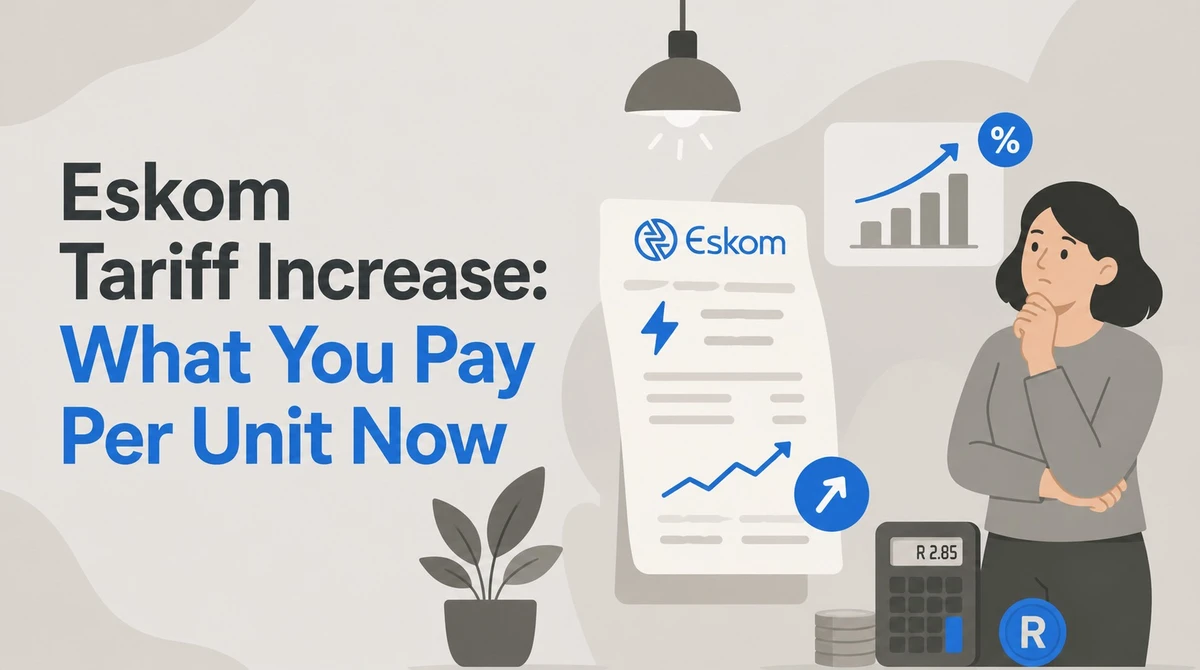
Electricity got more expensive again in 2026, and if your prepaid units seem to run out faster, that is why. The National Energy Regulator of South Africa approved fresh increases for both Eskom direct customers and municipalities this year, on top of steep rises the year before. This page sets out exactly how much went up, when it took effect, and what a unit of electricity actually costs now, which is a harder question than it sounds because there is no single national price.
Quick facts
| Detail | Summary |
|---|---|
| Eskom direct increase | 8.76 percent, effective 1 April 2026 |
| Municipal increase | 9.01 percent average, effective 1 July 2026 |
| Already approved for next year | 8.83 percent for the 2027/28 year |
| Price per unit | No single figure, roughly R3 to R4.50 per kWh for most households |
| Tariff structure | Flat rate per unit for Eskom Homelight and Homepower, no more blocks |
| Who sets your rate | Eskom if you are a direct customer, otherwise your municipality |
How much did electricity go up in 2026?
Two increases landed in 2026, at different times, because Eskom and municipalities are billed separately.
Eskom direct customers saw an 8.76 percent increase from 1 April 2026. If you buy your electricity straight from Eskom, this is the rise that applied to you.
Municipal customers saw an average 9.01 percent increase from 1 July 2026. Municipalities buy electricity in bulk from Eskom and resell it to residents, so their new tariffs took effect at the start of the municipal financial year in July. Most South African households fall into this group.
These follow an even steeper set of increases the year before, when Eskom direct rates rose 12.74 percent from April 2025 and municipal bulk rates rose 11.32 percent from July 2025. So over two years the compound rise is well into double digits, which is the main reason a R100 token buys noticeably fewer units than it did.
Looking ahead, a further 8.83 percent increase has already been approved for the 2027/28 financial year, so the trend continues. Budgeting for a rising unit price each year is the realistic approach.
What is the price per unit of electricity in South Africa in 2026?
There is no single answer, and any site that gives you one flat number is oversimplifying. What you pay per kWh depends on two things: whether you are an Eskom direct customer or a municipal customer, and how much you use in a month.
As a rough guide, most households pay somewhere between about R3.00 and R4.50 for a unit in 2026, including VAT. Heavy users in the top usage blocks of some municipalities pay more. For example, the highest residential block in the City of Cape Town works out to roughly R4.69 per kWh including VAT. The only figure that is exactly right for you is the one on your own slip.
If you are an Eskom direct customer
Eskom direct customers are mostly in smaller towns, rural areas and some townships where the municipality has not taken over distribution. If that is you, your rate comes straight from Eskom’s residential tariffs, which are Homelight for smaller supplies and Homepower or Homeflex for larger homes and solar users. Since the 2025 restructure, Homelight customers pay a single flat rate per unit no matter how much they use, so the old penalty for going over 350 kWh a month is gone.
If you are a municipal customer
Roughly two thirds of households buy from their municipality rather than Eskom. Your municipality pays Eskom the bulk rate, then adds its own margin to cover local poles, cables, transformers and metering, which is why municipal rates are generally higher than Eskom direct rates. Many municipalities also still use inclining block tariffs, where the price per unit steps up once you pass a monthly threshold, so your effective rate rises the more you use. This is worth knowing, because buying a very large amount in one go can push you into a pricier block sooner.
What changed in the tariff structure
The 2026 increase is not just a bigger number on the same bill. The structure has shifted in ways that affect how you are charged.
Blocks are gone for Eskom residential tariffs. Eskom removed the inclining block tariff structure for Homelight and Homepower and now charges a flat rate per unit, with the Homepower tariff unbundled into separate energy, network and retail charges. Many municipal tariffs still use blocks, so this change applies to Eskom direct customers, not necessarily to you if you buy from a municipality.
Municipal tariffs were consolidated. Eskom reduced its many municipal tariffs into three, namely Municrate for smaller power users, Municflex for large power users and a separate public lighting tariff, which is meant to simplify bulk purchasing.
Prepaid tokens now last. Eskom introduced simplified prepaid purchase options called EasyElectricity for Homelight and Homepower customers, and notably these prepaid tokens do not expire once bought. The rates are the same as the standard tariffs, so it is about easier budgeting rather than a discount.
Why your bill rose more than the headline percentage
Some households feel the increase more than 8.76 or 9.01 percent would suggest. A big reason is the shift toward fixed charges. Eskom is phasing in a larger fixed service and administration charge for Homepower and Homeflex customers, rising from a third of the full charge to two thirds this year, with the energy rate adjusted alongside it. The effect is that a bigger slice of your bill is now a fixed monthly or daily charge you pay regardless of how little you use. For low-usage households, that fixed portion pushes the effective cost per unit higher than the headline increase implies.
How to work out your own cost per unit
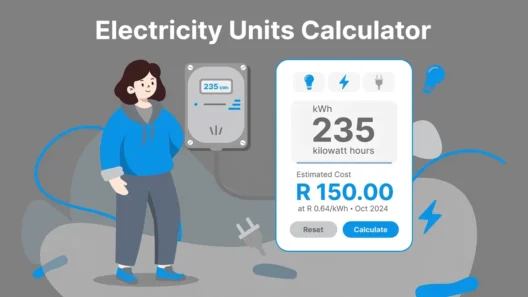
The most accurate way to know your rate is to divide a recent purchase by the units it bought. If R200 gave you 60 units, your effective rate is about R3.33 per kWh. Your prepaid slip often prints the rate directly, and your municipality publishes its tariff schedule each year when the new rates take effect. Once you know your rate, you can work out what any amount will buy using our units calculator, linked below.
Frequently asked questions
How much is the Eskom tariff increase for 2026?
Eskom direct customers went up 8.76 percent from 1 April 2026, and municipal customers went up an average of 9.01 percent from 1 July 2026. A further 8.83 percent has already been approved for the 2027/28 year.
What is the price of electricity per unit in South Africa?
There is no single national price. Most households pay roughly R3.00 to R4.50 per kWh including VAT in 2026, depending on whether they buy from Eskom or a municipality and how much they use. Check your slip for your exact rate.
Why is Eskom direct cheaper than my municipal rate?
Municipalities buy electricity in bulk from Eskom and add their own margin to fund local distribution infrastructure. That margin is why municipal customers usually pay more per unit than Eskom direct customers.
Why do I get fewer units for the same money now?
Because the per-unit price rose in both 2025 and 2026, and because a larger share of the cost has shifted into fixed charges. Together these mean each rand of your purchase buys less energy than before.
Do Eskom prepaid tokens still expire?
Under the EasyElectricity purchase options introduced for Homelight and Homepower, prepaid tokens do not expire once bought. Always confirm with your own vendor, since municipal prepaid systems may differ.
When do municipal electricity tariffs change each year?
Municipal tariffs usually change on 1 July, the start of the municipal financial year, while Eskom direct tariffs change on 1 April. That is why the two 2026 increases took effect on different dates.
Related tools and guides
- Electricity units calculator
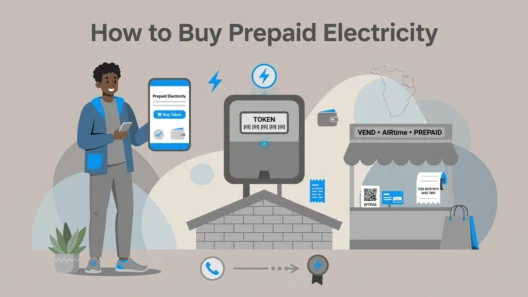
- How to buy prepaid electricity
- How to register for free basic electricity
Disclaimer: This article provides general information only. Electricity tariffs vary by municipality, tariff type and usage, and change annually. The figures here are indicative and include VAT where stated. Always confirm your exact rate and charges against your own electricity slip or your municipality’s official tariff schedule.