



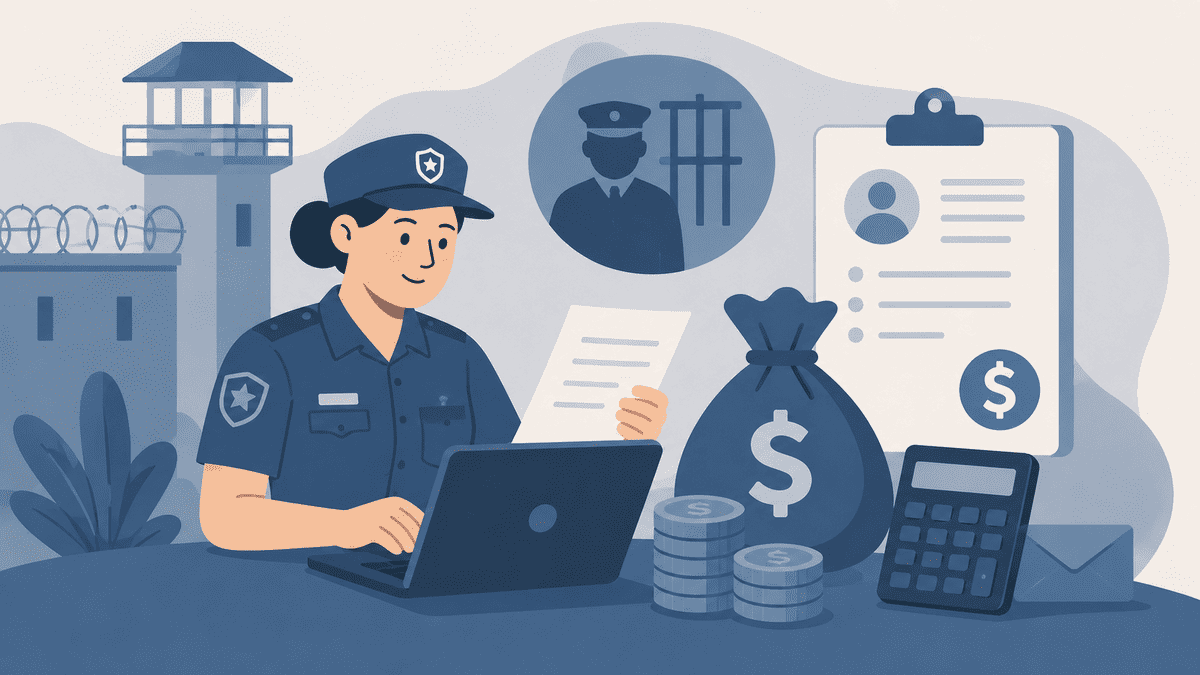
A correctional officer in South Africa earns roughly R12 000 to R45 000 per month in 2026, depending on rank and years of service. Entry-level warders start at about R12 000, mid-level officers earn around R20 000, senior officers about R30 000, and top ranks up to R45 000 and more. The average is roughly R14 000 to R27 000 a month. Correctional officers are public servants employed by the Department of Correctional Services (DCS), with pension, medical aid and danger allowances on top.
Quick facts: correctional services salary (2026)
| Level | Monthly salary (estimate) |
|---|---|
| Entry-level warder (0 to 3 years) | About R12 000 |
| Mid-level officer (3 to 8 years) | About R20 000 |
| Senior officer (8 to 15 years) | About R30 000 |
| Top ranks (15+ years) | Up to R45 000+ |
| Employer | Department of Correctional Services (DCS) |
| Extras | Pension, medical aid, housing, danger and overtime allowances |
How much does a correctional officer earn per month in 2026?
Correctional officer pay rises with rank and service. The typical range is R12 000 to R45 000 per month, with an average often reported around R14 000 to R27 000. “Prison warder” is the older public term, while “correctional officer” is the official title. Because DCS is a government department, pay follows the public-service salary structure, and the department’s cost-of-living adjustment for 2026 was handled along the same lines as the rest of the public service.
To see any of these figures after deductions, use our take-home pay calculator.
Correctional officer salary by experience
- Entry-level (0 to 3 years): about R12 000 per month.
- Mid-level (3 to 8 years): about R20 000 per month.
- Senior (8 to 15 years): about R30 000 per month.
- Top-level (15+ years): up to R45 000 and more.
During basic training at a DCS college, recruits earn a lower trainee amount before being appointed.
DCS ranks and how pay grows
The Department of Correctional Services uses a rank structure that runs from correctional officer (warder), up through senior and head correctional officers, into management ranks, up to the National Commissioner appointed by the President. Pay rises at each level, and promotion depends on vacancies, qualifications, performance and experience.
Allowances and benefits
On top of the basic salary, correctional officers receive public-service benefits: a Government Employees Pension Fund (GEPF) contribution, medical aid support, a housing allowance, and a danger allowance for those working in high-risk or maximum-security centres. Because correctional centres run 24 hours a day, night shift, weekend and overtime pay can add meaningfully to monthly take-home.
How to become a correctional officer
To join DCS you generally need a matric, to be a South African citizen, to pass a physical fitness and medical test, and to have no criminal record. Successful applicants complete the DCS Basic Training Programme before appointment. Applications use the government Z83 form. For related law enforcement pay, see our SAPS salaries and ranks guide and our South African salary guide.
How we worked this out
The figures on this page are estimates based on correctional officer salary survey data, public-sector pay information and industry guides for 2026. DCS pay follows the government salary structure and varies by rank, notch and allowances, so treat these as guide ranges and confirm the figure in the specific vacancy or with the department.
Frequently asked questions
How much does a correctional officer earn per month in South Africa in 2026? Roughly R12 000 to R45 000 per month depending on rank and service. Entry-level warders start at about R12 000, mid-level officers around R20 000, and senior officers about R30 000.
Is a prison warder the same as a correctional officer? Yes. “Correctional officer” is the official title, while “prison warder” is the older term still used by the public.
What is the starting salary for a correctional officer? About R12 000 per month at entry level, with a lower trainee amount during the DCS Basic Training Programme.
Do correctional officers get allowances? Yes. A pension, medical aid, housing allowance and a danger allowance for high-risk centres are paid on top of the basic salary, along with overtime and shift pay.
How do I become a correctional officer? You need a matric, South African citizenship, a clean criminal record, and to pass a fitness and medical test, then complete the DCS Basic Training Programme.